
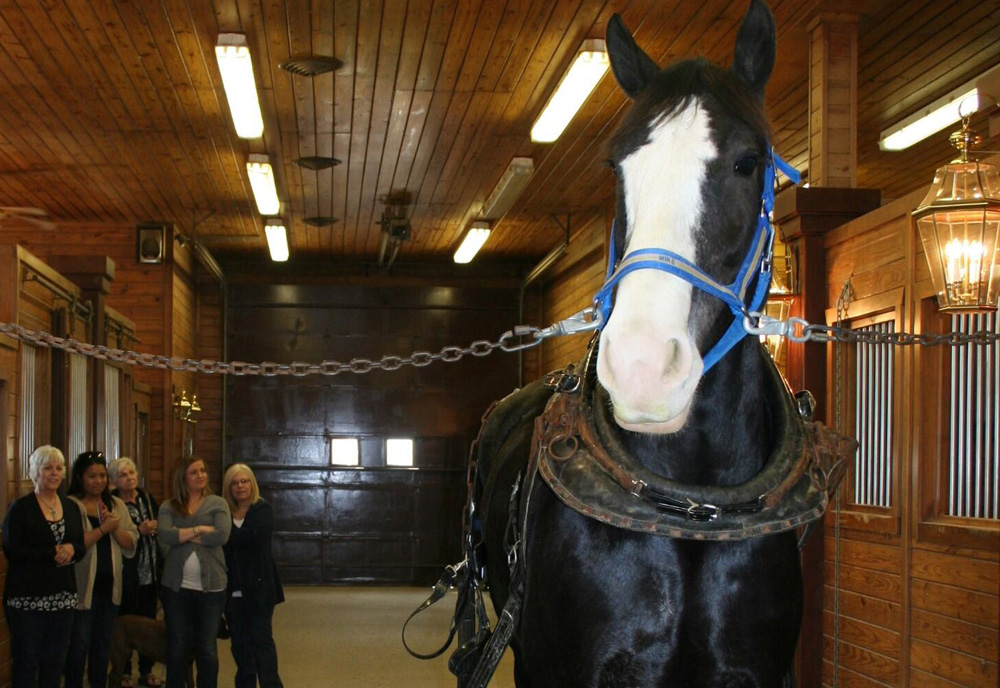
The clippety-clop of horseshoes the size of dinner plates can be heard as colossal creatures, known as the Express Clydesdales, enter the barn. The size of the proverbial Goliath they may be, but these 1-ton teddy bears have hearts of gold and kindness to boot.
In 1996, Bob Funk, CEO of Express Employment Professionals, headquartered in Oklahoma City, Oklahoma, as well as owner of Express Ranches in Yukon, Oklahoma, was visiting the Canadian Western Agribition in Regina, Saskatchewan, Canada, when he became captivated with the stately black and white Clydesdales. These particular Clydesdales are rare; only 10 percent of the breed population is black and white in color. By 1998, he had purchased a team of the horses and a barn to house them near Yukon, Oklahoma.
“The contrasting black and white color and their majestic size attracted me,” Funk said. “Also, Oklahoma did not have an nationally recognized six- or eight-horse hitch. I wanted to represent our state nationally with the beautiful horses and presentation.”
Express Clydesdales General Manager Josh Minshull agreed Oklahoma was lacking in draft horse team representation.
“There are big hitches in New Mexico, Texas, Kansas and the surrounding states, but Oklahoma really didn’t have one,” Minshull said.
Minshull started work at Express in 2002 after he finished high school near Seattle, Washington. He learned the ins and outs of the draft horse world as an apprentice with a Belgium horse hitch while growing up in the evergreen state. Now in his fourteenth year with Express, Minshull described his duties with the Clydesdales as his ideal occupation.
“There are just not a lot of jobs out there where you can pursue this type of work,” he said. “I took over as manager at the age of 20 after I had been with the hitch for about three years. Everything kind of fell into place for me to live out my dream job.”
Minshull not only manages the staff and horses, he also acts as trainer, farrier and drives the coach in competition.
“First and foremost, I love the horses,” he gushed. “I love traveling and meeting new people everywhere we go. It’s exciting for me everyday.”
World-class attraction
Express Clydesdales are considered equine celebrities in some circles. They travel by semi to numerous events during the year. Minshull said the team made 177 appearances in 55 different venues last year. Although their traveling schedules change from year to year, some common events the horses appear at include: the St. Patrick’s Day Parade in Chicago, Illinois, Mardi Gras in New Orleans, Louisiana, The Macy’s Thanksgiving Day Parade in New York City, New York, The Rose Parade in Pasadena, California, The National Western Stock Show in Denver, Colorado, and The Calgary Stampede in Calgary, Alberta, Canada.
However, the Clydesdales are not the only celebrities at such events. The hitch had the prestigious honor of chauffeuring Prince William and his wife, Catherine (Kate), the Duchess of Cambridge, at the Calgary Stampede in 2011.
“Those types of things are just icing on the cake,” Minshull said.
Other icing on Minshull’s metaphorical cake include impressive titles earned by the hitch: World Champion Six Horse Hitch at the Calgary Stampede and Clydesdale Six Horse Hitch at the World Clydesdale Show.
However, to Minshull and his employer Funk, the Clydesdales aren’t just for show, they are also an important educational tool for visitors to come and learn about horses and Clydesdales specifically, at the barn in Yukon, and on the road.
“Bob wanted people to experience the big horses and to learn about them as well. That’s one of the things we try to do as a staff; people come into the barn and we try to teach them and open ourselves up to any kinds of questions about the horses,” Minshull stated.
Usually around 12 horses are housed in the barn for the public’s viewing. In all, Express owns about 35 black and white Clydesdales.
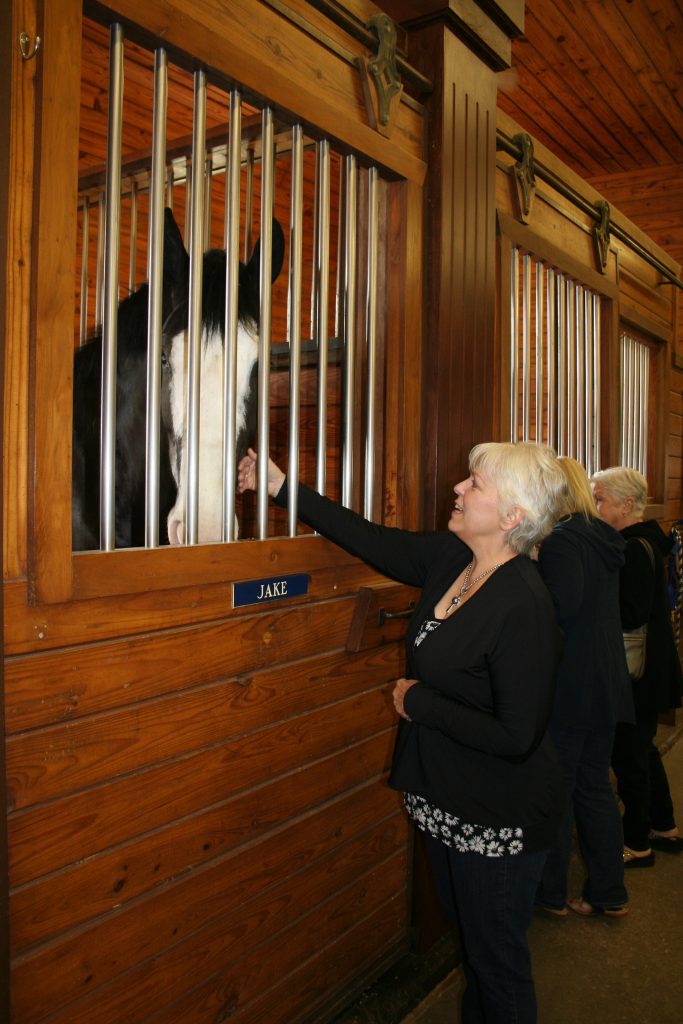
“A special thing about us is that there are not a lot places where you can go and actually touch them and get close to them. That’s one thing the owner wanted, was to allow people to interact and pet the horses, not just see them from a distance.”
Bridging the gap
Along with an open door policy, the location of the barn has become an asset to the educational goals of Funk and his 6-foot-tall friends.
“We’re kind of an Oklahoma City suburb so we do have a lot of visitors from Oklahoma City and a lot of those people have never seen a draft horse much less a Clydesdale up close. I think that’s pretty special,” Minshull said. “Clydesdales are really the perfect breed of horse to do what we do because they are so docile and friendly, yet they are so massive. Because we are a free attraction I think that is something that is nice for people coming by; it doesn’t cost them anything to come out and see the horses.”
Although the horses are the main attraction for patrons, the barn they are housed in is quite a classy abode. Built in 1936, the barn was restored by a group of Amish carpenters in 1998 when the Clydesdales first made Yukon their home. The Clydesdales names are plated on the stalls and brass fixtures illuminate the pine and walnut wood trimmings along the inside of the barn. Events such as weddings are held in the upper level of the structure. What was once the hayloft has been transformed into an elegant banquet hall for such occasions.
A gift shop chocked full of Clydesdale merchandise, including T-shirts and coffee mugs, can be found at the entrance to the barn. Cameras are always welcome and staff encourages visitors to ask questions and get to know the horses. The barn is open for visitors all week except Mondays, making it a perfect outing for families. Minshull says people come from all over the U.S. and Canada to visit the horses.
“Oklahoma is central to the United States, and a lot of people travel through here, if not to here, so a lot of people stop and take a look.”
A cue for charity
Although the hitch is well known in competitions and as a tourist attraction, the horses also serve more philanthropic duties as well.
“First off, Bob kind of thought he’d have them around as just kind of a novelty but then he decided we could compete with the horses and also use them as goodwill ambassadors for his company,” Minshull explained.
The primary charity the Clydesdales support is Children’s Miracle Network. Minshull indicates last year the horses raised $110,000 for CMN while traveling or at home in the barn. He said someday the staff hopes to raise $300,000 in a year’s time. Funds are raised by donations from people taking photos with the horses and through wagon rides. Minshull says Express works closely with the organization both locally and nationally.
“We chose Children’s Miracle Network because of their low overhead assisting local hospitals with more bottom line funding than other organizations. CMN is very near and dear to my heart because they help so many children,” Funk said.
Just as the Clydesdales are known for their kind, loving demeanors, Funk and the staff at Express have taken a page from their book. As simply as the noble giants have captured their hearts, they have chosen to share the charm and good rapport of the Clydesdales with anyone interested in becoming acquainted with the big horses with the even bigger hearts.
Lacey Newlin can be reached at 620-227-1858 or [email protected].
Side bar:
Reining in the competition
When the horses are hooked to a wagon or coach they are known as a hitch. The horses are grouped in teams of two and each team is known as different position. The horses placed closest to the wagon are known as the wheel team. Only the biggest, strongest Clydesdales are wheel horses because they pull almost 60 percent of the load. Minshull likened the wheel team to lineman on a football field.
The center duo is known as the swing team. Swing horses are a little bit smaller, more athletic and lighter weight than the wheel horses. The lead team runs the show at the front of the hitch. Clydesdales in the lead team are the most athletic, smallest and most proud looking of the hitch. Minshull said the lead horses have to cover the most ground and have to be ready to go anywhere the reins point them. These horses are the most elegant, most aggressive horses, he said.
Competing with a hitch is essentially the same as western pleasure, only with a team and a wagon. Express Clydesdales train four to five times a week starting eight weeks before competition. Express staff works to improve leg animation, while paying attention to keeping their heads high and to maintain the look of being proud horses. Minshull said the hitch is judged on performance at a walk and trot. The judges mainly look for uniformity of the horses, teamwork, athleticism and animal conformation.
TOP PHOTO: Beth Colbert Vail, Margaret Colbert, Amy Vail Barksdale, Sandy Freeland and Lauren Freeland Dowdy take a look at one of the Clydesdales (Lacey Vilhauer)

