Many thoughts race through the brains of cattle producers and their advisers as winter weather begins to wane.
Spring brings new mindsets as the critters enter another crescendo. A complete and opposite set of extremes await.
Ranchers and specialists alike know what’s coming, and they gear up for the spring thaw, edging toward summer’s searing heat.
Prepping for summer isn’t overly complicated, said Jaymelynn Farney, Ph.D., livestock specialist at the Southeast Area Research and Extension Center in Parsons, Kansas.
“For a cow-calf guy, it’s almost inconsequential, as long as you’re not in a drought,” she said. “If you’ve got summer grass and you’re calved out, most of the work has happened two to three months before you go to grass.”
That’s when ranchers these days are going through calving season, said Justine Henderson, livestock production agent for the Central Kansas Extension District in Saline and Ottawa counties.
“Calving is probably one of the most important things on their minds this time of year,” she said in a telephone interview in early February.
“You want to make sure cattle are already meeting their nutritional requirements before going into calving season,” Henderson said. “It’s important to ensure the cows and heifers are in ideal body condition before, during, and post calving season.”
Winter challenge
Calving commands most of Ralph Johnson’s attention through February. Before the Brookville, Kansas, rancher can delve into dealing with warmer conditions, he’s contending with baby bovines hitting the frozen landscape in western Saline County.
“This arctic stuff is hard on them,” Johnson said, referring to windchill factors feeling like 20 below zero.
“If the calves are born in the right place, out of the wind, and the mother works with them, they can survive.”
But if all of the above isn’t sufficient, alternatives include taking them indoors.
“You’ve got to get them warmed up, maybe put them under a heat lamp, and give them some colostrum,” he said.
An “ideal diet” is essential to the pregnant cows during winter months, said Sam Hands, of Triangle H, a farm and ranch primarily in southern Finney County. That includes adding vitamins A and E, and proteins to the diet during gestation, which lasts about 283 days.
“You’re trying to feed the fetus internally so it grows and is prepared to meet the world,” he said.
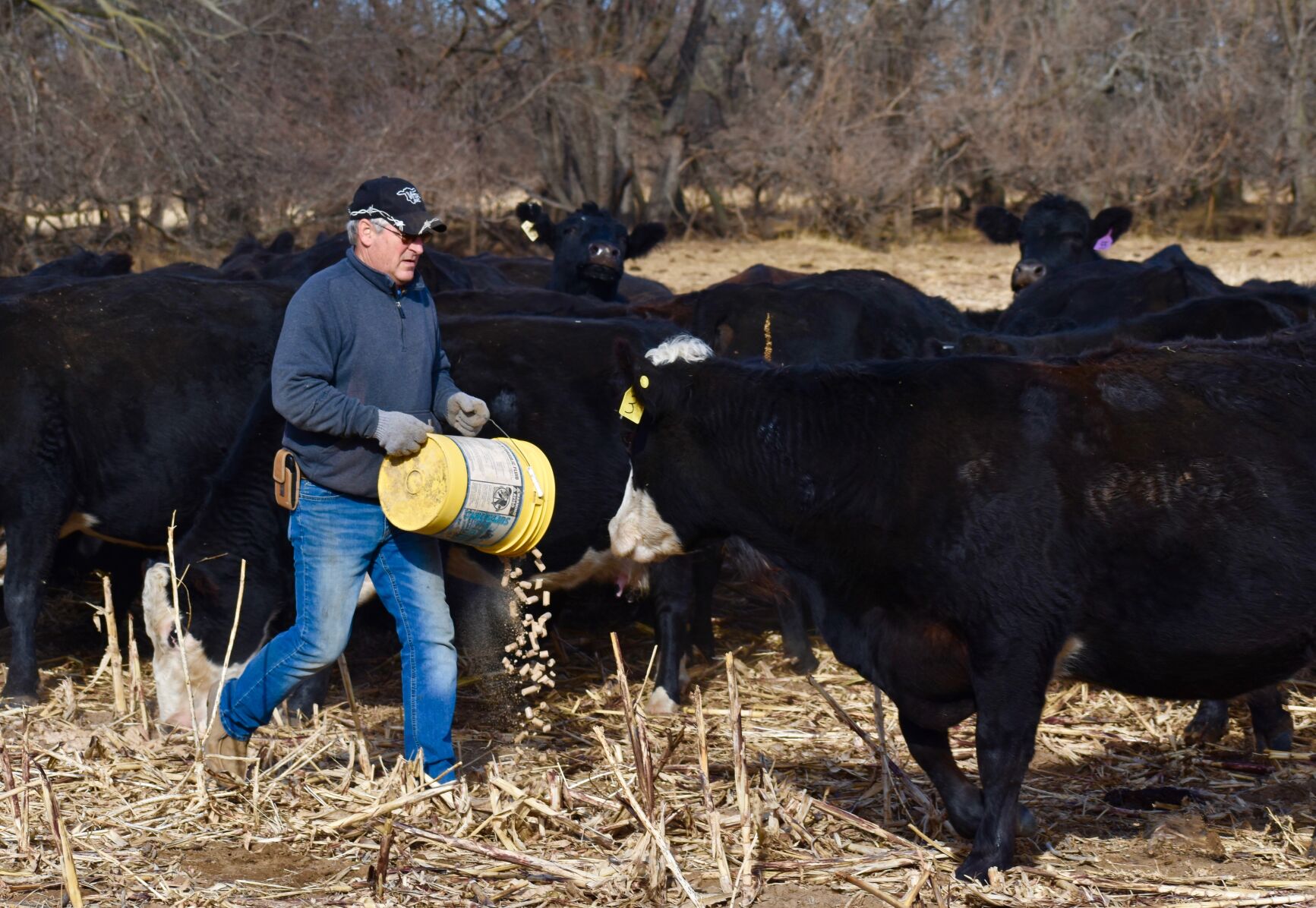
Before calving, Johnson feeds his cows prairie hay and sedan grass, plus a couple of pounds daily of range cubes containing 20% protein, each day.
As calving begins, he ups the range cubes to 5 or 6 pounds a day. If the herd is running on milo stalks, free-choice protein lick tubs are included.
“After the grass starts, I just feed mineral and salt until fall. Then I start feeding pellets,” Johnson said. “Everybody has a little bit different program. I think extra feed pays off, for cows and calves both.”
Seasonal needs
Hands divides his year in half—winter and summer months—and relates first to the cattle’s environment, whether they’re pasture cattle or in cow-calf or stocker operations.
“In the winter months, if possible, you’ve provided shelter and windbreaks because of the cold north winds and snow,” he said. “Whereas, in the summer, you would provide shade, make it more comfortable for the cattle.”
And out in semi-arid southwest Kansas with few trees and other natural barriers to the elements, Hands added, “In pastures, you don’t get much shade or wind protection from a one-wire electric fence.”
Justin Waggoner, Ph.D., Kansas State University Research and Extension beef cattle specialist, trains his spotlight on momma cows as he gears producers for the change in seasons.
“It’s always a good idea for us to make ourselves aware of cow body conditions,” said Waggoner, whose base is in the Southwest Area Extension Office in Garden City, Kansas.
He typically evaluates cows on a scale of 1 to 9, but the highest number isn’t necessarily best.
“Ideal is around 5 or 6,” Waggoner said. “A thin cow is at 1 or 2 and extremely fat or obese is 8 or 9.”
The typical target is 5, he said.
“That’s kind of our minimum for reproductive success in the next breeding season,” Waggoner said. “For a lot of producers, if we’ve done a good job of managing through the fall and winter months, in many cases, we’re on target.”
This time of year brings cold stress on cattle, he said, which increases demand for energy but not necessarily protein.
“Take the energy up. A lot of times, we target making sure cows have plenty of available forages, growing crop residues—corn or milo stalks—or native grass with supplements that will bring both proteins and energy into the profile,” Waggoner said.
Typically, it involves feeding 2 to 6 pounds of commercial range cubes, or byproduct distillers grains from ethanol plants or corn gluten feed, he said, and some producers supplement with alfalfa hay.
Rations key
Confined feeding will include ensilage, hay and byproducts as a protein source.
“That’s maybe more common in north central Kansas and Nebraska; not so much in Garden City,” Waggoner said. “In southwest Kansas, a large number of producers are utilizing some form of crop residues, like corn stalks or dormant native grass.”
Similar goals exist with fall calving August into October, with breeding during December and January.
“Our goal with fall calving cows is somewhat the same as spring calving,” he said. “Make sure you’re going into the winter months with cows having a good body condition score. In some situations, you may need to begin supplementation on fall calving cows prior to calving in the August and September time frame.”
Then it’s really just the same—monitoring cow conditions through the winter months, Waggoner said, by making sure the animals have adequate forage available.
“That’s going to be the prime driver of the amount of energy they can consume to meet their requirements,” he said. “We utilize protein supplementation on those animals as well, enhancing the digestion for forages, making sure cows get the most out the forage they’re consuming.”
Before weaning, Waggoner may consider giving calves supplemental feed, although most of their nutrients come from milk.
“They will begin to graze some forage up to weaning times. Some may choose creep feeding (an apparatus that keeps the cow from the feed),” he said. “It is still a common practice for many, but there can be an additional cost to consider.”
Another focus that varies by season, Hands said, is updating vaccines and tackling parasites—for example, lice and grubs during winter and flies in summer.
Feedlots may opt for a natural attack by distributing wasp larvae that are predators to the flies, also spraying and pouring insecticides to control the pests.
“Using natural means is good, also in feed,” Hands said. “You’ve still got to have Mother Nature to make the world go around, but you have to make it more comfortable for the cattle, particularly in more concentrated environments.”
There are advantages to feeding ruminant critters like cattle, with four stomachs.
“They’re like a tremendous processing unit,” Hands said. “Their digesting system is geared toward dry matter (feed).”
In the warm season, supplements include a range of minerals when the herd is grazing on green grass, and he recommends supplementing dry forage.
“Make that process a little more smooth and (the transition to green forage) not so drastic,” Hands said. “Ruminant animals can digest a great variety of products. They can take what might be considered not useable from a human standpoint, to being able to produce high quality red meat for humans.”
Tim Unruh can be reached at [email protected].