While most of the country received light precipitation at best last week, large totals fell on a few areas.
A few swaths in the Upper Midwest recorded 1.5 to 3 inches, specifically from central to northeastern Minnesota, across much of Wisconsin and the western Upper Peninsula of Michigan, and from northeast Kansas and southeast Nebraska into southwest Iowa. Beneficial moderate to heavy precipitation also fell on parts of the Northern Rockies, northern Intermountain West, and Pacific Northwest. Most of the nation west of the Appalachians, however, saw light precipitation at best.
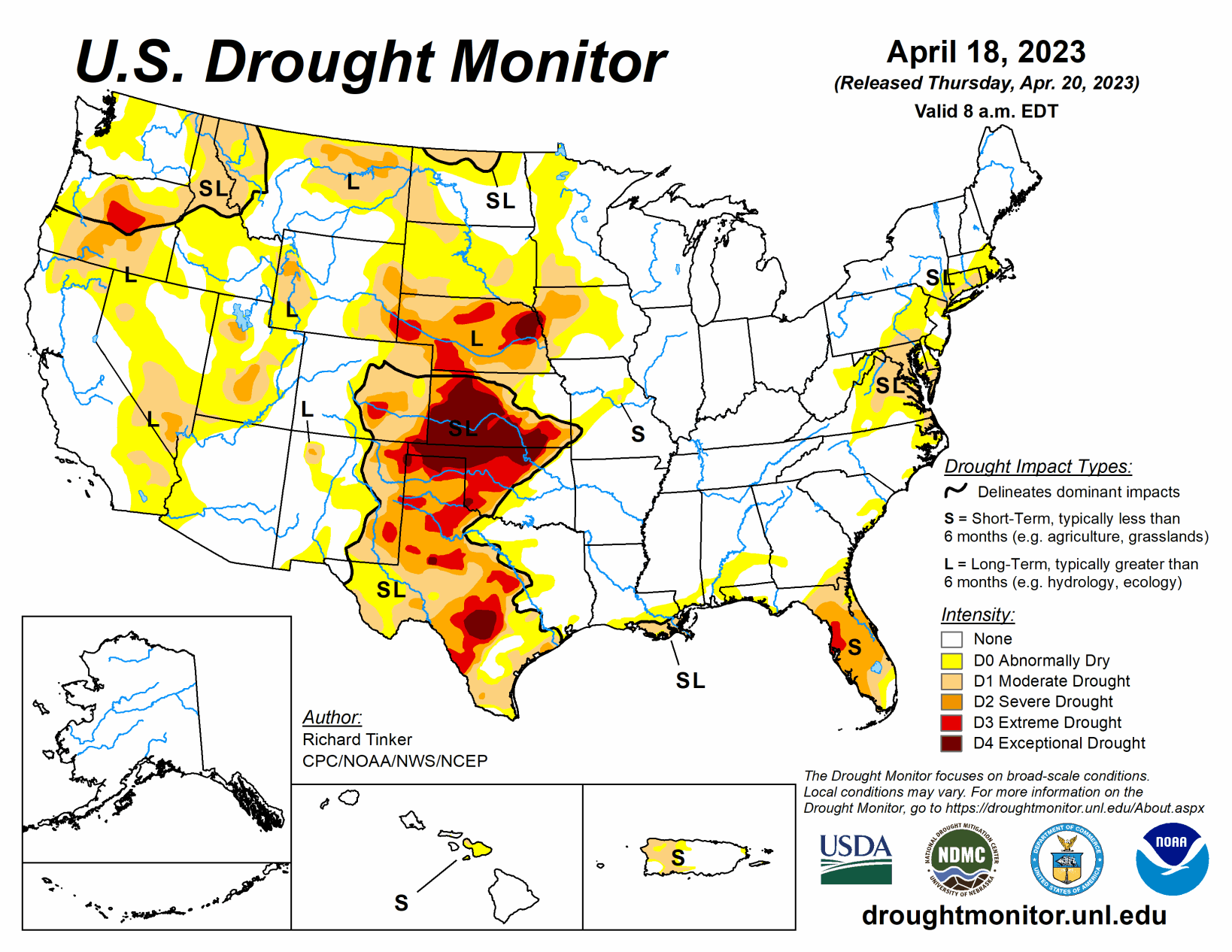
On the whole, some areas of dryness and drought in the Southeast, the Upper Midwest, the northern Rockies, and the Pacific Northwest felt improvement over the course of the week. In addition, rapid snowmelt quickly recharged soil moisture and boosted streamflows from the Dakotas to the western Great Lakes Region, prompting improvement in some areas. But most locations experiencing abnormal dryness or drought saw conditions persist or intensify, with deterioration to D3 or D4 (Extreme to Exceptional Drought) noted in some areas across the western Florida Peninsula and the southern half of the Great Plains.
South
Heavy rainfall also eased dryness and drought from southern Louisiana eastward into the Florida Panhandle. Moderate drought there is now restricted to southeastern Louisiana, where substantial multi-month precipitation shortfalls remained despite a wet week. Elsewhere, Tennessee and the Lower Mississippi Valley remained free of dryness and drought, as did eastern Texas and southeastern Oklahoma.
A tight gradient exists from near normal conditions in the aforementioned areas to extreme or exceptional drought (D3-D4) over portions of central and western Texas and Oklahoma. Beneficial rains fell on Deep South Texas and southeastern Texas, bringing limited improvement, but a dry week for most of the central and western sections of Texas and Oklahoma meant conditions persisted or deteriorated there. Most locations across central and northern Oklahoma have 3-month SPEI below the 5 percentile threshold, with 90-day precipitation 3 to 5 inches below normal.
As of April 16, the Weekly Weather and Crop Bulletin reports 53% of Oklahoma winter wheat and 52% of Texas winter wheat crops in poor or very poor condition.
Midwest
Most of the Midwest Climate Region remained free of dryness and drought, and long-term dryness finally came to an end in east-central Michigan. There were also areas of limited improvement to dryness and drought in parts of Minnesota due to moderate precipitation and/or melting snow.
Farther south, dryness and drought was essentially unchanged across Iowa, and abnormal dryness expanded in a swath across central and west-central Missouri, where 60-day precipitation totals were 1.5 to 3 inches below normal
High Plains
A majority of Kansas and portions of Nebraska remained entrenched in D3 to D4 (extreme to exceptional drought). Some D3 and D4 expansion took place there, but a few small areas saw limited improvement from localized rainfall. Some areas of deterioration were also noted across D0 to D2 areas in central and eastern Colorado, but most of the state was unchanged from last week, as was Wyoming.
Farther north, precipitation was unremarkable and generally below normal in the Dakotas, but rapid melting of the unusually deep snowpack has been recharging soil moisture and boosting streamflows, with river flooding reported in some areas. As a result, dryness and drought generally eased this past week, reducing D0 and D1 coverage, and removing last week’s D2 from southeastern South Dakota.
The Weekly Weather and Crop Bulletin reported poor or very poor conditions for 60% of Kansas winter wheat, 40% of Nebraska winter wheat, and 38% of Colorado winter wheat.
West
Areas of moderate to heavy precipitation brought continued improvement to many of the dryness and drought areas in Washington, Oregon, and Montana. Improvement was also noted across parts of Utah as the unusually deep snowpack continued to slowly melt, recharging soil moisture and boosting streamflows.
From May 5 to Aug. 9, 2022, anywhere from 25 to 39% of the West Climate Region was entrenched in D3 or D4 drought. As of April 18, only about 1.5% of the region was in D3, restricted to interior northeastern Oregon.
According to the California Department of Water Resources, mid-April statewide reservoir contents were about 19.5 million acre-feet in 2021, and less than 18 million acre-feet in 2022. But after abundant December to March precipitation in most of the state, mid-April reservoir storage has rebounded to around 27.5 million acre-feet this year, slightly above the long-term average of around 26 million acre-feet at this time of year.