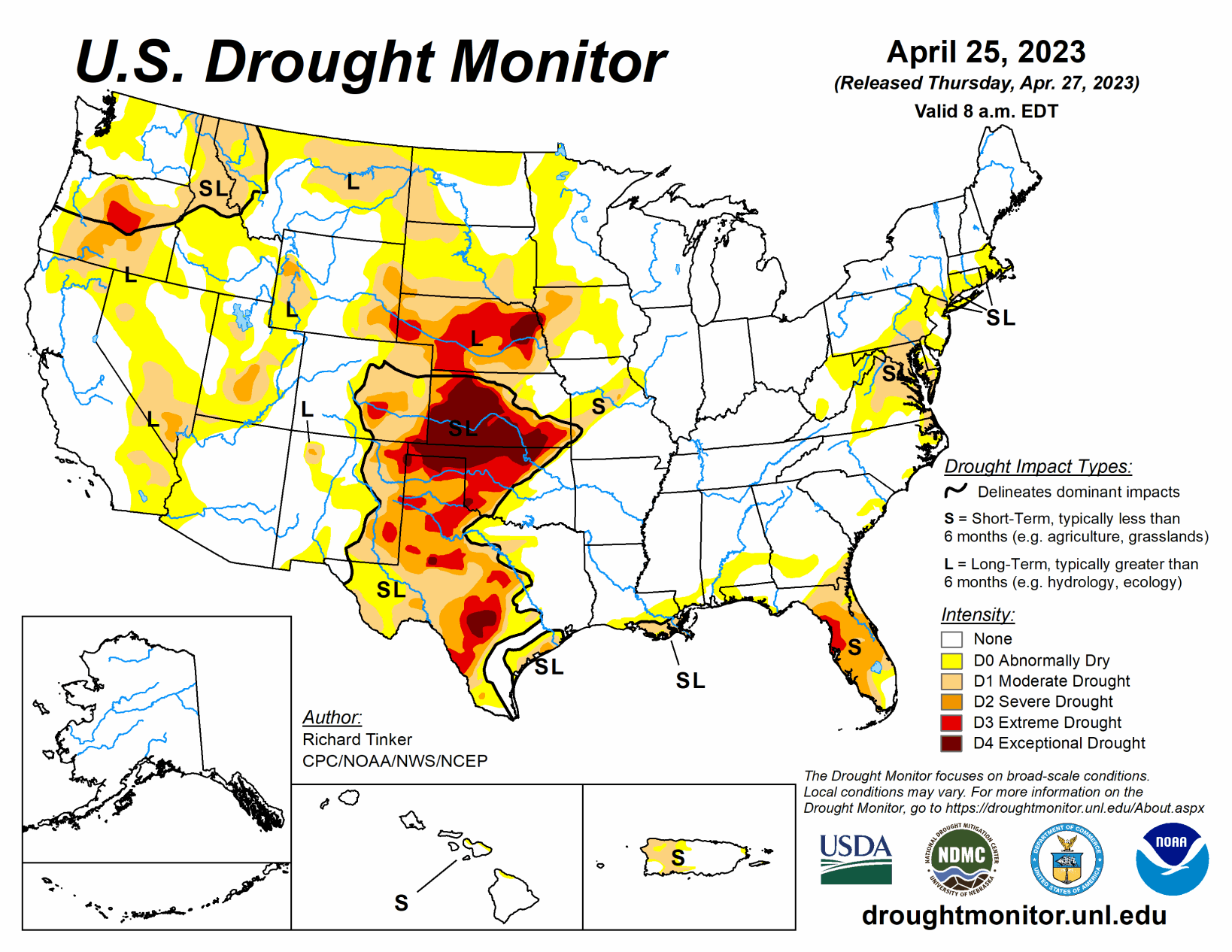
Heavy precipitation fell on areas of dryness in the Northeast, the southern and northern Plains, the northern Rockies, northern Intermountain West, and Pacific Northwest, and more-scattered areas in the mid-Atlantic Region and Florida.
Enough rain fell on some areas of dryness to improve drought designations, including parts of the D3 and D4 areas in central to southern Texas. In contrast, the D3 to D4 areas in the rest of the Plains and the northwestern Florida Peninsula and recorded little or no precipitation, keeping extreme to exceptional drought in place with a few areas of deterioration, especially in central Nebraska and the northwestern Florida Peninsula.
Locations from eastern Texas and Oklahoma eastward through Mississippi and Tennessee remained free of any designation on the Drought Monitor, though a number of areas reported that short-term dryness—on the order of a few weeks—was becoming noticeable over northern stretches of this area. Thus dryness and drought were again limited to areas near the Gulf of Mexico and over central and western sections of Texas and Oklahoma.
Heavy rain eased dryness-related impacts over much of central and southern Texas. Several inches of rain in eastern parts of Deep South Texas allowed for 2-category improvements, with much of the area going from D1 last week to no designation this week. Still, large areas of D3 and D4 remained over central and western parts of Texas and Oklahoma, with more limited reductions occurring in these areas. But enough rain fell to pull D4 out of Bexar County, Texas.
To the north and west of central Texas, little or no rain fell this past week to the 8 a.m. EDT April 25 valid period of the Drought Monitor, keeping conditions essentially unchanged in most areas, though some degradation was noted in small sections in west-central and northern Texas. Most of the northern tier of Oklahoma remains entrenched in exceptional (D4) drought, in addition to a few scattered areas farther south. According to the U.S. Department of Agriculture, 63% of Oklahoma winter wheat was in poor or very poor conditions, as was 55% of Texas winter wheat.
Midwest
Most of the Midwest Climate Region remained free of dryness and drought, confined to areas from Minnesota southward through Missouri, plus a small patch in west-central Illinois. Declining conditions in Missouri and adjacent Iowa led to a broad expansion of moderate drought (D1) in a swath through the middle of Missouri, and a few smaller locales in adjacent areas. In contrast, moderate to heavy precipitation and significant snowmelt led to improvements from northern and western Iowa northward through southern Minnesota.
High Plains
The general pattern observed during the past few weeks continued. Unusually deep snowpack was melting in the central and northern Dakotas, leading to some improvements there, including the removal of all moderate drought (D1) from northern North Dakota.
In the Great Plains from central and western South Dakota southward through Kansas, the continued lack of substantial rainfall led to intensification over a relatively large part of these areas. In particular, D3 expanded through most of central Nebraska, and lesser expansion of D3 and D4 reported in central Kansas. To the west, conditions remained generally unchanged in eastern parts of Wyoming and Colorado, with deterioration (to D2) limited to a small area in southeastern Wyoming. In the other area of extant dryness and drought in western Wyoming—adjacent to Utah and Idaho—some areas saw improved conditions, as did states to the north and west.
The USDA reported 62% of Kansas winter wheat in poor or very poor condition, as was 42% of Nebraska winter wheat. Only 7% of Colorado winter wheat was in very poor condition, but almost one-third of the rest of the state’s crop was in poor condition.
West
Areas of moderate to heavy precipitation brought some improvement across western Oregon and portions of Montana, while melting of the deep snowpack farther south eased conditions in parts of southeastern Idaho, much of the western half of Utah, northeastern Oregon, and small patches in the southern Great Basin and Southwest. The only area in the West Climate Region that noticeably deteriorated was some D0 expansion in southeastern Montana, where conditions have been similar to those in the central and southern High Plains Climate Region.