K-State agronomist provides cotton producers pre-planting considerations
While experts recommend planting cotton from May 1 to June 5, Kansas State University extension agronomist Logan Simon said variables like germination rate, soil and air temperatures more appropriately indicate when growers should break out their seeders and get cotton in the ground.
“In Kansas, we use a target temperature of 60 degrees Fahrenheit,” he said. “In the cotton producing regions of the state, we saw a seven-day average soil temperature of 61 degrees Fahrenheit as of May 2, so if people were planting, they were right where they needed to be.”
Producers can monitor soil temperatures during the cotton planting window using the K-State Mesonet.
Yet, before planting, Simon reminds growers to get their fields “clean” because cotton seedlings aren’t as aggressive as some other crops.
“If we are not starting in a good clean environment – giving cotton its best chance – any sort of competition early on is going to impact the success of our cotton crops certainly, so it’s important to think about weed burn-down,” he said.
Growers can achieve proper weed burn-down by deploying herbicides like flumioxazin, which needs to be applied 2–4 weeks before planting for good burn-down residual activity.
After successful weed control campaigns have created clean fields, germination rates will also greatly influence the best time for cotton seeding.
“All cotton is going to come with a bag rating for a warm germination rate,” Simon said. “We also have a cool germination test for cotton, but it is not usually on the bag; it can be requested from your seed dealer.”
With Kansas cotton growers putting seed in the ground a little cooler than the rest of the cotton belt, cool germination tests have proven to be especially important when prioritizing different seed lots.
“We want to make sure that we are using the highest germ seed first and holding on to some of that lower cold germ material until later in the planting window when we know our soil temperatures are higher,” Simon said.
Beyond germination rate and soil temperature, air conditions at planting also influence the success of a cotton crop.
“In western Kansas, we’re still getting some cold nighttime temperatures, and that is impacting our ability to accumulate degree day 60s,” Simon said. “60 degrees Fahrenheit is our base for cotton, and we want to ensure that we’re accumulating enough growing degree days in that five-day window after planting to put our cotton in good shape.”
Degree day 60s – a type of growing degree day – measure heat accumulation to forecast crop development based on temperature.
The relationship between predicted degree day 60s and planting conditions:
- Very poor – Less than 10.
- Poor – 11–15.
- Marginal – 16–25.
- Good – 26–35.
- Very Good – 36–49.
- Excellent – More than 50.
During the first part of the cotton planting season, Simon said southwest Kansas was very poor, while south-central Kansas was marginal, noting that growers with high-germination plant material might be able to start after accumulating a marginal amount of degree day 60s.
Brand names appearing in this article are for identification purposes only and does not imply endorsement or disapproval by Kansas State University of any particular product.
Volunteer cotton and soybeans: enemies of cotton quality and yield
In south-central Kansas, producers commonly follow soybeans in crop rotations with cotton. In the past, Kansas State University extension agronomist Logan Simon said producers plant an Xtend soybean followed by an Enlist cotton variety.
With restrictions placed on over-the-top applications of Dicamba, cotton growers may start facing new weed control challenges due to using soybean and cotton technologies of the same kind.
“We’ve got two different technologies that we’re able to use in order to get control of volunteer soybeans and cotton across those two (Xtend and Enlist),” he said. “Unfortunately, with the loss of our label for over-the-top Dicamba, we expect those Xtend beans to shift to other products, which could create situations where Enlist soybeans are followed by an Enlist cotton.”
Volunteer cotton and soybeans negatively impact the opposite crop by creating competition for space and key nutrients within the soil. Kansas State University weed specialist Sarah Lancaster said growers have limited options when it comes to control.
“The only option that I’ve been able to find to control volunteer soybeans in cotton, based on research conducted at North Carolina State University, is called Envoke, which is an ALS-inhibiting herbicide,” she said.
Lancaster notes that this product is only safe to be applied to cotton and not soybeans. When going back to soybeans in crop rotations, she also warns that growers must have a soybean variety tolerant of sulfonylurea herbicide residues (STS soybeans).
Another avenue for lowering the volunteer burden in fields includes utilizing different application methods to encourage selectivity between soybeans and cotton.
“One option would be to use a hooded sprayer in soybeans, or in cotton, a post-directed spray, to get that selectivity,” Lancaster said. “Some products with labels for that in either crop would be Aim or Valor.”
Brand names appearing in this article are for identification purposes only and does not imply endorsement or disapproval by Kansas State University of any particular product.
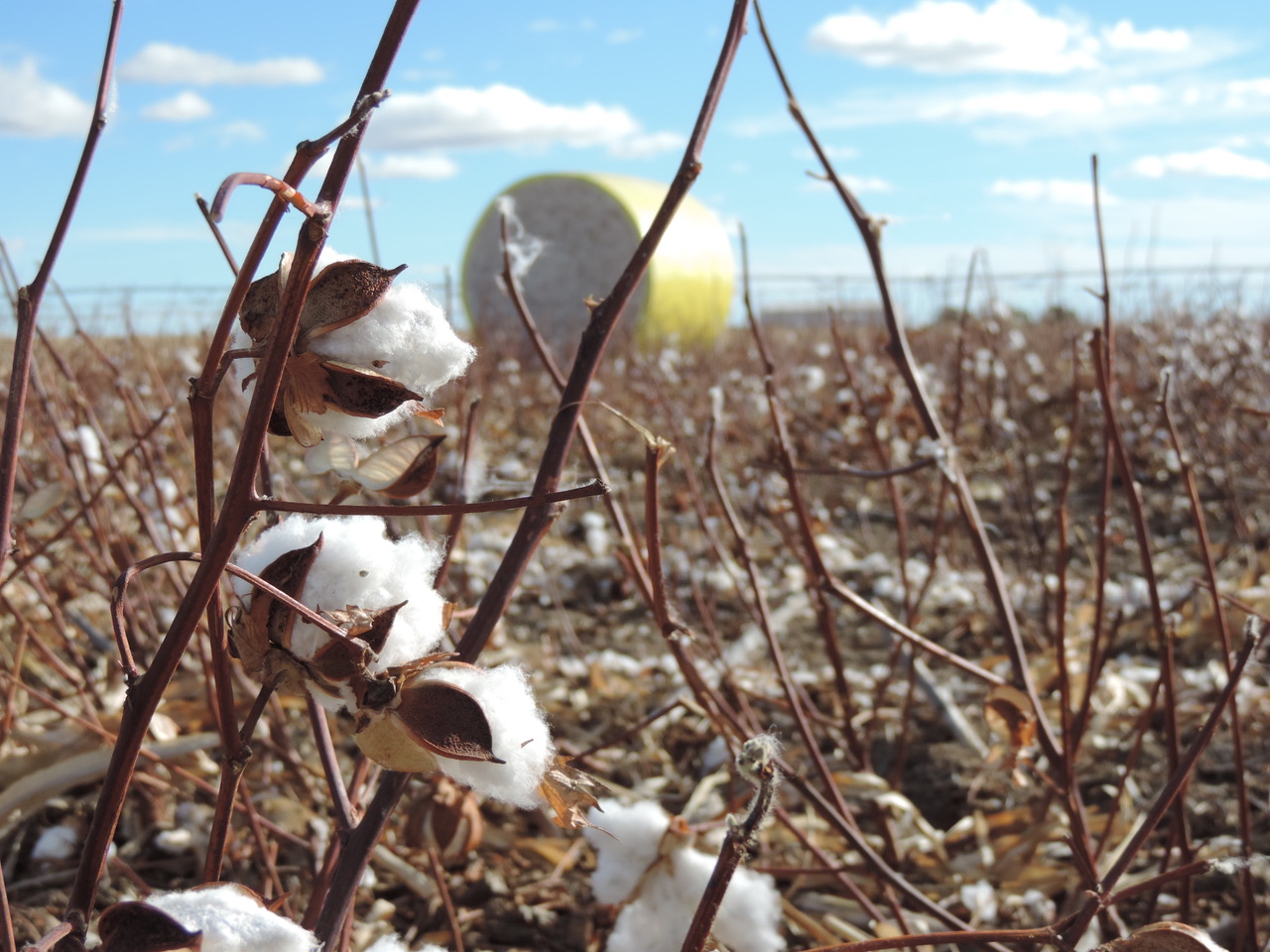
PHOTO: K-State researchers have teamed with colleagues at Oklahoma State University to study the long-term environmental and economic viability of cotton production in areas where water is scarce. (K-State Research and Extension)