Private water well screenings set for Williamson County Aug. 21 -22
Residents invited to a free water well screening, results meeting following flooding
The Texas Well Owner Network, TWON, is hosting a water screening event for Williamson County residents who may have had their private water wells inundated with floodwaters during the July rainfall events.
The screening will be held on Aug. 21-22 in Georgetown.
Joel Pigg, Texas A&M AgriLife Extension Service program specialist and TWON coordinator, Department of Soil and Crop Sciences, Bryan-College Station, said the Texas Well Owner Network program is for Texas residents who depend on household wells for their water needs.
“The TWON program was established to help well owners become familiar with Texas groundwater resources, septic system maintenance, well maintenance and construction, and water quality and treatment,” Pigg said. “It allows them to learn more about how to improve and protect their community water resources.”
Water samples will be screened for total coliform bacteria and E. coli bacteria. He said well owners in flooded areas are advised to get their water tested.
“The results for the flooding programs are showing a positive result for E. coli from 25-36%, where we normally see a 3-10% positive rate,” Pigg said. “The results for the total coliform bacteria are showing a positive result from 73-76%, where we normally see a 30-35% positive rate. We are well above the normal things that we do see.”
Water sampling and meeting information
Water samples can be dropped off on Aug. 21 from 8:30-11 a.m. at the AgriLife Extension office for Williamson County, 100 Wilco Way, Suite AG201, Georgetown. There will be no cost for the water well screening.
The follow-up meeting to explain the results of the screenings will be at 11 a.m. on Aug. 22 at the AgriLife Extension office.
Sampling instructions
A water sample form must be completed for each sample submitted. Follow the directions below for sample collection: visit https://twon.tamu.edu/ for a printable version of the collection instructions and the sample information sheet.
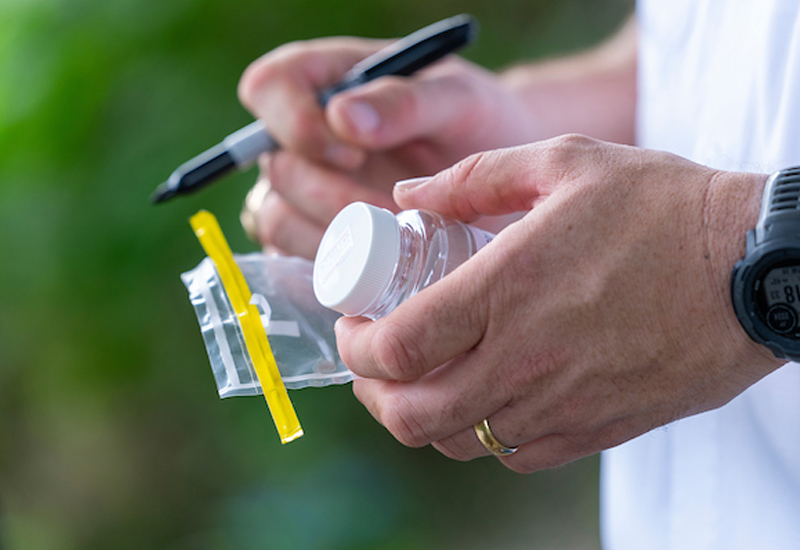
- Pour the contents of a new 12-20 ounce bottle of water out and fill it with a water sample from your private water well.
- Take the sample from the spigot/hose bib nearest the wellhead. Remove the water hose, if one is present, and take the water directly from the spigot/hose bib.
- If an inside faucet is used, remove the aerator on the faucet before making the collection. Rinse and dry the exterior of the faucet to prevent contamination of the water sample.
- If possible, wipe with a Clorox-type towelette or paper towel wetted with a light bleach solution to kill any bacteria present on the faucet. Allow the cleaning solution to dry before sampling.
- Turn the water on full force and let it run for 2 minutes or until the pump starts running.
- Reduce the water flow to a small stream, then take the sample.
- The sample should be collected within 24 hours of submission to ensure accurate results.
Refrigerate the sample and transport it to the drop-off location in an ice chest as soon after collection as possible. It is best to collect the day the sample is submitted. Otherwise, make sure the sample is kept cool and out of direct sunlight.
“We encourage you to bring samples from all wells on your property,” Pigg said. “Also, many participants who have water treatment equipment take samples before and after the treatment to make sure the equipment is functioning properly.”
Each sample should be labeled with a name and the well it came from.
Pigg said it is essential for those submitting samples to be at the follow-up meeting to receive results, learn corrective measures for identified problems and improve their understanding of private well management.
For more information on the water screening, contact Pigg at 830-275-3866 or [email protected].
The screenings are presented by AgriLife Extension and Texas Water Resources Institute, TWRI, in partnership with the AgriLife Extension offices in Williamson County.
Funding for TWON is through a Clean Water Act nonpoint source grant provided by the Texas State Soil and Water Conservation Board and the U.S. Environmental Protection Agency. The project is managed by TWRI, part of Texas A&M AgriLife Research, AgriLife Extension and the Texas A&M College of Agriculture and Life Sciences.
PHOTO: Texas Well Owner Network will offer a free well water screening on Aug. 21-22 in Georgetown for residents of Williamson County. (Michael Miller/Texas A&M AgriLife)