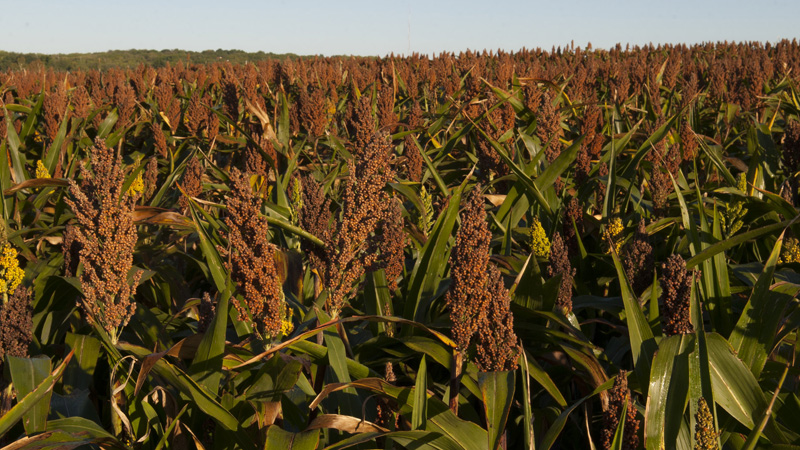
Occasionally there can be a need to use a harvest aid on grain sorghum. The crop usually is left to terminate and senesce naturally from either the plant maturing out or by a killing freeze. The main purpose of using a harvest aid would be to improve harvest timing. Delayed harvest after the grain becomes mature can potentially reduce grain yields. An exposed crop can experience losses due to pest pressures like bird damage, as well as environmental losses like severe storms with strong winds or hail.
Many factors can delay harvest. Some newer genetics may exhibit characteristics like “stay green” where the plants stay green longer. At harvest, the higher moisture content of the plant can potentially spike grain moisture if combines are not set correctly. If fields have excessive weed infestations, the same concerns of spiking grain moisture can delay harvest.
If stands are on the thin side and growing conditions improve later in the season, the addition of late tillers can become problematic. Unevenness in maturity of a field can also delay harvest. Preparing the crop for harvest is achieved when harvest aids are applied correctly. Harvest aids in grain sorghum fall into two groups, herbicides and desiccants. The products available have very little influence on the grain itself but work more in the vegetative biomass of the plant. Therefore, these products have very little to no direct impact on grain moisture when applied according to the labels. Glyphosate (ie Roundup), carfentrazone (i.e. Aim), and sodium chloride (i.e. Defol 5) are currently the only three products labeled for use in grain sorghum.
Sodium chloride is a true desiccant and may not kill the crop but can rapidly dry-down any plant material that it contacts. If not harvested in a timely fashion, plant lodging or regrowth can occur. Glyphosate and carfentrazone are herbicides that, when used as directed, can terminate the crop or weeds. Glyphosate is more widely used but generally takes longer to shut down the plants. Glyphosate also has a longer pre-harvest interval at seven days, while carfentrazone is only three days. Carfentrazone is a good option to assist with broadleaf weed desiccation and is a great option to tankmix with glyphosate if there is concern of herbicide resistance.
If a producer chooses to have a harvest aid applied, applying the product correctly will greatly affect any potential economic gains. The first component of applying these products correctly involves application timing. A harvest aid should not be applied any earlier than physiological maturity, often referred to as black layer. Appling too early can reduce grain fill which will directly reduce grain yields.
To check for black layer, inspect the base of seeds on multiple plants, tillers of each plant, and locations within each panicle. Delayed plant emergence and late tiller additions will likely be farther behind. Typically, panicles mature from the top down. Maturity can widely range, so understanding how far along the majority of the crop is will improve proper application timing. Applying too late will not reduce grain yield, but delaying harvest due to labeled pre-harvest timing intervals may lead to losses.
In addition to proper application timing, adequate spray coverage is also an important part in a successful harvest aid application. Apply these products in a minimum of 10 gallons of water per acre when ground applied or a minimum of 5 gallons of water per acre when aerially applied. Under certain conditions, like thick canopy of sorghum or weeds, increasing carrier volume up to 15 or 20 gallons of water per acre can increase efficacy of these products.
Harvest aids usually have no impact on grain yield potential in sorghum. Since these applications are made after physiological maturity, total yield potential has been set and crop dry-down is the only aspect remaining. Just like other crop protection products, harvest aids can only protect yield potential. A two-year study recently done by Oklahoma State University found yields for sorghum not treated with harvest aids resulted in an average reduction of around 7 bushels per acre in northcentral Oklahoma and just over 5 bushels per acre in the panhandle.
Grazing sorghum stover after grain is harvested is a great way to get more value out of the crop. Refer to product labels for grazing restrictions. Defol 5 doesn’t provide any specific grazing restrictions for sorghum but lists 14 days for similar crops such as corn. When Aim is applied alone, grazing and hay operations may proceed with no restrictions. Roundup PowerMax states there should be at least 7 days before feeding of vegetation with a post-harvest application but doesn’t mention any grazing restrictions when applied pre-harvest.
While it might be tempting to graze the stover soon after grain harvest, waiting might be a safer option. Waiting 5-7 days after a killing freeze greatly reduces the risk of prussic acid issues. New regrowth can also be a higher risk for nitrate toxicity. As far as a ‘rule-of-thumb’ for stocking rates, it is roughly estimated by assuming 8-12 pounds of palatable forage per bushel of grain produced. So for example, a grain yield of 80 bushels per acre might produce 640-960 pounds of forage.
PHOTO: Grain sorghum (HPJ Photo – Lacey Vilhauer)