This year’s wet conditions have disrupted many hay cutting schedules across Iowa, leaving many producers uncertain about when or whether to take a final alfalfa harvest. As we move into fall, it’s important to start preparing perennial hay fields for winter. A key consideration is timing your final cutting to support winter survival and minimize winter kill risk.
The general rule of thumb is to allow five to six weeks (about 900 growing degree days, or GDD) between the final harvest and a killing frost. Alternatively, cutting less than 2 weeks before a killing frost (around 360 GDD) is also considered safe. A third option is to harvest after a killing frost, but this should be done quickly to avoid nutrient leaching.
Alfalfa GDDs are calculated similarly to corn, but with a lower base temperature of 41 degrees Fahrenheit:
GDDalfalfa = ((Tmax + Tmin) / 2) – 41
This five- to-six-week window is critical because alfalfa needs time to rebuild root reserves after harvest. Initially, the plant uses stored energy to regrow. Once it reaches about 6 to 8 inches of height, it begins photosynthesizing enough to replenish those reserves. This regrowth period typically aligns with the 900 GDD guideline.
During this time, alfalfa also begins to winterize, triggered by cooler temperatures and shorter days. A killing frost for alfalfa usually occurs when temperatures drop to 24 degrees or lower for several hours. After this, the top growth is damaged and active growth stops. If you choose to harvest after a killing frost, do so promptly to avoid nutrient loss.
In many areas, producers have taken their third or even second cutting mid to late August due to wet conditions, which may place their final harvest in the “no-cut” window between 360 and 900 GDD. However, there is still an option. If you cut within 360 GDD (roughly two weeks) before a killing frost, it’s generally safe because the plant won’t regrow enough to deplete root reserves. That said, this approach carries risk: if warm weather persists, you could unintentionally fall into the no-cut zone.
However, cutting in the <360 GDDs or following a frost, it’s worth considering whether it’s necessary. The yield from a late cutting is often low, but the quality tends to be high. If you need high-quality hay, this might make the cutting worthwhile. Keep in mind that additional time may be needed to properly dry the alfalfa down with cooler temperatures and shorter days. And on the other hand, leaving the remaining material in the field can help collect snow, which forms an insulating layer that helps prevent winterkill.
To help assess your situation, the University of Wisconsin has developed a tool that uses historical weather data to estimate the risk of your final cutting relative to the average first killing frost. You can access it here: Weather and Alfalfa Planning Tool.
In conclusion, depending on your harvest schedule, you may or may not land in a safe cutting range. Making that decision can be difficult, but using available information can help you make the most informed choice for your field.
Shelby Gurss is an assistant professor and forage Extension specialist and is reprinted with permission from Integrated Crop Management News and Iowa State University Extension and Outreach.
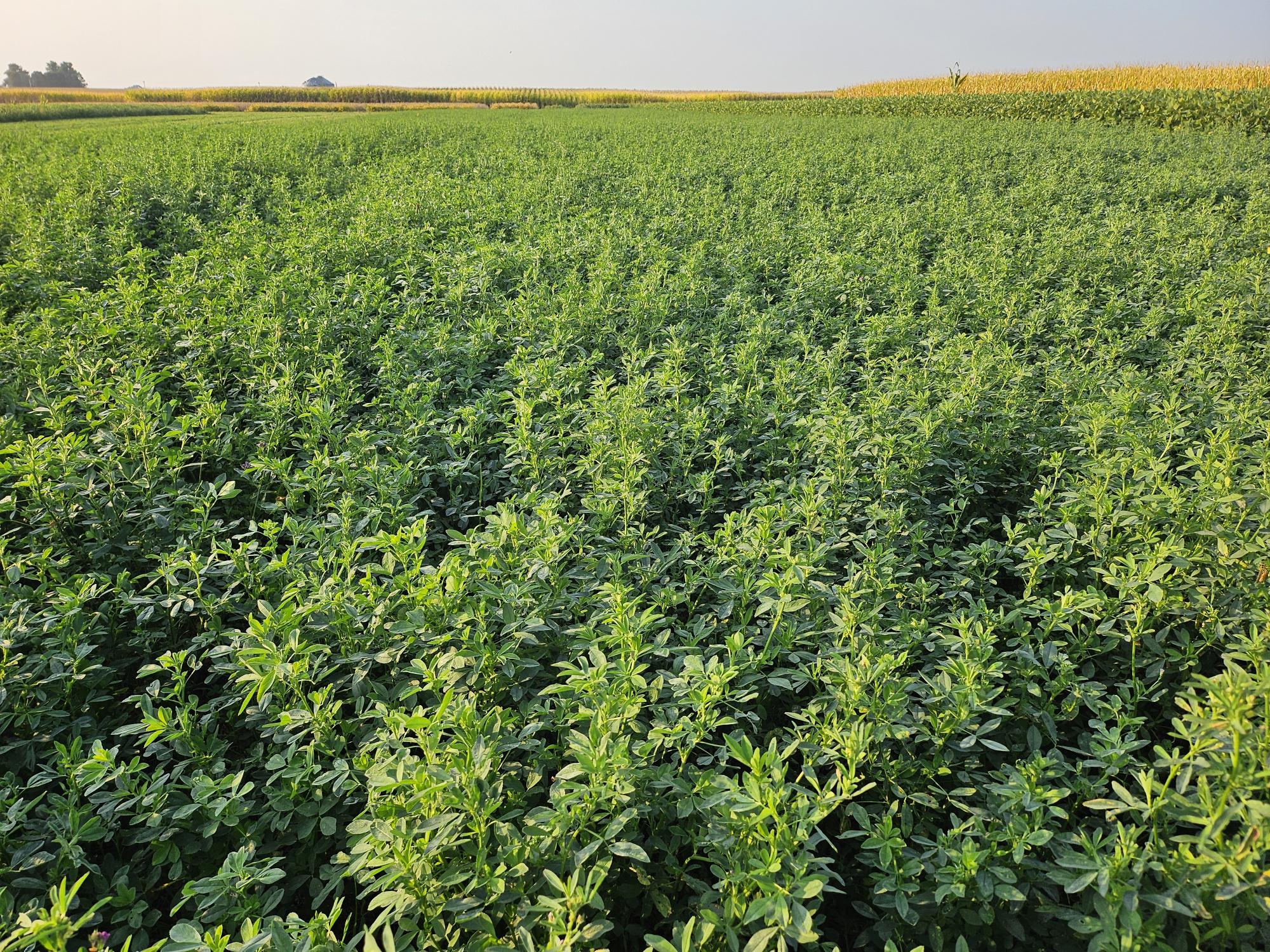
PHOTO: An alfalfa field in early-mid September (Sept. 10), just starting to get into the “no cut” window. At this stage it may be enticing to harvest but either waiting till we are closer to the frost <3860 GDDs or right after a frost can help reduce potential damage to the stand. (Courtesy photo.)