Heading into the fall harvest season, it is a suitable time to reflect on the demanding work that keeps America running, especially the tireless efforts of farmers and ranchers who provide food and fuel for the United States and beyond.
But in today’s digital age, a new threat looms over these family operations: Data vulnerabilities. Google’s recent announcement, warning Gmail users of a massive data breach tied to a third-party hack at Salesforce, serves as a stark reminder. Hackers accessed sensitive data, sparking a wave of phishing scams and prompting urgent calls for password resets across 2.5 billion accounts.
For rural businesses already stretched thin, everyday tools like email can expose critical farm data to cybercriminals.
Data breaches come in many forms and actions
Data breaches are not just headline-grabbing events affecting big tech companies; they are a growing epidemic that hits close to home. They occur when unauthorized parties access sensitive information, often through phishing emails, ransomware or exploited software weaknesses. In the agriculture sector, threats have surged, with cyberattacks up 607% in 2020 alone, making it one of the most targeted industries. Ransomware, where hackers encrypt files and demand payment, is particularly rampant—212 incidents hit food and ag in 2024.
Recent examples underscore the variety. The Google-Salesforce breach exposed business data, fueling scams that spoof legitimate emails to trick users into revealing more information. Closer to the farm, Farmers Insurance suffered a similar Salesforce-linked hack, compromising more than 1 million customers’ names, addresses, birth dates, and driver’s licenses—including ag producers. Other breaches include ransomware shutting down meat processors like JBS, disrupting supply chains and costing industry millions of dollars.
Studies show farmers often rely on common email services, increasing exposure. Nationally, 85% of U.S. farms have internet access, with 90% using email for business and 75% prefer to be contacted by email for marketing purposes. Gmail dominates with more than 1.8 billion users globally and 76% market share in the U.S., followed by Outlook (14%) and Yahoo (18%). Services like Microsoft 365 are popular for business tools, but older providers like Yahoo, Hotmail and AOL persist in rural areas due to familiarity.
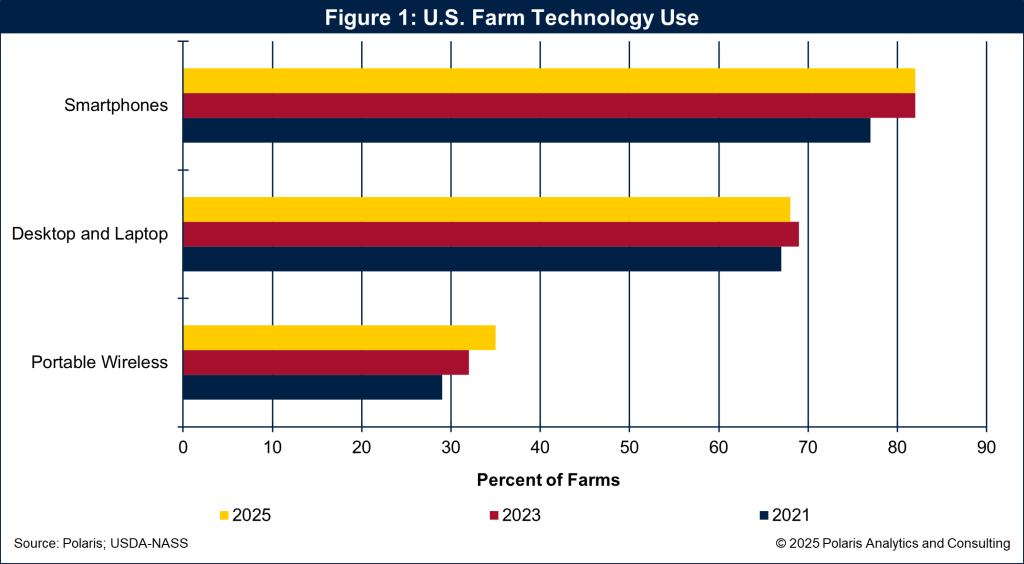
Across the U.S. and High Plains, 82% of the farms use smartphones and 68% use desktop or laptop computers to access the internet in 2025. A growing number of farms, 35% in 2025, up from 29% in 2021, use other wireless devices such as tables to access the internet. The technology used to access the internet by percent of farms is shown in Figure 1.
Security tools vary too. While antivirus like Norton and McAfee are common, Norton tops surveys for usage, but adoption in ag lags. A Canadian study found 82% of farms believe they have never been attacked, yet suppliers report otherwise, revealing a gap in awareness.
Risk of data breaches on the farm: what’s at stake?
For small family farms and ranches, the stakes are high. Many lack dedicated IT staff, making them prime targets for cybercriminals exploiting weak security. Vulnerabilities stem from outdated software, shared devices, and transmitting sensitive data via e-mail or cloud services.
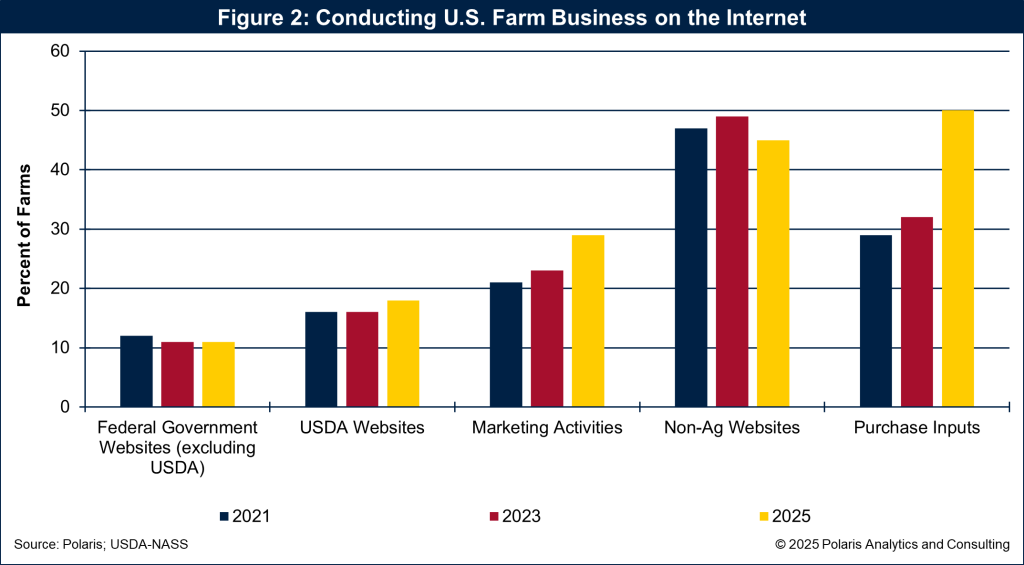
One-half the farms in the U.S. and similarly across the High Plains purchased inputs over the internet in 2025, up from 29% in 2021. For marketing purposes, 30% of the farms used the internet in 2025, eight points higher than in 2021. In 2025, 21% of farms used the internet to access U.S. Department of Agriculture websites, up from 16% in 2021. The use of the internet to conduct farm business by activity is expanding and becoming more important as shown in Figure 2.
What is at risk? Beyond emails and financials, farm-specific data like crop and livestock records, GPS equipment mappings, and precision ag info from tools like tractors or drone surveys. A breach could expose trade secrets, enabling competitors to undercut prices or steal innovations.
Ransomware might lock equipment during planting season, halting operations and causing crop losses. Financial hits are severe: Stolen bank details lead to fraud, while identity theft—amplified by breaches like Farmers Insurance—could ruin credit for loans or subsidies.
Studies highlight ag’s unique risks. Automated farming technology, like IoT (internet of things) sensors, is vulnerable to hijacking, potentially altering irrigation or feed systems. Phishing preys on trust in rural networks, with emails mimicking suppliers or USDA alerts. The Farm and Food Cybersecurity Act, reintroduced in 2025, aims to bolster defenses, recognizing the sector’s critical role in national infrastructure.
Protecting against data breaches
The good news? Simple steps can fortify your operation. Start with basics: Use strong, unique passwords (at least 12 characters, mixing types) and change them regularly, especially post-breach like Google’s warning. Enable multi-factor authentication on emails and accounts; it is a game-changer for blocking unauthorized access.
Invest in reputable antivirus like Norton, McAfee, or Bitdefender, which include malware scanning, phishing protection, and VPNs for secure transmissions. Keep software updated with patches to fix vulnerabilities that hackers exploit. Back up data regularly to external drives or clouds, ensuring ransomware cannot wipe everything. Train your family and employees: Recognize phishing (e.g., urgent emails with links) and avoid public Wi-Fi for sensitive tasks. Conduct cybersecurity assessments, like those from the Critical Infrastructure Security and Resilience in America’s Cyber Defense Agency, offers free resources for ag. For emails, consider switching to secure providers or using encrypted services for farm data.
Finally, monitor for breaches: Tools like personal data cleanup (from McAfee or Norton) scan for exposed info. If hit, act fast by changing passwords, alerting banks, and reporting to authorities.
Farmers and ranchers already battle weather and markets; do not let data breaches add to the load. By staying vigilant, you protect not just your operation, but the families and communities depending on it. Happy Harvest season, stay safe out there.
Ken Eriksen can be reached at [email protected].