I have just returned home from a rewarding trip to Baker County, Oregon. I went to speak at a meeting organized by local cattlemen with the theme of “Make Beef American Again” and this could not have been more appropriately timed with the challenges to cattlemen in the area paralleling that of other resource providers.
To begin 2025, I was told that 50% of the land in the county is deeded or privately owned and 50% is owned by the government. The community of Baker City does a wonderful job celebrating the fascinating history of the county, but I believe focusing on the present and the future are just as important.
This region was first settled thanks to gold being discovered. In fact, the Oregon state government gives this little factoid about mining for gold:
Baker County mining began with the discovery of gold in Griffin Gulch in 1861. This and the development which followed at Auburn represent gold mining at its historic best. Since 1861, much water has flowed down the sluice boxes with respect to mineral resource development within the county. As a result, the discovery story is left for historians to tell, and the following paragraphs are devoted to the high points of the many kinds of mining endeavors that occurred in Baker County between 1861 and 1959.
Dan Johnson was one of the organizers of the event and he is still mining gold today in Baker County. His quick summary was that a high hurdler in the Olympics had dozens of fewer hurdles than he does to keep his mining operation functioning.
Oregon has also been front and center in the war on logging. Once again, let’s turn to the state of Oregon for a quick history lesson in the timber industry:
There is over 150 years of history in the wood products industry in Oregon, beginning with the first known sawmill built west of the Mississippi River in 1827 near Fort Vancouver. Settlers in the area saw the forests as a hindrance at first, wishing to clear-cut the land for agriculture and having little use for timber. However, in 1849 wealthy farmers began to build homes of sawed lumber instead of residing in log cabins, and the lumber industry took off.
By 1900, the lumber industry assumed a major role in the state’s economy. However, since there was no organized forest prevention authority at the time, forest fires ravaged the land uncontrollably, damaging millions of acres of forest. The State Forestry Department, along with a new Board of Forestry and a State Forester, was created in 1911 in an effort to minimize the problem.
The advent of World War II in December of 1941 generated foreign and domestic demand for wood products. In the 1950s, the increasing demand for timber and high tree values started the new trend of harvesting second growth timber, making tree farming a booming industry. In 1961, more than “one-fifth of the nation’s sawtimber supply was in Oregon forests, [supplying] about one fourth of the softwood lumber, half of the plywood and more than one-fourth of the hardboard produced in the United States.”
In past 10 years I have been in eastern Oregon several times so it was not news to me that government has all but shut down the logging industry. The sawmills have been removed and again the hurdles are high. On this trip, I met Allen Chase, an 80-year-old who manages a local historical society and he very quickly laid out the facts that the movement for all government lands to be “wilderness” areas, thus removing all human interaction, is not only taking it’s toll on the local economy, but creating a dangerous environment with massive fuel loads for wildfires.
The mining and timber industries are being targeted by the largest landowner in the U.S.—the federal government, in my opinion. The government seems to have no notion that people actually own these resources. Until we all cry, “TIMBER” at the loudest decibel anyone has ever heard it, the spiral downward of our great nation and our property rights will only continue.
Editor’s note: The views expressed here are the author’s own and do not represent the views of High Plains Journal. Trent Loos is a sixth-generation United States farmer, host of the daily radio show “Loos Tales” and founder of Faces of Agriculture, a non-profit organization putting the human element back into the production of food. Get more information at www.LoosTales.com, or email Trent at [email protected].
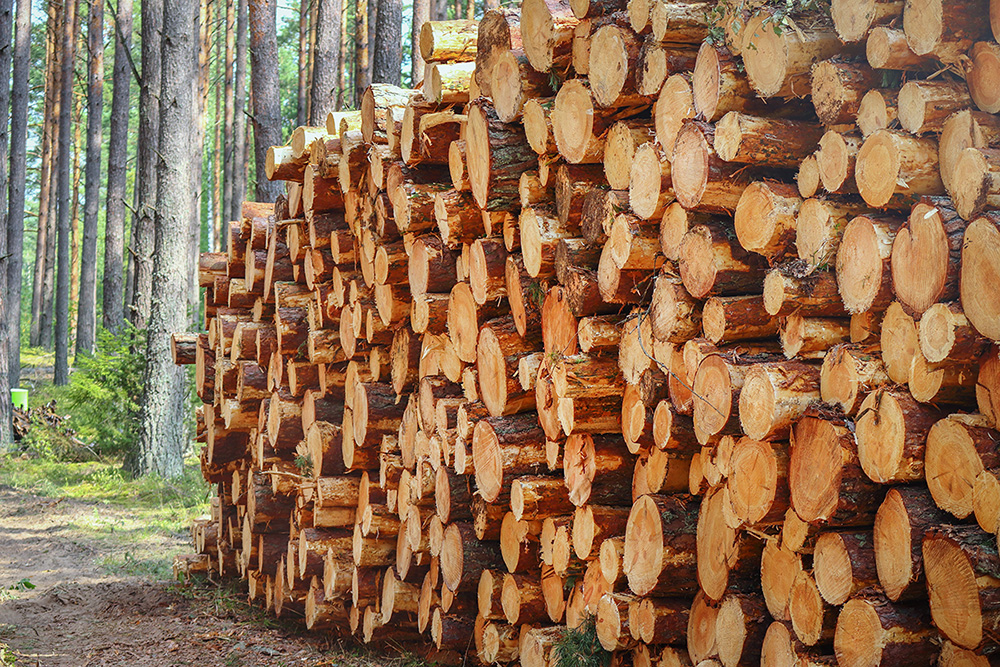
PHOTO: Tree logs and stumps with bark lie stacked in a forest after being cut. (Adobe Stock │ #525593214 – Marija Crow)