
Kansas governor puts 43 counties under drought watch
Gov. Laura Kelly has signed a proclamation approving updated drought declarations for Kansas counties.
Above-normal precipitation in recent months has led to noticeable improvement in drought conditions, particularly across the western two-thirds of the state. Fall 2025 is expected to rank as the 41st wettest on record, with south-central Kansas on pace to end the year among its top 10 wettest ever. However, pockets of dryness continue to persist in many parts of northeastern Kansas.
The drought declaration removed 39 counties from drought status and placed 43 counties into watch status. This action was recommended by Connie Owen, director of the Kansas Water Office and chair of the Governor’s Drought Response Team.
County drought stage declarations
Drought watch—Allen, Anderson, Atchison, Bourbon, Brown, Butler, Cherokee, Clay, Cloud, Coffey, Crawford, Dickinson, Doniphan, Douglas, Elk, Franklin, Geary, Greenwood, Jackson, Jefferson, Jewell, Johnson, Labette, Leavenworth, Linn, Lyon, Marshall, Miami, Montgomery, Morris, Nemaha, Neosho, Osage, Ottawa, Pottawatomie, Republic, Riley, Shawnee, Wabaunsee, Washington, Wilson, Woodson, Wyandotte.
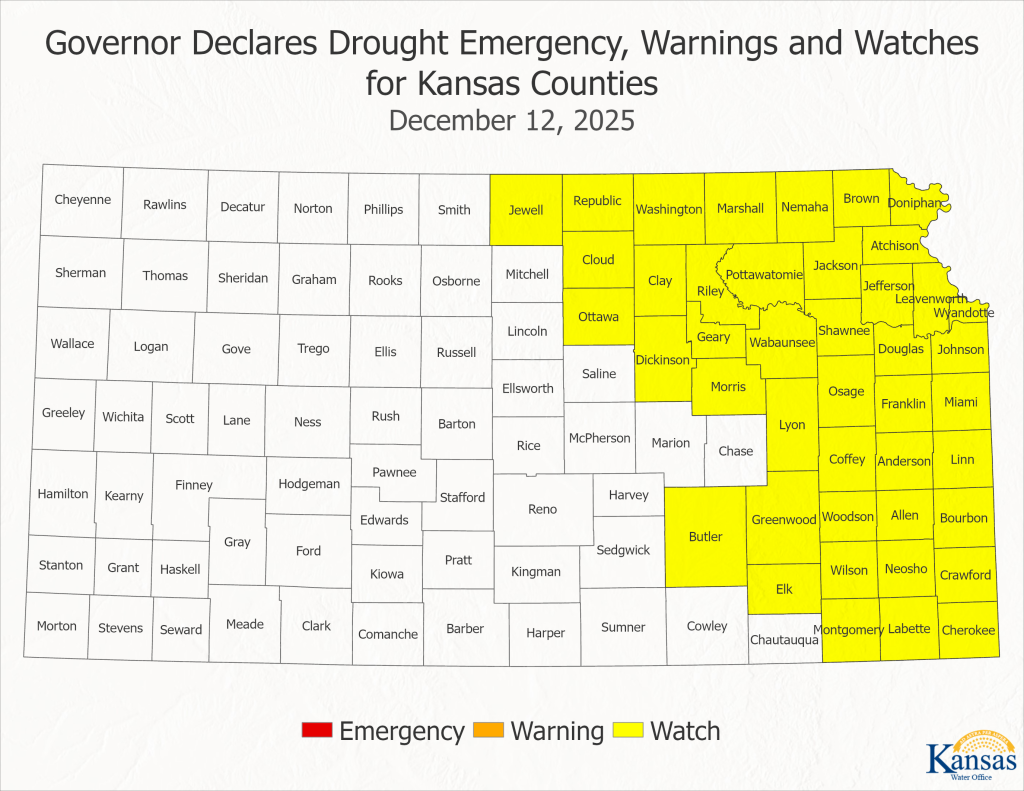
No counties are in the drought emergency or drought warning stages.
“Despite recent progress, numerous counties are still experiencing challenges from diminished water availability and stressed resources,” Gov. Kelly said in a release issued Dec. 12 “As we enter the winter months, I urge Kansans to use water wisely and stay attentive to the evolving impacts of drought on public health, agriculture, and wildlife across the state.”
Kansas is expected to have below normal precipitation this winter, which can lead to a potential for above normal fire activity during any warm or dry period the state may receive. The Governor’s Drought Response Team will continue to monitor the drought conditions across Kansas and make recommendations to Gov. Kelly as conditions change.
“Counties in a watch status have conditions which indicate the probability of a water shortage is rising,” Owen said. “It is important to monitor these conditions and be mindful of water usage in these counties.”
This proclamation shall remain in effect for those counties identified until rescinded by a proclamation ending the declaration or revising the drought stage status.
Authorizes and directs all agencies under the jurisdiction of the governor to implement the appropriate watch, warning, or emergency-level drought response actions assigned in the Operations Plan of the Governor’s Drought Response Team.
The Governor’s Drought Response Team will continue to watch the situation closely and work to minimize the negative drought-induced effects on Kansans. Kansans are encouraged to report drought-related conditions and impacts in their region through the Condition Monitoring Observer Reports system.
For more detailed information about current conditions, visit the Climate and Drought webpage on the Kansas Water Office website at kwo.ks.gov.



