Marcus Hansen has always felt a pull to grow.
“When I was little I would help my mom in the garden. As I got older, I think my interest outgrew her time to work on it,” he says with a laugh. “I actually turned a good portion of our yard into a garden.”
When it was time for college, Hansen knew he was ready for new terrain. Hansen left the Twin Cities for St. Peter in southern Minnesota, where he explored the river valley, visited nearby towns, and became a farmers market regular. Four years later, he began a Master in Urban Planning at the University of Minnesota’s Humphrey School of Public Affairs. He was excited for the next step but worried about losing touch with the Greater Minnesota communities he’d grown to care about.
Thanks to generous support from the Mary J. Page Community-University Partnerships Fund and a project partnership between the University of Minnesota Extension’s Regional Sustainable Development Partnerships (RSDP) and the Region Nine Development Commission, Hansen stayed connected as a student research assistant researching options for a permanent space for the Mankato Farmers’ Market. As a student focused on urban planning and community development, Hansen saw the role as a perfect fit.
“When I lived in St. Peter, I shopped at the Mankato farmers market all the time,” he says. “So getting to work on this project felt like a full circle moment.”
Fertile ground
Since the 1980s, the Mankato Farmers’ Market has been a local staple, offering producers within a 40-mile radius a place to sell their goods and connect with the community. Every purchase supports local businesses and strengthens regional food systems.
Despite its long-standing presence, the market’s current setup leaves little room to grow. Located in the parking lot of a national retail chain, it’s only accessible by car, limiting both vendor space and foot traffic. Looking to explore options, the farmers’ market partnered with the Region Nine Development Commission and Southeast RSDP, eventually bringing Marcus Hansen to the team.
Hansen researched how other markets transitioned to permanent spaces, identified potential sites in the area and developed surveys to gather community insight. With encouragement from project partner Sabri Fair, an environment and sustainability planner with the Region Nine Development Commission, and funding from the Mary Page Fund, Hansen visited the market and surveyed vendors and shoppers to understand their preferences for a new space.
“We learned vendors are most interested in a location that is highly visible, like along a major corridor, with space to grow,” he says. “Many shoppers say they want a site they can walk or bike to, and that feels welcoming on a Saturday morning.”
Hansen also used Geographic Information System (GIS) mapping to track how people arrived at the market and where high-traffic points existed, helping connect on-the-ground perspectives with data-driven insights.
“I’m really grateful that the Mary Page Fund enabled me to visit the market in person and talk to the community. Ultimately, we couldn’t have done meaningful research without it,” says Hansen.
A new season
Hansen and the team compiled their findings and recommendations into a report that included proposed sites, maps and relevant zoning information to help guide future planning. His research contributed to a broader report used by project partners to engage city leaders and potential funders.
He credits his experience working in Mankato with helping him bloom as both a professional and a person.
“When I was choosing a graduate school, I was torn between the University of Minnesota and an out-of-state option. I worried I might not grow as much if I stayed local,” he recalls. “But this experience showed me that even as a student in the Twin Cities, I can still make an impact in communities beyond Minneapolis and St. Paul; it affirmed for me that I had made the right decision.”
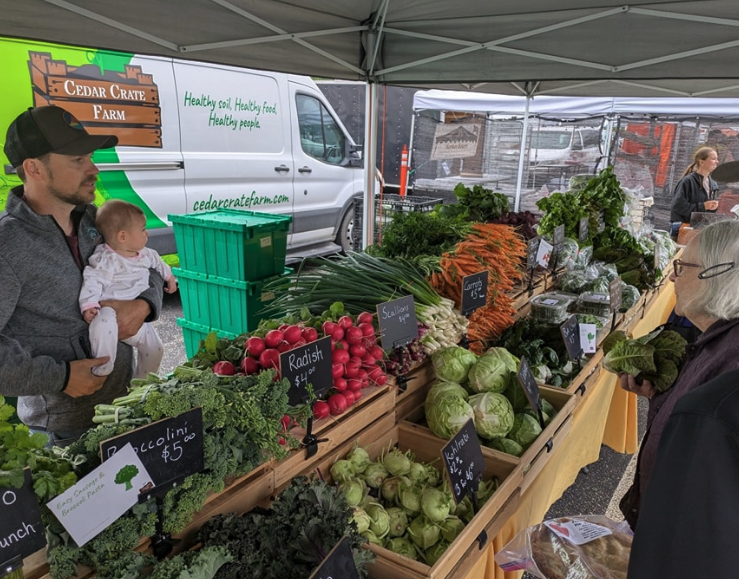
PHOTO: Customers shopping for vegetables at the Mankato farmers market. (University of Minnesota Extension)