Studies indicate raccoons are becoming more domesticated, but don’t treat them as pets
K-State wildlife expert cautions against feeding, petting wild animals
Raccoons living in America’s cities may be showing subtle physical changes that suggest the earliest stages of what scientists call “domestication syndrome,” but a Kansas State University wildlife expert cautions that the masked mammals remain very much wild animals.
Drew Ricketts, a wildlife specialist with K-State Extension, said recent research comparing raccoon populations across the United States found measurable differences between animals living in highly urban areas and those in rural regions.
“When we think about animals becoming domesticated from the wild species that they started out as there are a number of traits that they can develop that basically are adaptations to allow them to be less fearful of humans — or to allow humans to be less fearful of them — that facilitate the process of those critters living in close proximity to humans,” Ricketts said.
Listen to an interview by Shelby Varner with Drew Ricketts on the weekday radio program, Agriculture Today, produced by K-State Extension
The study examined raccoons from counties classified along a gradient of human population density, ranging from highly urban to deeply rural. Counties were ranked on a scale of one to nine, with nine representing areas with 5,000 or fewer people that are not adjacent to a large metropolitan area.
“What they considered to be urban counties was a class one through three,” Ricketts said. “That sort of lines up with what we would expect to be a metropolitan zone, and these are the most urban areas, and so we’re talking about having a quarter of a million people or more living in a county.”
Researchers focused on one specific physical trait: rostrum length, or the length of the snout.
“The researchers wanted to control for some adaptations that might be associated with animals living in warmer or colder places,” he said. “So they included Plant Hardiness Zone,” a measure commonly used to describe regional climate.
After accounting for climate, the results showed that raccoons in the most urban areas had snouts about 4% shorter than those in rural environments.
“That’s a small percentage of a difference, but it was a significant difference,” Ricketts said. “It’s some evidence that raccoons that live in urban environments are developing some adaptations that might facilitate them living closer to humans.”
However, Ricketts stressed that these findings do not mean raccoons are becoming pets.
“Raccoons should still be viewed as wild animals,” he said. “It doesn’t make sense for us to go try and pet them or capture them or anything like that.”
He also warned against intentionally feeding raccoons, noting it increases the risk of aggressive or negative encounters.
“Some researchers have found traits associated with domestication,” Ricketts said, “but that doesn’t mean that raccoons that we see in urban environments are domesticated.”
More information on managing common wildlife animals in Kansas is available online from K-State Extension.
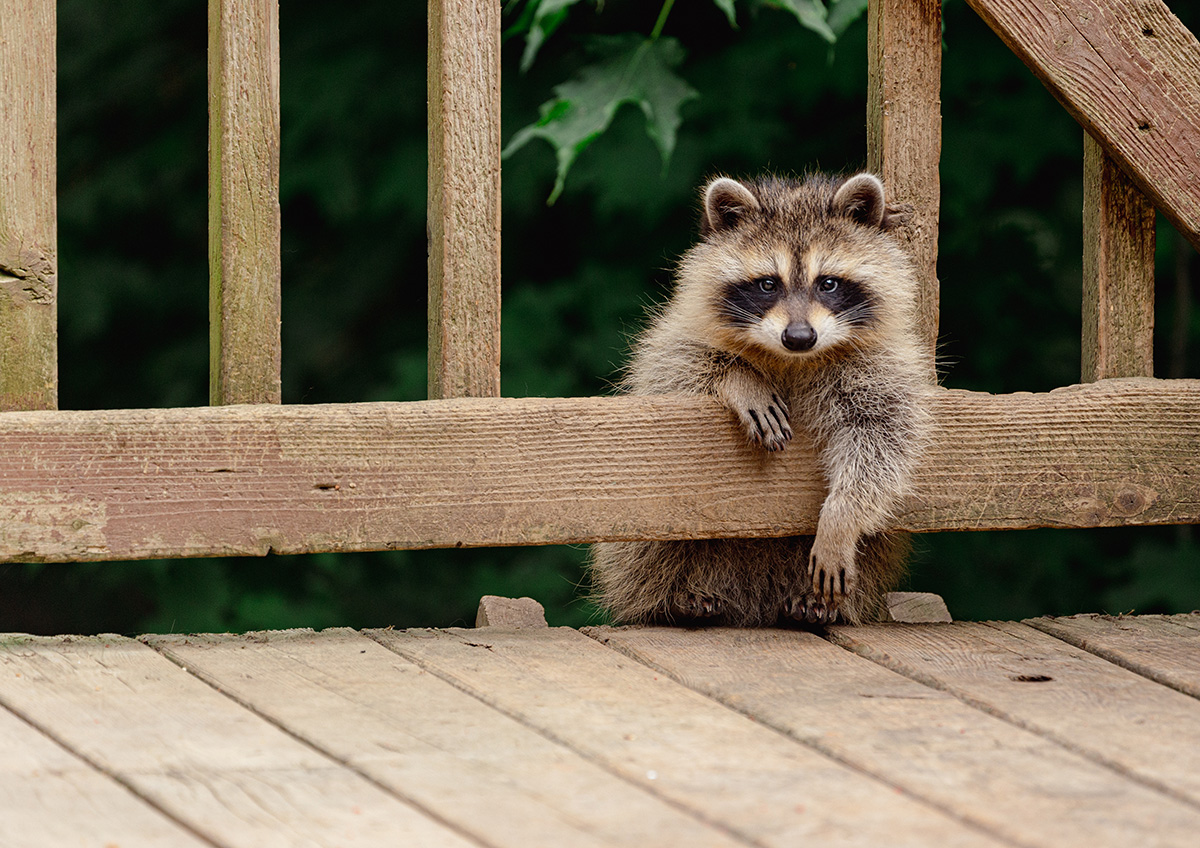
PHOTO: Baby raccoon climbing over wooden railing onto deck. (Adobe Stock │ #623433771 – Anne)