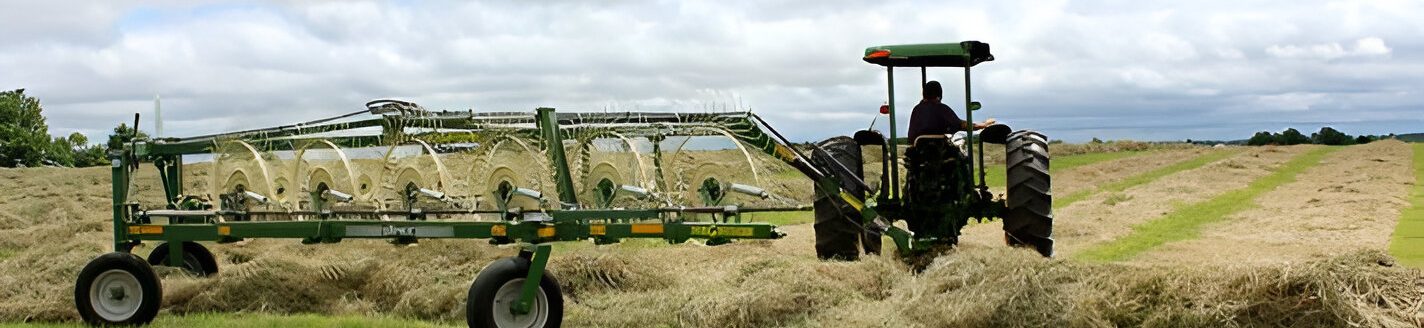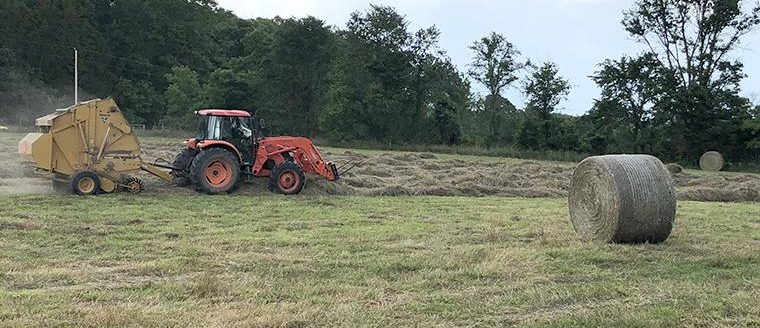
Haymaking is a game of threes, says University of Missouri Extension state forage specialist Carson Roberts.
To be profitable, producers must manage three key factors: equipment expenses, quality and yield.
Haymaking grew in popularity in the 1970s with the introduction of the large round baler. Large bales improved efficiency and reduced the labor required to handle and store small square bales. But just because producers can make more hay, it doesn’t mean they should, he says.
Skyrocketing equipment costs are forcing producers to take a harder look at haymaking economics. Machinery prices have far outpaced calf sale prices. Since the 1970s, the cost of a baler has increased tenfold, while calf prices have only increased a little more than fivefold.
A producer must have an understanding of this inflation issue and how to better leverage equipment in order to have a profitable haying enterprise.
To manage this, a producer has a several options: 1. Reduce equipment to match the acreage; 2. Spread equipment costs across higher yields; 3. Spread equipment costs across more acres. No. 2 has the greatest potential at increasing profitability, if the cost of increasing yield isn’t too high.
Fifty years ago, a 500-pound calf sold for about $71 per hundredweight, and a new round baler cost roughly $5,000, enough to support 14 calves per baler. Today, producers average 29 calves and a baler that costs around $58,000.
The typical cow-calf producer in Missouri manages 45 to 60 cows and makes hay on about 75 acres. In high-yield years, producers may spend around $60 per bale. In low-yield years, that cost can climb to $120 per bale due to fixed costs and overheads.
While haymaking is steeped in tradition and gives producers a sense of control over feed inventory, it is an expensive enterprise. Roberts encourages producers to consider the economics of selling equipment and transitioning hayfields into grazing opportunities.
Producer attitudes have also shifted over the past five decades. In the past, many producers focused on making as much hay as possible, regardless of quality.
“This is not always the best strategy,” Roberts says.
Early first cuttings contain fewer coarse stems and mature seedheads. They are typically leafier and more digestible, with significantly higher protein content than later cuttings.
For producers who continue to make hay, Roberts suggests improving profitability by managing in-field traffic. Feeding hay back onto hayfields when the ground is frozen allows nutrients to return to the soil. He also recommends rotating fields through a graze-graze-hay system.
Ultimately, haymaking requires careful management of machinery costs to remain profitable. Roberts urges producers to sell excess or unused equipment and match machinery size to acreage.
Moving away from haymaking can be uncomfortable, he says, especially for those who value the tradition and sense of control it provides. However, purchasing hay can also offer control over the quality fed to the herd.
“You can control the quality of the hay you purchase,” Roberts says. “But you cannot always control the quality of the hay you make.”
PHOTO: Beautiful summer sunrise over fields with hay bales. (Adobe Stock │ #451660073 – Piotr Krzeslak)