CattleFax Outlook signals cattle cycle turning as strong demand meets tight supplies in 2026
The popular CattleFax Outlook Seminar, held as part of CattleCon 2026 in Nashville, Tennessee, shared expert market and weather analysis Feb. 5.
“The U.S. cattle and beef industry enters 2026 with strong but volatile market conditions, as historically tight cattle supplies, record-setting beef demand, and elevated policy and weather uncertainty continue to support prices, even as markets appear to near cyclical highs. Tight inventories and exceptional demand remain the dominant forces shaping the market; however, producer demographics, high input costs, and policy uncertainty point to a slow and measured expansion phase,” said Mike Murphy, CattleFax chief operating officer in a news release.
Weather outlook: Transition brings risk
La Niña continues to weaken and is expected to dissipate by March, with a transitional phase most likely through spring and early summer. “We’re watching a classic transition year unfold,” said Matt Makens atmospheric scientist. “Even as the ocean changes, the atmosphere typically takes four to eight weeks to respond, so weather impacts will lag.”
In the near term, drought risks remain elevated across the southern U.S. and central Plains, with a 70% chance of intensification, especially south of I-70 and west of I-35. Spring’s neutral setup may help moisture distribute more evenly, though lingering La Niña effects could still limit precipitation west of I-35.
Summer outcomes hinge on how quickly a potential El Niño develops. A fast forming El Niño could deepen drought in corn growing regions while increasing precipitation in the West, whereas slower development may support more balanced moisture. By fall, El Niño becomes increasingly likely, though global climate factors could still alter its typical impacts. “El Niño isn’t a guarantee of rain for everyone,” Makens said. “Other global patterns can amplify or mute its influence, so close monitoring remains essential.”
Economic, energy, and feed grain outlook
Shifting the discussion to an outlook on the economy, energy and feed grains, Troy Bockelmann, CattleFax director of protein and grain analysis, noted that inflation continued to moderate in 2025, ending the year at 2.7% CPI growth and spending most of the year below 3%, the lowest since 2020-2021. With inflation relatively low, the U.S. Federal Reserve lowered interest rates in 2025, finishing the year with the Prime Rate just below 7%, which is still relatively high relative to the 3% level seen from 2009 to 2021.
“After several years of navigating economic turbulence, the U.S. is finally entering 2026 with a macro-economic foundation that feels steady and more predictable,” said Bockelmann. “Moderating inflation, improving monetary policy, and strong consumer spending are reinforcing the sense of stability across the industries we serve.”
U.S. corn production reached a record 186.5 bu/acre in 2025, driving total output to 17 billion bushels from 98.8 million planted acres. Competitive prices and ample supply are expected to boost exports in 2026. With a 13.6% stocks‑to‑use ratio, corn prices should stay in the $4 to $5/bushel range.
CattleFax shared that U.S. hay production increased slightly in 2025 to about 123 million tons. Hay prices are expected to average around $145/ton in 2026. On the energy front, Bockelmann said that energy supply should remain adequate, keeping prices low and rangebound for diesel, natural gas and oil. When taking a look at competing proteins, pork and poultry markets are expected to see modest growth in 2026.
Cattle markets: Strong fundamentals, shifting dynamics
Kevin Good, vice president of market analysis at CattleFax, reported the U.S. beef cow herd decreased 280,000, while dairy cow inventories increased by 190,000 head.
Cattle availability will remain constrained in the first half of 2026 due to limited feeder cattle supplies. Fed slaughter is projected to decline by 600,000 head, primarily early in the year, and non-fed slaughter is expected to remain historically tight at 5.6 million head. Total commercial beef production is projected to decline again in 2026, albeit at a slower pace than in 2025. With imports up 5% and exports down 5%, U.S. per-capita beef supplies are forecast 0.2 lbs. larger in 2026 to 59.2 lbs., the largest since 2010.
Retail beef demand remained historically strong in 2025, with record retail prices supported by steady consumption and exceptional product quality. Consumer preferences continue to favor high-protein, nutrient-dense foods, reinforcing demand even as higher prices move through the supply chain.
“With 84% of fed cattle grading Choice or higher and 12% grading Prime, the industry is well positioned to sustain premium pricing,” Good noted. “Beef demand continues to be anchored by exceptional quality and strong consumer confidence in beef as a premium protein. Even as markets adjust and trade flows shift, the fundamentals supporting long-term beef demand remain solid.”
Price outlook for 2026
Cattle and beef prices are forecast to average steady to higher in 2026, with risk increasing later in the year as markets anticipate larger supplies in 2027.
Cow-calf producers are expected to retain the strongest leverage as the cycle turns, supporting continued profitability for several more years. CattleFax forecast the average 2026 fed steer price at $224/cwt., steady from 2025. All cattle classes are expected to trade higher, with 800-lb. steer prices expected to average $335/cwt., and 550-lb. steer prices averaging $440/cwt. Utility cows are expected to average $155/cwt., with bred cows at an average of $4,000/cwt.
2025 USDA All-Fresh Retail Beef prices are expected to average $9.25/pound, however, the continued increase in retail prices has CattleFax predicting consumer resistance to further price increases, even as demand is supported by a strong economy, beef quality and dietary focus on protein.
“As we look ahead, several factors will shape the trajectory of the beef industry. The potential threat of New World screwworm and the status of Mexican feeder cattle imports is something we’re watching closely,” Murphy said. “At the same time, shifts in packing capacity are rebalancing market leverage. Finally, the dairy industry will continue to be a growth industry supplying more cattle to the beef industry, following strong financial performance in 2025.”
Despite near-term volatility, the long-term outlook remains positive. Strong domestic demand, improving beef quality, and sufficient packing capacity are expected to continue supporting profitability for the cow-calf sector as the industry moves into the next phase of the cattle cycle.
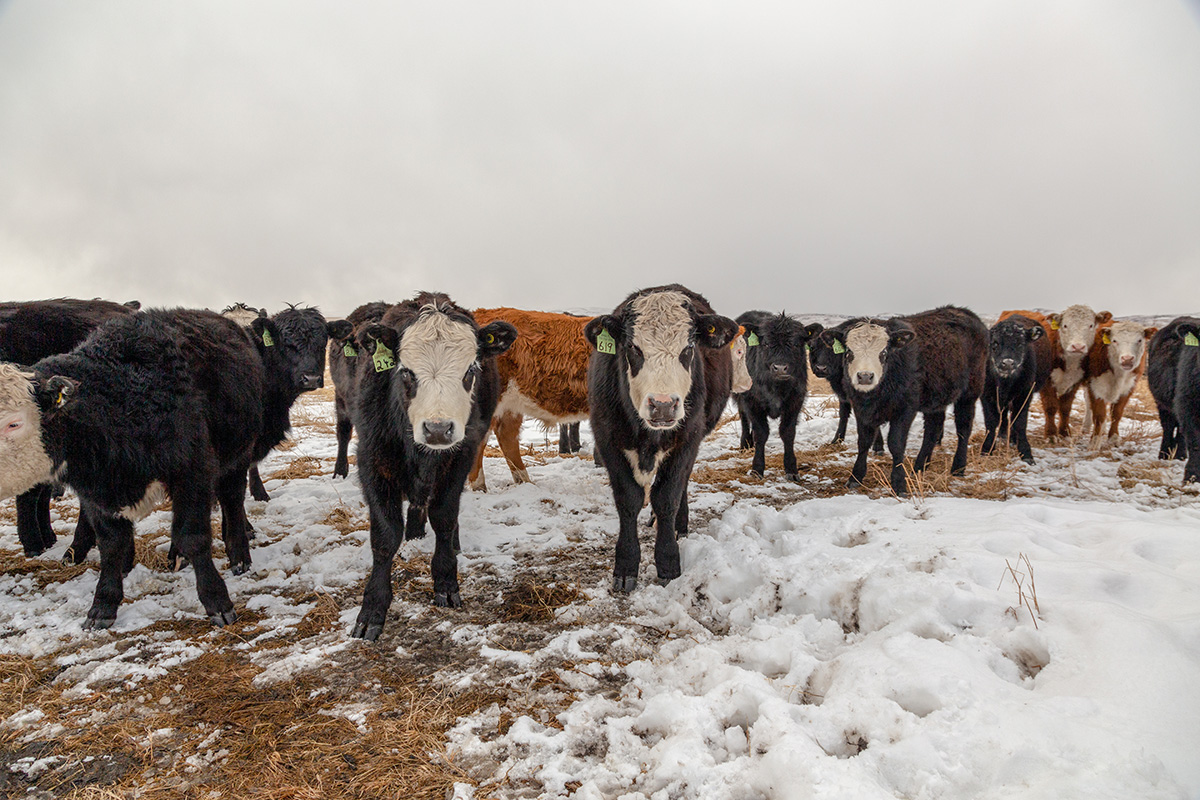
PHOTO: Hereford cattle in a field with snow. (Adobe Stock │ #229786694 – Diane)