Proper late winter and spring grain storage is critical
As outdoor temperatures warm during late winter, spring, and early summer, the potential for grain storage problems increases, along with the need for grain monitoring and management.
Temperature fluctuations are common in spring
During a typical day, the outdoor air temperature may fluctuate by 25 to 30 degrees. This warms the bin and the grain next to the wall during the day, but during the night, the bin and the grain next to the wall are cooled. The result is that the bin and grain near the bin wall will be near the average temperature.
The same will occur during an extended warm period, followed by a cool or cold period. The grain temperature will be near the average of the two periods.
Grain is an insulator, so grain temperature fluctuations are limited to the grain adjacent to the bin wall. Dry grain that has been cooled to 20 to 30 degrees in northern regions and 30 to 40 degrees in central states is not expected to be affected by these temperature fluctuations.
The stored grain temperature increases in parts of a bin in the spring due to solar heat gain on the bin.
Solar energy produces more than twice as much heat gain on the south wall of a bin in the spring as it does during the summer. This, in addition to the solar heat gain on a bin roof, can create an environment conducive to grain spoilage. A ten-degree increase in temperature reduces the allowable storage time of grain by about one-half. For example, the storage time of corn at 17% moisture is reduced from about 130 days at 50 degrees Fahrenheit to about 75 days at 60 degrees and only 45 days at 70 degrees.
Aeration fans can help lower grain temperature
If the stored grain is dry, periodically run aeration fans during spring to keep the grain below 40 degrees as long as possible through spring and early summer.
In northern states, night air temperatures are normally near or below 30 degrees in April and 40 degrees in May.
In the central states, average temperatures are about 10 degrees warmer, but cool nighttime temperatures persist through April and early May.
Bin vents can become blocked with frost and ice when the fan is operated at temperatures near or below freezing, potentially causing roof damage. Leave the fill and access door open as a pressure relief valve when operating the fan at temperatures near or below freezing.
Cover the fan when it is not operating to prevent warm air from blowing into the bin or being drawn into the bin due to a chimney effect, which will heat the stored grain to temperatures more prone to spoilage and insect infestations.
Ventilate the top of the bin to remove the solar heat gain that warms the grain. Provide air inlets near the eaves and exhausts near the peak so the top of the bin can ventilate due to warm air rising, similar to what occurs in an attic, or use a roof exhaust fan to provide the ventilation.
Monitor grain moisture and temperature
Stored grain should be monitored closely to detect any storage problems early. Grain temperature should be checked every two weeks during the spring and summer. A temperature increase may indicate a storage problem.
Grain should also be examined for insect infestations.
Check the moisture content of stored grain to determine if it needs to be dried. Remember to verify that the moisture content measured by the meter has been adjusted for grain temperature. In addition, remember that moisture measurements of grain at temperatures below about 40 degrees may not be accurate. Verify the measurement’s accuracy by warming the grain sample to room temperature in a sealed plastic bag before measuring the moisture content.
Some in-bin cables estimate grain moisture content by measuring temperature and relative humidity, then calculating it using grain equilibrium moisture content equations. The measured moisture may differ by 1.0 to 1.5 percentage points from the true moisture content, so it is a tool that should be verified against another moisture content measurement method.
Corn needs to be dried to 13% to 14% moisture for summer storage to prevent spoilage. Soybeans should be dried to 11% to 12%, wheat to 13%, barley to 12%, and oil sunflowers to 7% to 8%. The allowable storage time for 13% moisture soybeans is less than 100 days at 70 degrees.
Grain stored in grain bags
Grain storage molds will grow, and grain spoilage will occur in grain bags unless the grain is dry. Grain in the bags will deteriorate rapidly at average outdoor temperatures unless it is at the recommended summer storage moisture content.
Grain bags that run east-west will have solar heating on the south side, which creates a temperature variation across the bag that will move moisture to the north side of the bag. Continue to frequently monitor grain stored in bags.
Work safely
Everyone needs to be aware of the safety hazards associated with handling grain and to apply the recommended safety practices.
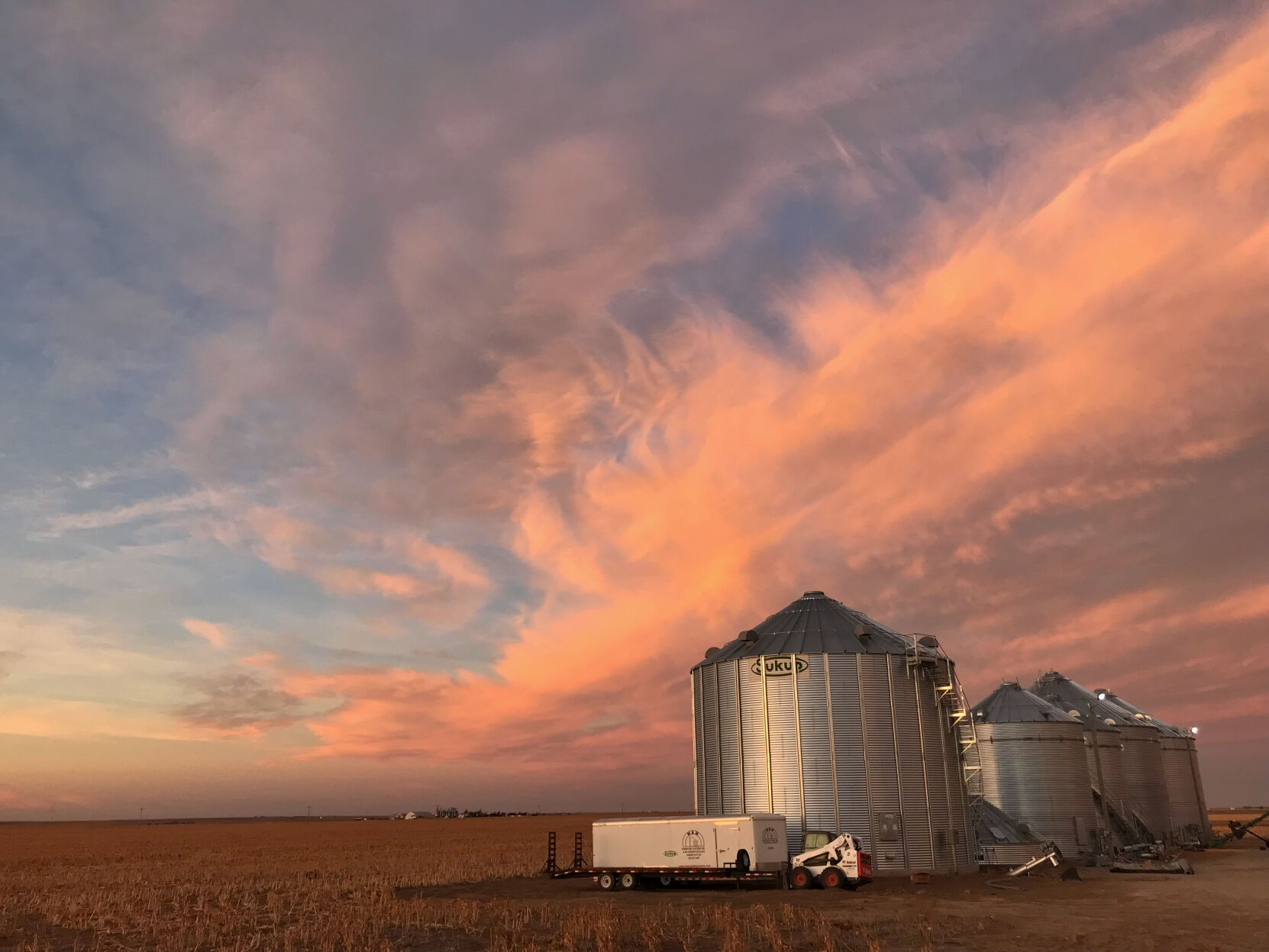
PHOTO: Grain bins (Photo: Rachel Regier, Ashland, KS)