State-By-State Hay Summary
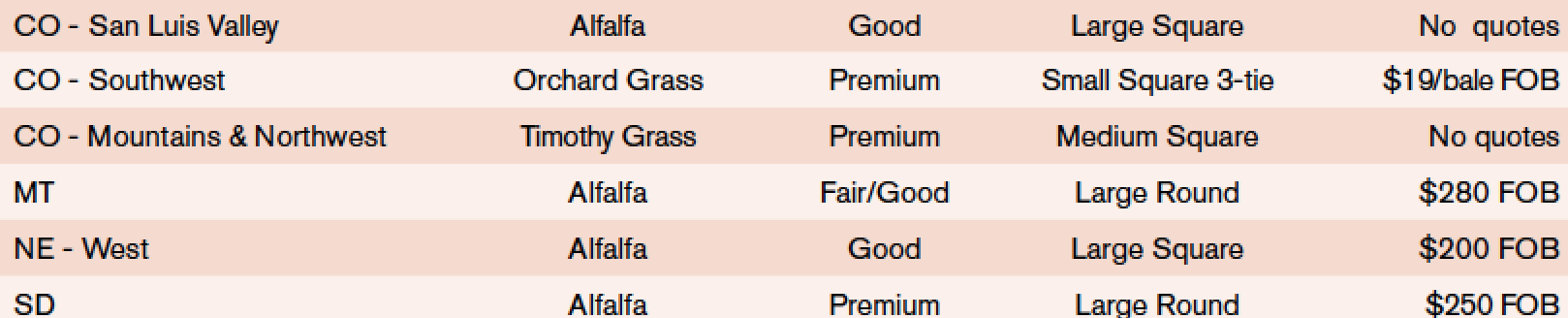
Colorado—In the Dec. 2 report, compared to last week, trade activity light on good demand for horse hay. Horse hay sold steady this period. Trade inactive on all other hay markets. According to the NASS Colorado Crop Progress report for the week ending Nov. 28, stored feed supplies are 7 percent very short, 25 percent short, 64 percent adequate, and 4 percent surplus. According to the U.S. Drought Monitor’s High Plains Summary for Nov. 30, little to no precipitation fell across the High Plains region this week. In Colorado, drying soils, high evapotranspiration, low mountain snowpack, and mounting precipitation deficits resulted in expansion of moderate to extreme drought in many parts of the state. The next available report will be Dec. 9.
Missouri—In the Dec. 2 report, compared to last report, even though it doesn’t much feel like it feeding season is nearing as of current producers seem to be in pretty good shape both for hay supplies and stock water. The supply of hay is moderate and demand is light to moderate and prices mostly steady. Meteorological winter arrived this week but no one could tell from the level of mercury in the thermometer. Several areas in the state set record highs a couple of days this week. The above average weather allowed for the wrap of up grain harvest for all intensive purposes just as the final crop progress and condition report for the year was released.
Nebraska—In the Dec. 2 report, compared to two weeks ago, comparable trades of baled hay prices in central, eastern and western Nebraska sold steady to weak. Ground and delivered hay remained steady. Demand throughout the state was moderate to good. Cornstalk baling and sales continue steadily, in efforts to stretch alfalfa and other feed forages. Per NASS the winter wheat condition is rated at 64% good or better.
Oklahoma—In the Dec. 2 report, compared to the last report Nov. 12, hay continues to be steady for much of the state with good demand, while movement is beginning to raise more. Feed cost are still high, which causes hay to remain the main feed resource for the producer. We continue to be in dry condition in most of the state according to the Mesonet. Next report will be released Dec. 17.
Texas—In the Nov. 26 report, compared to the last report, hay prices are steady in all regions. Trading activity and demand were moderate. Dry conditions have persisted in the Panhandle, west, and central regions. Excessive moisture continues in the south, which has further plagued producers that are trying to get a final cutting out of the fields. Yields in the south have been reduced this year due to limited cuttings because of heavy rains throughout the summer. Additionally, the cuttings that they have gotten out have had reduced quality due to the maturity of the crops. Dry land winter wheat is in poor condition across much of the Panhandle and west due to limited moisture during the planting and growing season. Drought conditions have expanded in those areas according to the US Drought Monitor. Next report will be released Dec. 10.
New Mexico—The hay growing season is over. Last report for the season was issued Nov. 5. Reports will resume in April 2022.
South Dakota—In the Dec. 3 report, compared to two weeks ago, all classes of hay firm. Very good demand for high feed value testing alfalfa hay, good demand for all other qualities. Very mild weather for this time of year, record setting daytime highs in the 60s and even low 70s. These warm temps help to reduce the need for supplemental feed for beef cattle. Drought conditions remain very high in the western part of the state as moisture remains elusive.
Wyoming—In the Dec. 2 report, compared to two weeks ago, baled hay and pellet prices in the east remained steady, though baled hay in the west sold steady to $5 higher on a light test. Trade was light to moderate and demand was moderate to good.
Montana—In the Dec. 3 report, compared to two weeks ago, hay sold fully steady. Demand for hay remains very good, however sales are very light. Very few producers have hay left to sale. Most ranchers have purchased the hay they need for winter needs and an open very mild winter has helped curb feeding needs. Producers and traders buying hay out of Canada report that supplies have started to tighten. Buyers are searching for hay further away from the state in order to find supplies. The drought continues to worsen as dry conditions continue. According to the drought monitor 100% of the state is in moderate drought or worse; 92.82% of the state is in an severe drought or worse. 66.82% of the state is in extreme drought or worse. 33.10% of the state is in an exceptional drought.