Oklahoma State secures $250 million endowment for new veterinary hospital
Oklahoma State University’s College of Veterinary Medicine has received a $250 million state investment to build a new veterinary teaching hospital. The state appropriation is the largest in university history and paired with the $78 million previously obtained in 2023 for the project, a state-of-the-art facility will soon be under construction in Stillwater, Oklahoma.
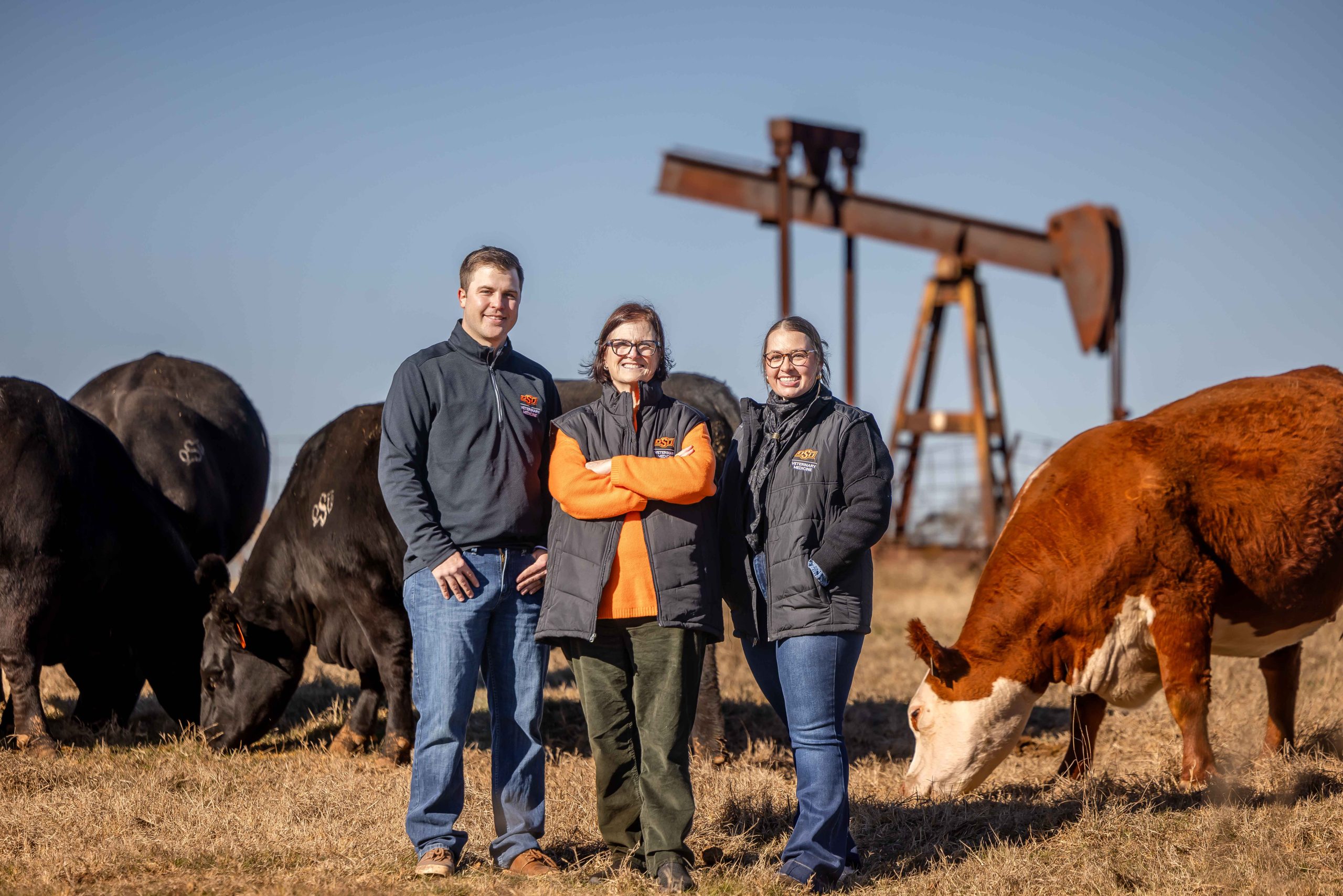
Photo Caption: CVM students stand alongside CVM alumnus Lee Denny. (Photo by Ellie Piper.)
The current 145,376-square-foot teaching hospital is more than 40 years old. The facilities are antiquated and space is limited.
“At the time it was built, it was intended to have a maximum of around 60 students being taught in their clinical year here,” said Kelly Black, DVM, director at OSU’s Boren Veterinary Medical Teaching Hospital. “Class sizes have expanded, and we now have around 106 OSU students as well as up to 45 students from other schools that are taking part or all of their clinical requirements through us each year.”
The American Veterinary Medical Association even placed OSU on probationary accreditation in fall 2024. It was restored to full accreditation status in spring 2025, with the understanding that facilities would be upgraded by the next site visit.
“We need to have the equipment and the space to teach students in a very effective way where they can retain hands-on, clinical skills,” said Rosslyn Biggs, beef cattle Extension specialist and director of continuing education at the OSU College of Veterinary Medicine. “This is not just a set of pens and a barn. This is elite-level care with a practical focus of instruction, so we have students that are ready to roll the day after graduation, and right now that’s becoming more challenging to deliver.”
Black said the original hospital was designed before veterinary medicine had sub-specialties, such as cardiology, dermatology, neurology, and oncology.
“Those were all under the internal medicine umbrella for veterinary medicine at that time, but these are each their own subspecialty now, and need their own space,” he said.
There are also contagious disease concerns with the current teaching hospital configuration. Black said the production animal area was not designed with any quarantine area for contagious patients.
“If we have something that is potentially contagious to other animals, we have to isolate them with less-than-ideal facilities,” he said. “This can lead to biosecurity concerns for our students and other patients in the hospital and is difficult to manage with our current set-up.”
Repairs and old equipment
However, it is not just a lack of space for the students. The current hospital also has infrastructure challenges, such as electrical, plumbing, heating and air conditioning systems that are difficult to repair and maintain because of the age of the facility.
“For instance, the ceilings are metal tiles,” Biggs said. “Those ceilings are rusting because we’re cleaning and disinfecting a lot of times, especially in large animal part. You can’t replace them because they don’t make them anymore. With the number of people and services we offer in the building, it’s just not in a situation where it can be rehabbed in an effective way to meet the needs of our students, faculty and staff, and most importantly, our animal owners.”
Black said sewage pipes are cast iron and constantly break and leak through the ceilings in the basement. Additionally, the barns do not have adequate climate control systems in them, which makes for hot summer months in the hospital.
“We have to bring in extra fans and evaporative coolers to help maintain the inside temperatures,” he explained.
Some of the equipment original to the current teaching hospital, specifically the surgery lighting, was not new when the facility was built in the 1980s, according to Black and Biggs.
“If you look closely at them, you will find they have small Veterans Administration inventory tags on them,” Black explained. “This means that when they were placed in the building 40 years ago, these were removed from a VA hospital somewhere that they had already probably been in use for 20 to 30 years before we got them. While we understand that students should be able to improvise when they need to, I think the public generally expects our students to be practicing medicine with current techniques and learning on equipment that isn’t 60 years old.
Biggs said staff and faculty have done an exceptional job of managing these situations without up-to-date facilities, but she sees a new level of education that can be provided for students.
“A new teaching hospital will match the product that we’re turning out,” she said. “It’s reflective of the great students, faculty and staff here. We put out great research and provide great service to the state and to animal owners, but our facilities haven’t always reflected that.”
Black agreed, also pointing out that a new facility would help show students how to design their facilities after they graduate to provide a functional veterinary clinic.
Upgrades in the new hospital
According to an OSU press release, the new hospital is expected to be 255,000 square feet and will support 150 students. The new hospital will feature cutting-edge equipment for both small and large animal care, such as CT, MRI, radiography and ultrasound imaging tools, a linear accelerator for oncology treatments and an aqua cow float tank.
“This will expose our students to cutting edge medicine and allow them to see these tools in action, instead of just learning about them in classes,” Black said.
Other features currently not available at the teaching hospital are planned for the new facility. Black said advanced beef cattle handling pens are a must, including calf working pens and a chute. He said not having this specialized equipment for calves makes it difficult to teach students and and is different from what they are likely to see when they start practicing.
“We need more areas that can safely hold bulls, and pens and chutes that allow us to move cattle with longhorns through easier,” he said. “We see animals of many varieties, and although most private practices don’t see camels on a regular basis, we have seen a few over the last couple of years. We need facilities that meet their needs also.”
There are 33 accredited veterinary medicine college in the United States, and both Black and Biggs believe improving OSU’s facilities to meet their standard of education will attract more students, staff and patients to elevate the entire program.
“We are competing with veterinary schools all over the country that have already upgraded their facilities,” Black said. “We will be able to expand our specialty services, diagnostic and treatment options. All of these will benefit everyone involved, and veterinary medicine for the state as a whole.”
Black said it is reasonable to expect that OSU’s vet school could increase the number of students they can accept into the veterinary curriculum with the new facility.
“I think we’re turning out great veterinarians, but we can always do better,” Biggs said. “We can always provide more opportunity, more experience for them, and we’re definitely committed to that.”
Although the funds are now available, final plans and a construction timeline are not. Black said they are still in the planning phase, but have already contracted the architects and construction company that will complete the project.
“There’re no plans to delay here,” Biggs said. “It’s long overdue and we’re committed and ready to go.”
Additionally, Biggs said the old teaching hospital will not be demolished, and they plan to continue utilizing it after the new hospital is erected.
Biggs recognized the significance of this historic appropriation being directed toward veterinary medicine. She said it is big statement for the legislature in Oklahoma to make and says much about the values held in the state. Black agreed.
“I would like to personally thank the legislature and all of those that advocated for us to receive this appropriation,” Black said. “We are an agricultural state that depends on our livestock to keep our economy healthy. This appropriation will help us to produce more veterinarians to support Oklahoma’s agriculture sector and maintain our production animal resources across the state for many years to come. We want to increase the number of rural veterinarians as well, and we believe this is one step in helping make this a reality to help support our rural communities and producers.”
Lacey Vilhauer can be reached at 620-227-1871 or [email protected].