Redmond takes a look at wildfire risk for High Plains
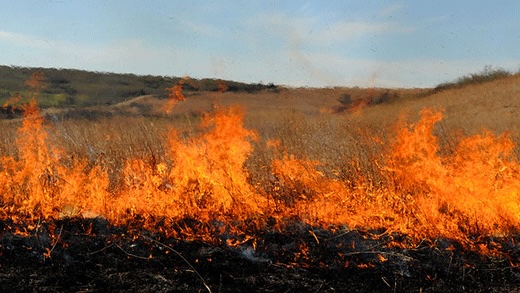
For Chip Redmond, fire behavior and fire conditions that lead to large fires are an interesting phenomenon.
Redmond is an assistant meteorologist at Kansas State University and the K-State Weather Data Library/Mesonet manager. He spoke recently during the National Integrated Drought Information System Summer 2025 Drought and Fire Outlook webinar.
“We really focus on topography, a lot,” he said. “This weather and fuel that drives fire across the Plains. We need the fuel to be in the right stage, and that’s all dependent on what the preceding weather has been.”
Conditions must be nearly perfect for the fire to work properly and go across the landscape. When the forages started greening up, it progressed rapidly much of the central Plains, Redmond said, but it did slow some because of cooler temperatures in places like Oklahoma.
“But then we had that warm period in early May. That really moved things along,” he said. “And because of that, we started having grass growth earlier than normal.”
That early growth gave the cool season grasses more opportunity to get more established and gain height. But it comes with a caveat.
“We’re really concerned about that fuel loading of grass. Those conditions are warmer than normal through the March through May period helped advance that green up,” he said. “But precipitation was void, so it slowed it down over Nebraska and northern Kansas. But areas where we saw precipitation anomalies in the positive, those are the areas we saw more advanced grass growth in, earlier than normal grass growth.”
But growth slowed down in May for parts of Kansas, southern Nebraska, Oklahoma, and northern Texas.
“We’ve had cooler than normal weather combined with precipitation and overcast skies, and we’re actually not getting the growing degree units we need to help continue that grass growth,” Redmond said. “Granted its good because we’re keeping the soil moisture around. We’re improving drought, and that’s all good, but we’re just not quite getting the grass growth because we need heat to help get that grass going.”
Soil moisture levels improved
How much the grass is going to grow during the season is obviously dependent upon the soil moisture levels, and right now Redmond is seeing improvements across the High Plains.
“But when we warm up or start getting that summer heat across the Plains, this vegetation is going to grow very quickly, and I think as a result, those areas where we have above normal soil moisture right now are going to be areas of focus for above normal fuel loading, or grass loading, that are the primary fire carrier across the central Plains,” he said.
There’s a couple of anomalies, he said, in areas like the Black Hills and other forested areas, but grass is a big wildfire carrier, especially in pasture lands.
“So unfortunately, it looks like we are going to face above normal grass loading,” he said. That’s going to help sustain if we do dry that grass out; it’s going to help sustain fire and help it get more established. We need to look at those weather conditions, and we need to see what’s going to happen.”
Across the region, Redmond doesn’t see many “really dry” areas, but northern/northeast Montana, northwest North Dakota have a couple regions that are drier than normal. He said to look at the energy release component—a component of how hot the fire is when it moves across the landscape.
“The higher it is, the more volatile fuels are, the more they can carry fire,” he said.
In early June there was a “pretty substantial decrease” in the energy release component in the region. But indicators point to an increase as temperatures are expected to rise, and it’ll be drier.
Summer outlook
There’s a lot of fire season to go, and some areas are going to need timely moisture and more moisture to help offset fire weather conditions going into the second half of the year.
Summer months are when Redmond starts seeing fires bleed into September.
“We enter this time of the year, things change, and we can really cure out fuels much quicker than we can in the spring,” he said. “We get that precipitation, or in the winter, they’re already cured out, and dormant. So, things can change really rapidly with just a couple of weeks of hot, dry conditions across the Plains. And that’s why we see fire occurrences increase as a result.”
Redmond said there are some critical fire weather patterns that typically result in high pressure across the West. There are two more that impact the Plains.
“One is the high-pressure breakdown. When that ridge starts to get low-pressure systems that slam into it from the west and start to break that down, that allows for stronger wind events and more lightning events,” he said. “Then the other critical fire weather pattern is dry lightning.”
When there is monsoonal moisture in the high pressure “spinning around those areas” where there are thunderstorms repeatedly, that’s typically over the highest terrain.
“Once those storms start to move off to the east, they don’t have as much moisture with them,” Redmond said. They also tend to have more wind and dry lightning develops and that starts fires.
When he looks at the instability, he looks at energy sources that can fuel thunderstorms.
“Moisture in the mid-levels and cooler weather in the mid-levels can help fuel those thunderstorms,” he said.
There are a couple of limitations. Redmond said it only takes about a week or two of warmer than normal temperatures and below normal precipitation.
Redmond believes the potential for fire increases as you get toward the end of June and into July for some areas. If the active pattern continues and precipitation sticks around, it might cause more challenges down the road.
“Going into August, though, we start to see those northern Rockies region above normal fire concerns bleed out into the Plains,” Redmond said. “I think that high pressure building in and from you get lightning with those conditions, we’re just going to get a lot more fire starts and a lot more opportunities for large fires.”
It could likely persist into September for some areas, depending on the tropical patterns and systems.
“If we can get moisture up in the north into the western monsoon ridge, and where that goes from there would be hard to dictate this far,” he said.
To finish up his discussion, Redmond said if there’s both a negative PDO and a weak spring La Nina, it suggests drier than normal conditions across the Plains. Current soil moisture levels will help grass loading be above normal. Coupled with the monsoonal pattern, it could be a problem.
“We’re likely to see more fire ignitions and less wetting rains, unfortunately, and that’s resulted in above normal, significant fire potential for the Northern Plains,” he said. “I didn’t talk about wind a whole lot. Wind is a tricky beast. We need to have the right pattern, right set up subtle changes to make big differences in wind across this region.”
The storm activity that we’ll likely see across the Northern Plains and some of the outflow winds are going to be a big driver of fire behavior.
“Which is not abnormal for that neck of the woods and thunderstorms daily can become big problems,” he said. “If we have outflows from them from different directions each day, it just becomes hard to put a fire out.”
Kylene Scott can be reached at 620-227-1804 or [email protected].