Domestic drone maker ramping up to meet long-term demand

Arthur Erickson is not too worried about the changes recently made to the Broadband Equity, Access and Deployment Act. States and other eligible entities worry that the changes might pause funding for the federally funded broadband deployment under the BEAD Act for another year or more.
The Trump administration—through the National Telecommunications and Information Administration, which administers broadband grant programs—has had states re-start the bidding process for internet service providers to apply for BEAD grants and given them just 90 days to do it.
Erickson is the CEO and founder of domestic drone-maker Hylio, which recently moved into a larger building in Houston, Texas. “We started out operating our drones in Central America, in areas where the broadband access was much spottier than it is here, and we designed our systems to operate off-grid, with only periodic connections necessary for updates.”
He adds, “There are features and functionality we would like to add if and when broadband connectivity improves” in rural regions, and that may come down the road. Right now there is plenty of demand for Hylio’s drones, which the company is turning out from its new 40,000-square-foot facility in Houston. The company has a combined 50,000 square feet of production area. “We’re turning out 1,000 a year, and could easily do 2,000 a year,” Erickson said. “We hope to ramp up to 5,000 a year.”
“The traditional ag equipment industry is in a holding pattern,” he said. This creates an opening for drone makers to see their products used in ways that reduce costs for producers. “Demand for Hylio’s products is accelerating; we had record sales this year and see no sign of that slowing down yet. Demand for traditional farm equipment has dropped, which conversely has created higher demand for precision ag tools like Hylio’s spray drones.”
Precision spraying by drones at the right times can reduce the usage of more expensive high-end ground sprayers and boost operating margins, Erickson said.
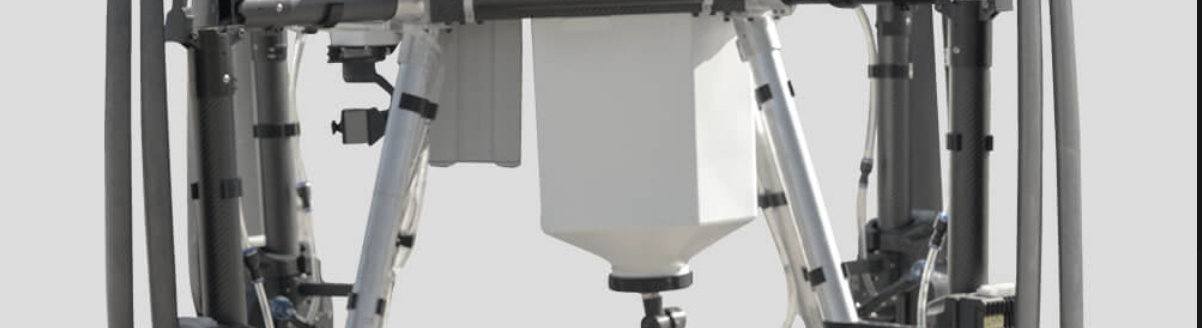
Hylio is developing products that will fulfill or surpass the capabilities of the most popular drones in use by Chinese drone-maker DJI, including a sprayer drone with a 30-gallon tank, which exceeds the payload of the biggest DJI drone by about 10 gallons. Another product under development is the Photon, a camera drone designed for agronomic scouting that might also be used by first responders.
DJI currently dominates the commercial drone market in both the United States and globally. But DJI’s drones—popular with farmers and first responders alike—will be “sunsetted” in the U.S, over the next couple of years by various rules and restrictions put in place by federal agencies due to security concerns. A key one by the Commerce Department will eventually shut out Chinese-built drones like DJI’s from accessing the spectrum. That timetable gives U.S. users of DJI drones, including farmers, time to pivot to other domestic suppliers.
But Erickson says his agenda is the domestic needs of America’s farmers and other drone customers, not to match any one competitor. “DJI and Hylio sometimes end up doing similar things in terms of product design because we’re both trying to solve similar problems, but our goal is not and has not been to ‘match’ them. Rather, we just try to make the best tech/products for the job at hand. We have technology that not even DJI has, such as swarm control. We also offer many other hardware and software features that they don’t.”
Erickson said Hylio gets inquiries from defense contractors every week, partly to make known opportunities for grants and loans. The Defense Department’s Office of Strategic Capital is a little-known federal office whose mission is to channel federal investment dollars to companies in areas deemed critical to national security. Hylio has applied for a $10 million subsidized loan. As domestic competition heats up, consumers will see benefits in innovation and price competition.
Hylio currently operates with about 70 employees and hopes to have 300 within a few years.
David Murray can be reached at [email protected].