The more you know about disaster prep can help alleviate losses later on
Farmers and ranchers depend on Mother Nature to help raise their crops, and even with their good intentions of a bin buster, it’s ultimately the weather that wins. Flooding is one of the most common weather hazards people will face, but drought, hail, severe storms, tornadoes, tropical cyclones, wildfire, and winter weather can wreak havoc on crops and livestock.
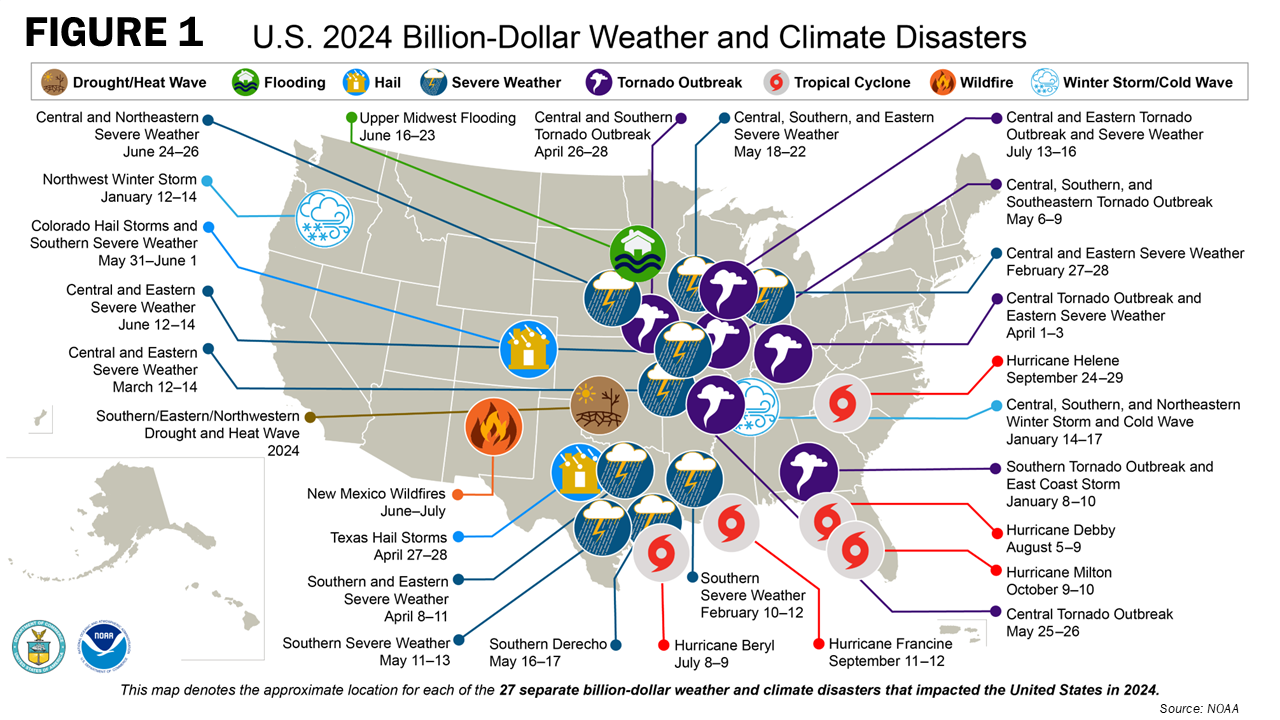
In 2024, an American Farm Bureau Federation analysis showed farmers and ranchers across the United States lost $20.3 billion to weather disasters. For the same year, the National Oceanic and Atmospheric Administration reported 27 weather disasters with $1 billion in damages.
With adjustments for inflation, last year was fourth overall in terms of economic impact. Couple that with the loss of life, and many disasters will haunt affected communities for many years.
Crop and livestock loss numbers
According to AFBF analysts about half of the losses to crops and rangeland were covered by the Risk Management Agency programs. The other 9.4% didn’t fall under policy coverage limits or qualify for existing RMA programs or were just left uninsured.
State losses, according to AFBF for 2024 included:
- Texas suffered the most significant agricultural losses for the third consecutive year, with total incurred damages exceeding $3.4 billion.
- Minnesota ranked second, with $1.45 billion in weather-related crop losses.
- California followed closely behind, with $1.4 billion in crop losses.
- Other notable Midwest states were Indiana at $165.7 million, Illinois’ at $226.4 million and Ohio at $324.5 million.
Corn was the most affected by flooding and excess precipitation in the Upper Midwest, topping $3.85 billion last year. Forage crops were second with $3.8 billion and soybeans reached $3.2 billion in losses.
According to AFBF, record flooding and hurricanes in various parts of the country dominated headlines in 2025.
“When combined with other torrential rain events and severe storms across the country, these causes resulted in $6.7 billion in crop losses. Of this, $4.3 billion (63%) was covered by RMA insurance policies. Corn faced the biggest hit under this category at over $2 billion, followed by soybeans at $1.5 billion,” AFBF noted in a news release.
Despite the widespread impact of flooding and hurricanes, drought and heat-related conditions accounted for the largest share of total crop losses, reaching over $11 billion. Of this amount, $5.3 billion (47%) was covered by RMA insurance policies.
Flooding safety awareness
Devastating floods in Texas during the Independence Day holiday have prompted awareness more now than ever before. The extreme loss of life coupled with damage levels, have been top of mind for many, not only in Texas, but across the U.S.
According to the National Safety Center, floods are some of the most common weather hazards in the U.S., and can happen anywhere at any time of the year. Many times, densely populated areas have a higher risk for flash floods than those in rural areas.
“Flash floods can occur within minutes or hours of a heavy rainfall, and waters can rise as high as 30 feet or more. Even small streams and creeks can flood rapidly and cause damage. Flash floods are usually caused by slow-moving thunderstorms,” according to a NSC news release.
The National Weather Service defines flash floods as short-term events that occur within six hours of a causative event—heavy rain, dam break, levee failure, rapid snowmelt and ice jams— and often within two hours of the start of high-intensity rainfall.
Cars and homes can be moved, trees uprooted and bridges are often destroyed. Residents in low-lying areas are particularly at risk since floods happen with little to no warning. According to the American Red Cross, flash floods are the No. 1 weather-related killer in the U.S.
NWS said almost half of all flash flood fatalities are vehicle related, and the NSC recommends if a person is driving and approaches a water-covered road, turn around. Just 6 inches of water can stall a vehicle, and 2 feet can float most cars, trucks and SUVs.
Here are some other tips to stay high and dry from NSC:
- Know your proximity to rivers, streams and dams
- During heavy rain, avoid underpasses, underground parking garages and basements
- Avoid hiking or camping if thunderstorms are predicted
- Develop an evacuation plan for your family
- Don’t walk in water above your ankles; you can be swept off your feet in as little as 6 inches of rushing water
- Turn off the electricity and other utilities
When making flood preparations, ready.gov suggests knowing your risk for floods. The Federal Emergency Management Agency’s Flood Map Service Center maps are located at www.fema.gov/flood-maps, and allows users to find the type of flood risks in their areas.
According to the ready.gov site, “remember that flooding doesn’t follow lines on a map. Where it can rain it can flood.”
Residents should sign up for a community’s warning systems to get emergency alerts, from the Emergency Alert System and weather alerts from NOAA and NWS. The National Risk Index is an easy-to-use, interactive tool that shows which communities are most at risk to natural hazards like flooding.
If one lives in a flood-prone area, regular homeowner’s insurance policies won’t cover flooding, and a separate flood insurance policy must be purchased for coverage. It typically takes up to 30 days for a policy to go into effect. Flood coverage under the National Flood Insurance Program is available to many homeowners.
When preparing for a flood emergency, make sure the household has a plan, including any pets or livestock, so the family knows what to do, where to go and what is needed to protect from flooding. Agencies suggest residents learning and practicing evacuation routes and to develop an alternate shelter plan and review a flash flood response. Gather supplies, including non-perishable foods, cleaning supplies, and water for several days, in case you must leave immediately or if services are cut off in your area.
Experts advise keeping important documents in a waterproof container, as well as creating password-protected digital copies. Protect your property before you have to leave by moving valuables to higher levels, decluttering drains and gutters, and installing check valves. Also, home dwellers should consider a sump pump with a battery.
Kylene Scott can be reached at 620-227-1804 or [email protected].