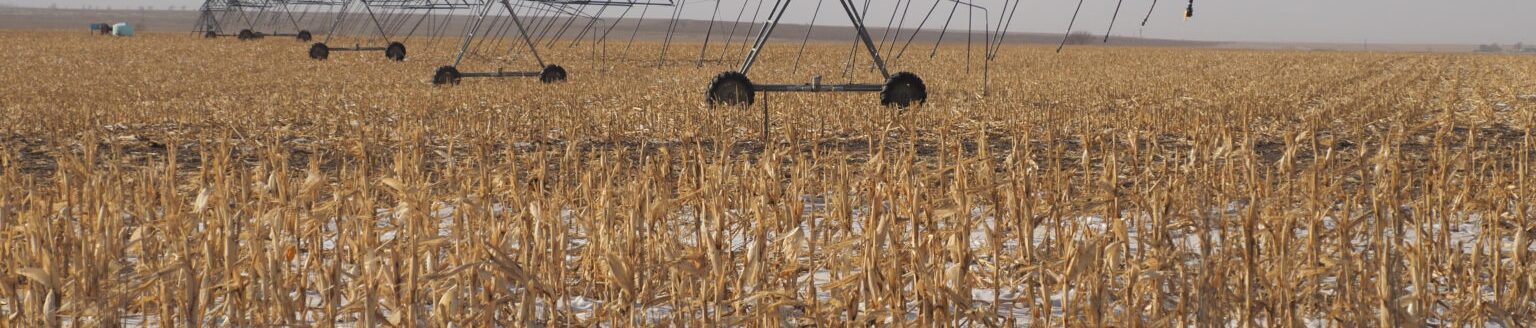
Water is essential for humans, livestock and crops and finding a way to match those needs with a limited resource is the goal of many High Plains experts.
One of those experts is Brownie Wilson, manager of geohydrology support services, with the Kansas Geological Services, speaks of threading of the needle of competing interests.
Agriculture is the No. 1 industry in most High Plains states and that is certainly true of Kansas. Water, both quantity and quality, is essential to growing crops, feeding beef and dairy cattle, and operating the processing centers that help feed Americans, Wilson said. Water is the lifeblood of rural communities and economies.
While each state is unique in how it manages its groundwater resources, they all have to look at long-term in terms of trends and governing policy, Wilson said. The Kansas Geological Survey in February noted an overall average decline of almost a foot across the High Plains aquifer in areas of western and south-central Kansas. The study noted those regions generally had been drier in the past five years.
Over the years Wilson has seen the impact of drought and wet years. When it comes to recharging an aquifer, location is everything, he said. In some areas of western Kansas it can take many years before rain runoff can actually reach the Ogallala Aquifer because of varying soil types and how far down water must travel to reach the aquifer.

If the soil is sandy that can also aid the rate of filtration.
Once below the surface, the downward movement of water can be faster in some areas and slowed or impeded by less permeable material, such as layers of clay in others, Wilson said. In south central Kansas, the water table is close to the land surface and the High Plains aquifer can recharge quickly.
For agriculture, the biggest impact on the drawdown is irrigation of row crops (primarily corn and soybeans) and that’s why rain during the growing season provides welcome relief as wells can be idled.
When water falls on row crops during July, August and into early September that’s when crops benefit the most, agronomists say.
“When we get water from Mother Nature it helps lower the demand from the aquifer and water saved in the ground will be there to be used another day,” Wilson said. “This year I’ve been encouraged with the rain we’ve had in some areas of the state.”
Measuring
In January, crews from the Kansas Geological Survey and Department of Agriculture, Division of Water Resources annually begins the process of checking water depth that can help the state, farmers and water districts with their management plans. Nearly 1,400 wells in western and central Kansas are measured.
Over the past two summers, the Kansas Geological Survey also works with ground water management districts in western Kansas to use a low-flying helicopter towing a large hexagonal frame equipped with scientific equipment designed to map geological structures and groundwater resources to a depth of 1,000 feet below land surface.
Wilson said it is always an attention grabber in operation, and it is why the state will send out press releases in advance.
Management districts
When it comes to farmers and water management districts, Wilson said they are critical to conserving water to ensure economic livelihood. The majority of farmers and ranchers are excellent stewards, and he has seen more changes by many irrigators who are using technology to more precisely apply water. They also look for genetics and crops that require less water.
“I do think the perception (of value) has changed over the years,” Wilson said. “Producers at one time defined success by the largest yields. Now many look at how they can grow with less water.”
The success of Sheridan 6’s Local Enhanced Management Area for an area in western Sheridan and eastern Thomas counties in northwest Kansas, he said, demonstrates how growers with similar interests can work together. Approved in late 2012 by the Kansas Department of Agriculture’s Division of Water Resources, the plan employs flex accounts. During a five-year period they use less water, and if they face a drought they can take out more water.
Growers were given 55 acre-inches for a five-year LEMA period, but were given flexibility, using more water in dry years while saving water in wet years when full irrigation was not needed, according to the state’s water office. They could also see temporary transfers of allocations between water rights anywhere within the Sheridan 6 boundary.
Wilson said irrigators in other water districts have made inquiries about in recent years after they have learned that flexible accounts can help them with their farm’s operation. During a Kansas Livestock Association meeting at the Hy-Plains Feedyard LLC in Montezuma last fall, several irrigators noted the importance of finding ways to conserve water for future generations of farmers and ranchers.
Quality
Quality is another problem Kansans face, and it goes beyond surface water, Wilson said. The most notable problems are with salinity and nitrates.
For communities that depend on groundwater that face those problems, they will look to blend the water, which is not always a pragmatic solution.
But it could also impact irrigators, he said.
Like quantity, it takes a good and proactive management plan to stay ahead of quality problems.
Wilson remains optimistic because technology, whether in application or crop genetics, continues to evolve. At one time irrigation wells were not considered viable when production was at 200 gallons a minute. Today, a farmer can make that well efficient and grow a profitable crop.
“The win-win scenario is finding solutions through the marketplace,” he said. Finding a way to ensure communities have a good supply of quality of water while at the same time farmers have ample water to feed cattle and crops that support that industry, is essential. “We’d like to have it where everyone wins.”
Dave Bergmeier can be reached at 620-227-1822 or [email protected].
Irrigation statistics
There were 212,714 farms with 53.1 million irrigated acres, which included 81 million acre-feet of water applied in the United States, according to the 2023 Irrigation and Water Management Survey results, published in October 2024, by the U.S. Department of Agriculture’s National Agricultural Statistics Service.
In 2018, the irrigation survey results showed that there were 231,474 farms with 55.9 million irrigated acres, which included 83.4 million acre-feet of water. The results show that the number of farms irrigating, the amount of land irrigated, and the total water used for irrigation decreased between 2018 and 2023.
Data highlights from the 2023 Irrigation and Water Management Survey include:
- The total amount of water used in 2023 was 81 million acre-feet, down 2.8% from 2018.
- The average acre-feet applied per acre was 1.5, which was the same as the 2018 irrigation survey. (An acre-foot is the amount of water required to cover one acre to a depth of one foot.)
- The largest portion of irrigated farmland acres in the United States was dedicated to cropland – including grain and oilseed crops, vegetables, nursery and greenhouse, and hay crops.
- Farmers irrigated 49.6 million acres of harvested cropland acres in the open in 2023.
- Groundwater from on-farm wells accounted for 54% of irrigation water applied to acres in the open; the average well depth in 2023 was 241 feet.
- The irrigation results show 12.6 million more irrigated acres with sprinkler systems than gravity irrigation.
- Five states accounted for around one-half of irrigated acres, and more than half of all water applied – Arkansas, California, Idaho, Nebraska, and Texas.
- Equipment, is one of the leading irrigation expenditures with farmers and ranchers spending $3 billion on irrigation equipment, facilities, land improvements and computer technology in 2023; energy costs for pumping well and surface water amounted to $3.3 billion.