Drought remains pesky in parts of the High Plains
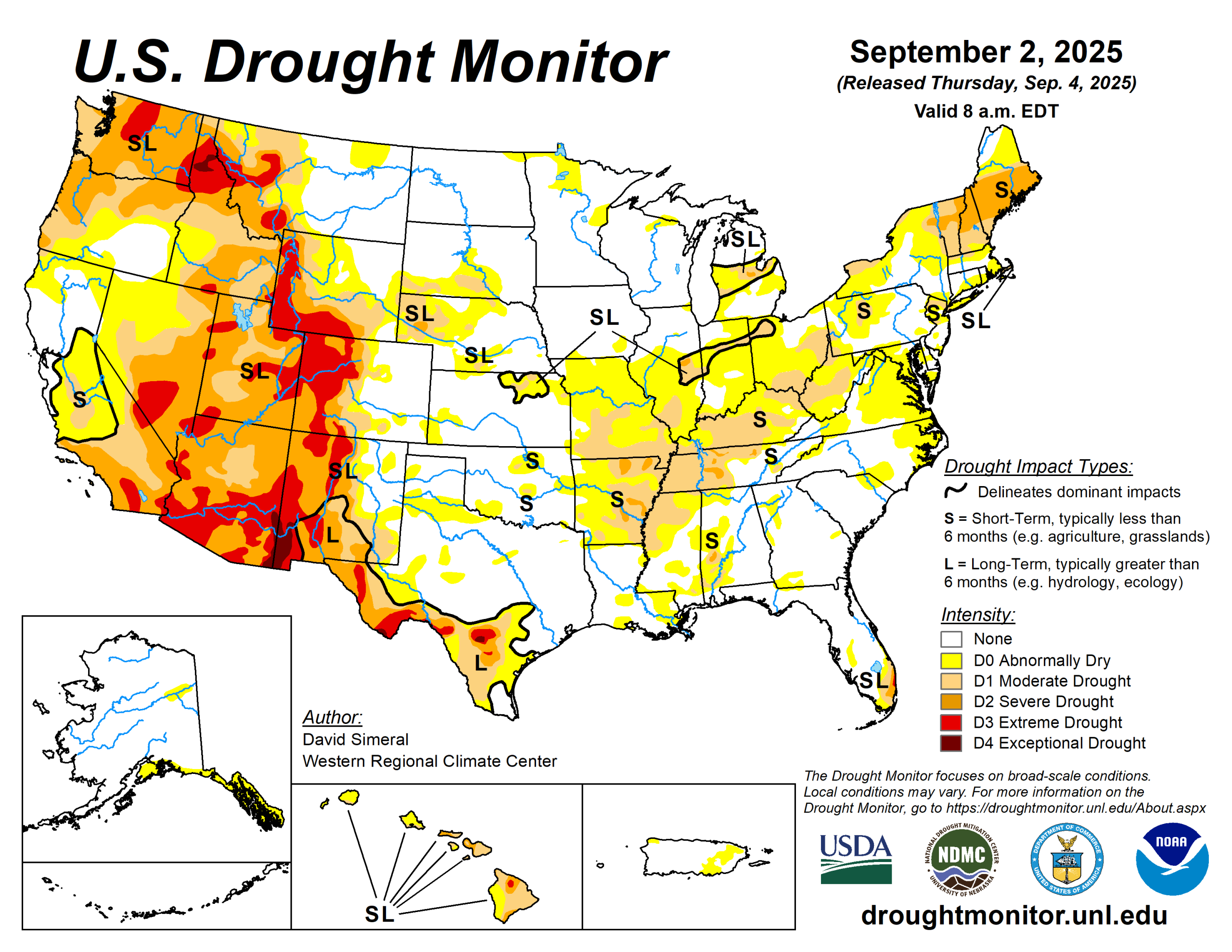
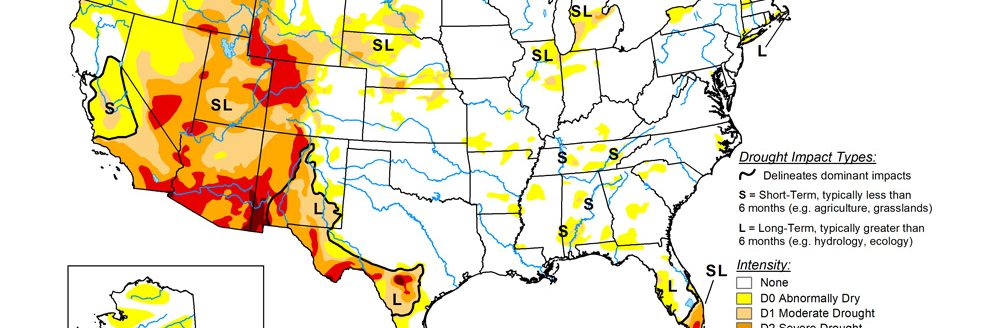
The U.S. Drought Monitor for the past week indicates short-term dryness and drought impact reports from the agricultural sector led to degradations in isolated areas of the Southeast and South.
Most of the eastern half of the conterminous United States experienced unseasonably cooler temperatures, while temperatures out West were above normal, especially across the Pacific Northwest and Desert Southwest.
In the West, conditions were generally dry; however, some isolated monsoon thunderstorm activity was observed in the Southwest, Sierra Nevada Range of California, Great Basin, and in the Rocky Mountains. In the Pacific Northwest, continued dryness as well as declining streamflow and soil moisture levels led to the expansion of areas of exceptional drought in the Idaho Panhandle.
In terms of reservoir storage in the West, California’s reservoirs continue to be at or above historical averages for the date (Sept. 2), with the state’s two largest reservoirs, Lake Shasta and Lake Oroville, at 104% and 112% of average, respectively. In the Southwest, the U.S. Bureau of Reclamation is reporting (Sept. 1) Lake Powell at 29% full (44% of average for the date), Lake Mead at 31% full (52%), and the total Colorado system (Sept. 1) at 38% of capacity (compared to 44% of capacity the same time last year).
The U.S. Drought Monitor is jointly produced by the National Drought Mitigation Center at the University of Nebraska-Lincoln, the U.S. Department of Agriculture and the National Oceanic Atmospheric Administration. (Map courtesy of NDMC.)
South
Improvements were made in eastern Texas, northern Arkansas, and central Oklahoma in response to locally heavy rainfall (ranging from 2- to 6-plus inches) observed. Elsewhere, short-term dryness led to introduction of areas of abnormally dry conditions in parts of Texas including the Panhandle and Edwards Plateau.
In terms of hydrologic conditions in Texas, the state’s reservoirs (cumulatively) were 77% full with many in the eastern part of the state in good condition (over 90% full), while numerous others in the western portion of the state continue to experience below-normal levels, according to Water Data for Texas (Sept. 3). For the week, average temperatures were below normal (2 to 8 degrees Fahrenheit) across most of the region except southern and western portions of Texas where temperatures were 1 to 5 degrees above normal.
Midwest
Widespread degradations were made across the region in response to precipitation shortfalls (ranging from 2 to 4+ inches) during the past 30-day period. Record to near-record dryness (for the past 30-day period) was observed at numerous observing stations across the region including the Springfield Airport, Missouri (-3.45 inches; driest on record), according to the Southeast Regional Climate Center.
Additionally, numerous drought impact reports (agricultural sector) were reported during the past seven days to the National Drought Mitigation Center’s Condition Monitoring Observer Report system—primarily from southern Missouri, north-central Kentucky, and southern Ohio.
For the week, average temperatures were well below normal (2 to 15 degrees) across most of the region, while northern Minnesota saw positive anomalies ranging from 2 to 6+ degrees above normal.
High Plains
Improvements were made in the region, namely in northern Kansas, and southern Nebraska, where some isolated shower activity (1 to 5+ inches) during the past week continued to help chip away at the longer-term precipitation deficits.
For the past 60-day period, the Lincoln, Nebraska Airport observed its sixth wettest on record with 10.24 inches (+3.69 departure from normal), according to the SERCC. Conversely, conditions deteriorated on the map in the southwestern extent of South Dakota where a combination of short and long-term precipitation deficits have persisted and leading to the expansion of areas of moderate drought.
For the week, above-normal temperatures (ranging from 2 to 10 degrees) were logged across northern North Dakota while much of the remainder of the region experienced below-normal temperatures (ranging from 1 to 10 degrees), especially in the southern extent of the region.
West
Some isolated monsoon shower activity was observed across areas of the central and northern Rockies. Improvements were made on the map in Colorado and western Montana. A more active monsoon season has affected southern and eastern portions of New Mexico.
Average temperatures were below normal across areas of the Intermountain West. Colorado and southern Wyoming had temperatures 5 to 10 degrees below normal.
Looking ahead
The National Weather Service’s Weather Prediction Center 7-Day Quantitative Precipitation Forecast calls for moderate to heavy precipitation accumulations across areas of the Desert Southwest (southeastern Arizona) in association with remnant moisture from Hurricane Lorena.
Additionally, heavy rainfall is expected in southern Florida, while light-to-moderate accumulations are expected across areas of the Pacific Northwest, Rockies, Texas, Lower Midwest, and Northeast. The Climate Prediction Center 6- to 10-day outlooks call for a moderate-to-high probability of above-normal temperatures across most of the West, Central and Northern Plains, and Gulf Coast region.
Conversely, below-normal temperatures are forecasted for the Midwest, Mid-Atlantic, Northeast, and areas of eastern California and western Great Basin. In terms of precipitation, there is a low-to-moderate probability of above-normal precipitation across most of the conterminous U.S. with exception of areas of the Southwest, Upper Midwest, and New England in proximity to the Great Lakes and Canadian border where below-normal precipitation is expected.
David Simeral is with the Western Regional Climate Center.