The history of The Old Farmer’s Almanac
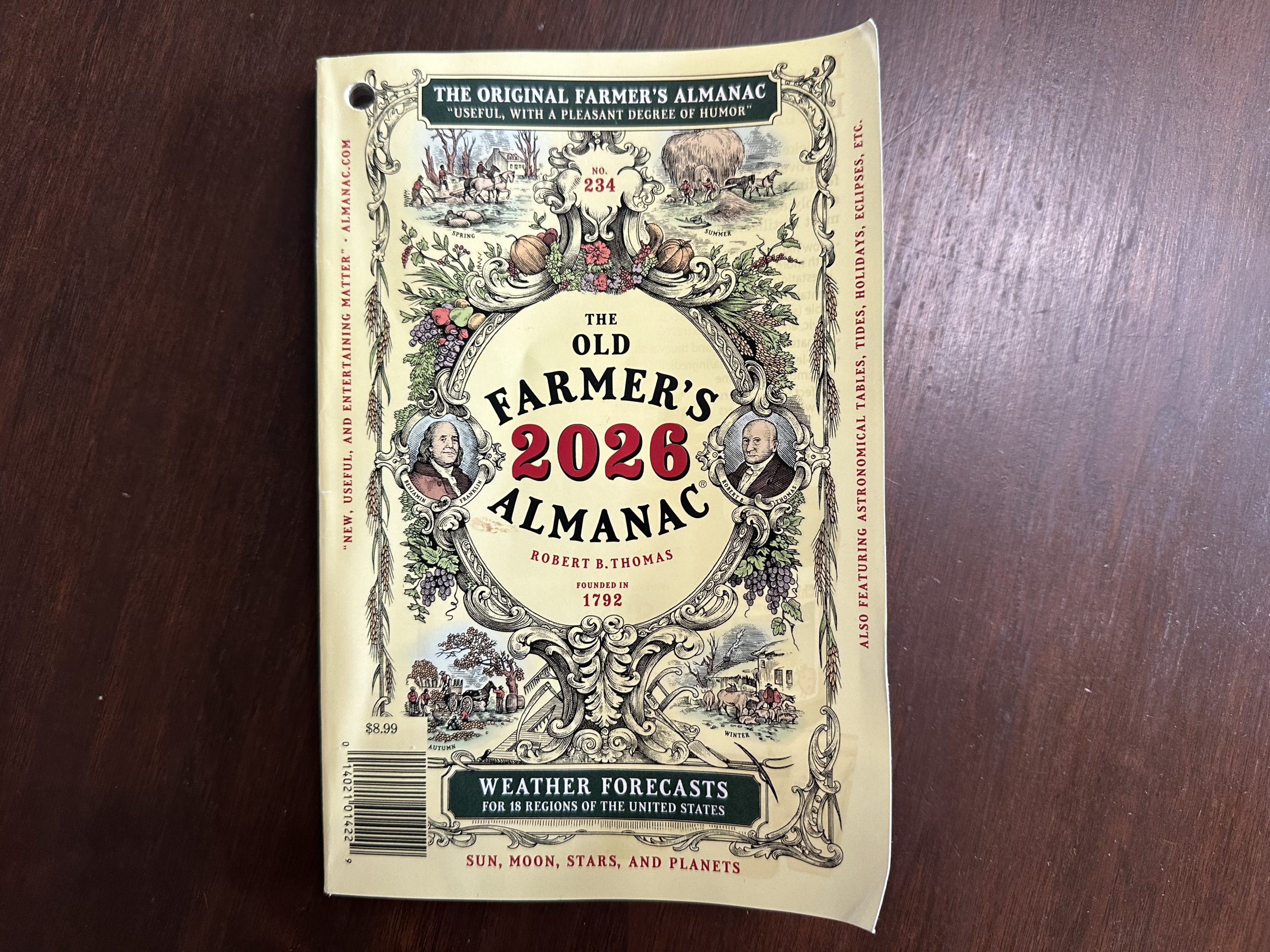
It’s a staple at any farm store, usually near the cash registers and close to the old timer candy. Even after more than two centuries, many still rely on its predictions each year. The Old Farmer’s Almanac is the longest running periodical in North America. It was founded by Robert B. Thomas in 1792, which was during George Washington’s first presidential term.
Thomas used a series of natural cycles and observations to make long-range weather predictions for 18 regions of the United States for the coming year. Those projections were compiled in a book and released every fall. Farmers, ranchers and gardeners utilized the book at a time when they did not have a meteorologist providing a weather report every day or weather apps that made long-range predictions.
Thomas died in 1846 at the age of 80. He served as the editor for more than 50 years, but The Old Farmer’s Almanac did not die with him. Since the publication began, there have been 14 editors, and the system for making long-range weather predictions is like the process Thomas developed, but it has evolved with the help of modern state-of-the-art technology and scientific principles to improve accuracy.
Today, the annual Old Farmer’s Almanac covers a wide range of topics including gardening, food, astronomy, weather, farming, fishing, home remedies, astrology, sports, and history, with some humor sprinkling throughout the publication. It took on several nicknames over time, including the “Little Yellow Book”, the “Gardener’s Bible”, and “The Almanac.”
At the time it was first printed, the almanac cost 9 pence per copy, which equates to about 9 cents. Since that time, it has been continuously printed every year, even amidst world wars, economic challenges and advancements in technology. Today, a copy of The Old Farmer’s Almanac costs $8.99, and it has a circulation of more than 2.5 million copies throughout the United States and Canada.
According to The Old Farmer’s Almanac website, on average the almanac’s predictions are 80% accurate. The 2026 almanac stated the 2025 December through February weather predictions were 88.9% accurate for temperature departures from normal. The almanac was correct for 16 out of 18 regions in this category. Additionally, for precipitation in 2025’s meteorological winter, the almanac was 83.3% accurate, correctly predicting 15 out of 18 regions for rainfall. The total accuracy of The Old Farmer’s Almanac’s 2025 winter forecast was 86.1% accurate.
Not everyone puts his or her faith in a publication like the almanac, but its long-running track record is hard to deny. There are few periodicals that have been in circulation for 233 continuous years. It is an anomaly that has stood the test of time, earning the trust of many agriculturists who rely on it to aid in planning and financial decisions. Even in 2025, the almanac is a trusted source of information, proving print has the power to live on and withstand any obstacle.
Lacey Vilhauer can be reached at 620-227-1892 or [email protected].