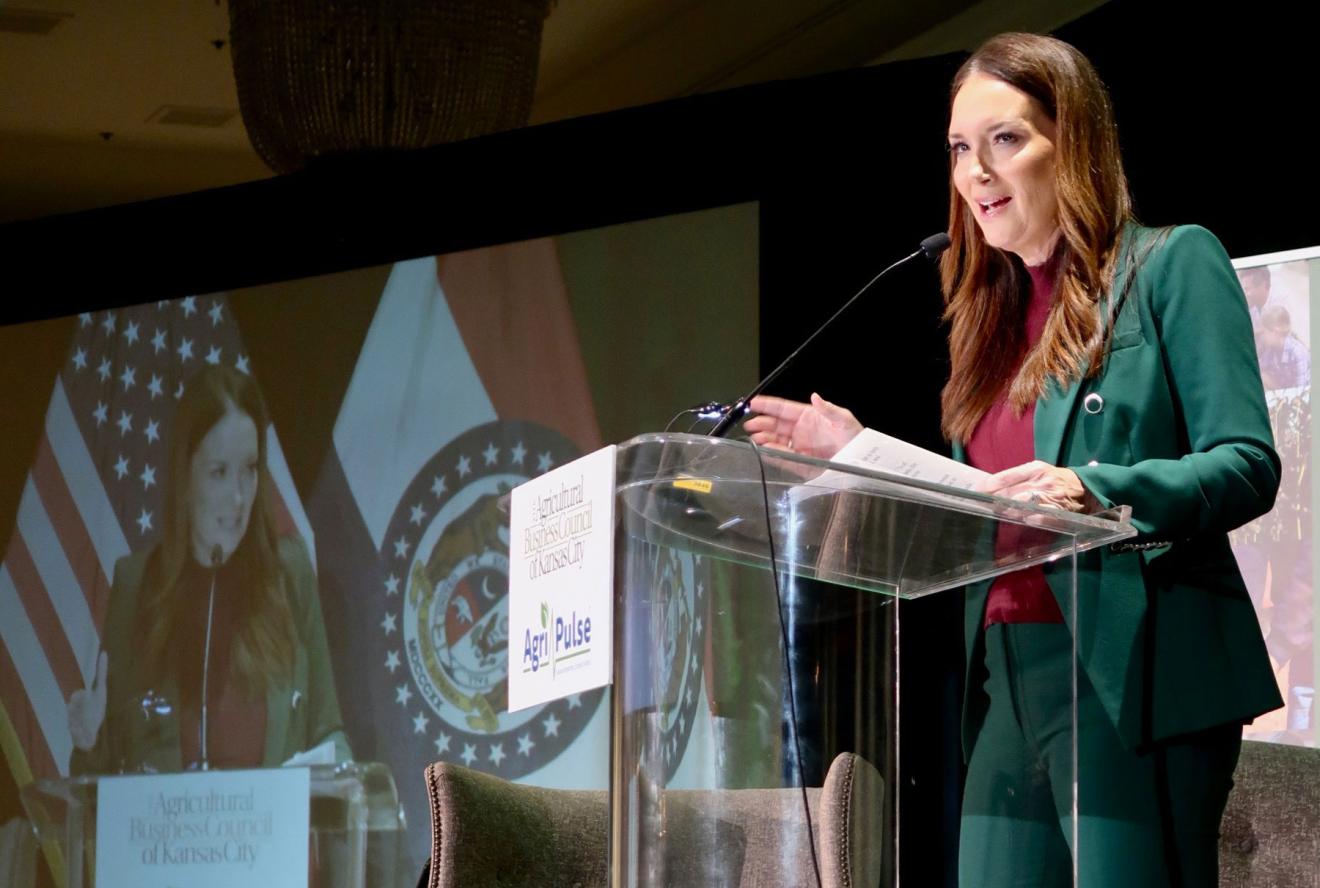
“I was supposed to be overseas,” Secretary of Agriculture Brooke Rollins told the crowd at the Ag Outlook Forum in Kansas City, Missouri. “But I changed my schedule to be here.”
Rollins made several high-profile announcements during a rousing keynote speech at the Sept. 25 event, which was organized by the Agricultural Business Council of Kansas City and Agri-Pulse Communications. Agri-Pulse’s President Sara Wyant introduced speakers and moderated several panels.
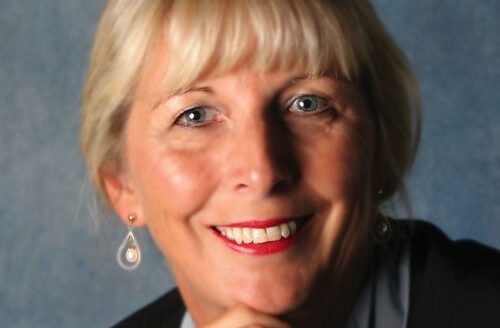
Rollins (pictured above in a USDA photo) recently learned from Mexico that a New World screwworm fly had been found in a trap 70 miles from the United States border; the previous closest find was 400 miles away. The U.S. Department of Agriculture immediately dispatched a “boots on the ground” team to Mexico, she said, where officials learned that Mexico has not been complying with monitoring protocols.
“Mexico has failed to enforce cattle movement restrictions and is not doing daily fly traps,” as it agreed to, she said. She warned that the U.S. “won’t even consider” re-opening the border to animal imports until Mexico shows 100% compliance with measures to monitor and prevent infestation of the pest.
Current measures focus on releasing billions of sterile flies in currently affected areas of Mexico and Central America. The fly lays eggs in open sores or wounds; the larvae burrow into and consume living flesh and can cause death in cattle between seven to 14 days, if left untreated. They can infect any mammal species, including humans. A later panel at the event focused on the state of efforts to prevent the pest from entering the country, along with measures to combat it if those efforts don’t succeed.
Rollins began by touting the success of the administration’s economic programs. She noted the release of adjusted second-quarter gross domestic product numbers, which were revised upward to a 3.8% annual growth rate from the previous estimate of 3.3%, driven primarily by stronger-than-expected consumer spending, including in services. “It’s been a remarkable eight nine months,” she said. “God’s hand is on our work.”
She praised the relocation of headquarters functions of the USDA from Washington, D.C. to Kansas City, even though it “made a lot of people in Washington, D.C. unhappy,” and noted that she has traveled more to Missouri than to any other state during her tenure.
Rollins announced that Missouri farmer Richard Fordyce would be sworn in later that day as an undersecretary of agriculture. A fourth-generation farmer and a former administrator of the Farm Service Agency during the first Trump administration, Fordyce brings extensive experience to lead the FPAC mission area, which includes the FSA, Natural Resources Conservation Service, and Risk Management Agency.
On the same day that the Senate confirmed Fordyce, it also confirmed Dudley Hoskins as undersecretary of marketing and regulatory programs and Scott Hutchins as the undersecretary for research, education and economics.
Five Point Program
Rollins spoke of the “centrality of agriculture to the American public and the American experiment.” Even though farmers make up only 1.2% of the population today, as opposed to 90% at the founding of the country, farming remains “essential to the continuation of this country.”
She said slumping commodity prices and high input costs are a crisis for producers. She blamed what she said was the Biden administration, during which not one new trade agreement was signed in four years, for failures including a $50 billion trade deficit inherited by the second Trump administration.
“Unfortunately, I do not have a silver bullet” for all these issues, she said, but laid out a five-point program of support for agriculture. It includes prioritizing relief to farmers through the Supplemental Disaster Relief Program and Emergency Commodity Assistance Program. The two programs have so far distributed $13.5 billion, with another $2 billion to be delivered within a few weeks. She said USDA is working on streamlining processes to get aid out faster.
Some farm provisions that would normally be in a farm bill were included in the One Big Beautiful Bill Act passed by Congress earlier this year, including adjustments to statutory reference prices. The bill raises statutory reference prices (price guarantees) for major covered commodities by 10 to 21%, starting in crop year 2031.
The second pillar, she said, is driving down farmer input costs. “I’m incredibly concerned about undue foreign influence on our ag markets,” she said, adding that the antitrust department of the Department of Justice is working closely with USDA to prevent anti-competitive behavior by input suppliers. Interest rates, she said, have remained “unbearably high for too long,” despite a slight recent dip.
Rollins criticized the high costs of the H-2A program, through which temporary farm labor is accessed, and said she was working with Secretary of Labor Lori Chavez DeRemer and Secretary of Homeland Security Kristi Noem to make the program more streamlined and efficient including by—among other measures—concentrating its functions in a single office and eliminating the requirement for in-person interviews.
“Ultimately, further changes will require action by Congress,” she said.
The third pillar is expanding markets to make producers more competitive. Rollins said the government is looking at repurposing $285 million from canceled diversity, equity and inclusion programs to market promotion efforts, and praised newly signed trade dals with Japan, the Philippines, Vietnam, and Indonesia as “massive wins for American agriculture.” Japan has promised to increase its imports of U.S. rice by 175%, she said.
She mentioned a deal with the United Kingdom to buy more U.S. ethanol, which she said could increase demand by as much as 50%. “By next year, we believe these deals will have visible effects.” That led to Rollins’ fourth pillar, boosting domestic uses for U.S. biofuels.
“We’re moving on Trump time,” she said, so support renewable fuels by cutting the Renewable Identification Number credits in half for foreign biofuel feedstocks. “We are the most pro-biofuels administration in our country’s history,” she said.
Finally, she said efforts to “protect and secure U.S. farmland” will address foreign ownership head-on.
Also, the USDA will no longer provide incentives for the use of farmland for green energy, she added. The administration has been trying to cancel or roll back many of the Biden administration’s green-energy programs.
No heifer retention payments
Rollins said that despite current high beef prices, the U.S. cattle industry is in crisis. The average age of ranchers is 63. Since 2017, the U.S. has lost 17% of its cattle ranches, a decline of about 150,000 operations. Cattle inventory is the lowest in 75 years, even as Americans are eating more beef than ever and consumer demand remains high despite high prices.
Although the government wants to encourage herd growth, it does not plan to issue direct payments for heifer retention. “But we will open up more working lands and improve incentives,” she said.
“Finally, we are putting agriculture back at the center of our policy-making, economy and strategy,” she said. “You have all of American heritage and history on your side.
David Murray can be reached at [email protected].