Texas A&M AgriLife Extension publishes fact sheet on invasive pasture mealybug
Experts share latest insights and monitoring recommendations as invasive pest threatens Texas pastures
Texas A&M AgriLife Extension Service has released a new fact sheet to help forage producers and ranchers identify and monitor the pasture mealybug, an invasive pest recently confirmed in multiple Texas counties.
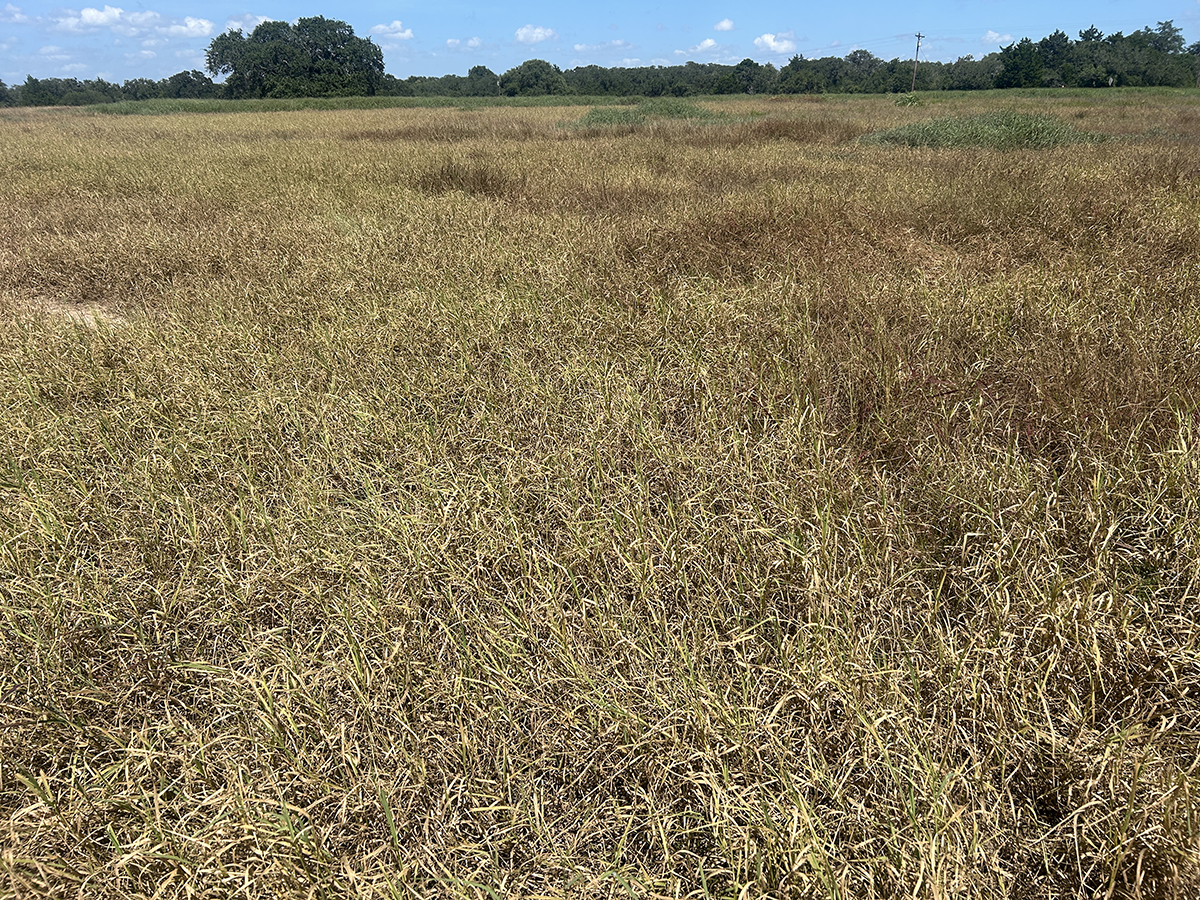
This pest is associated with a syndrome termed “pasture dieback,” a condition that kills patches of pasture grasses. It is identified by reddening or yellowing leaves, stunted growth and root reduction.
First confirmed in Texas this summer, the pest has now been identified in almost two dozen counties, stretching from the Rio Grande Valley to areas south of Hearne and east to Texas City. Infestations have devastated some Bermuda grass hay fields and other improved pastures.
“In one case, a 10-acre Bermuda grass hay field went completely brown and never came back,” said Stephen Biles, AgriLife Extension integrated pest management entomologist in the Texas A&M Department of Entomology, Port Lavaca. “That level of damage represents a real threat of losses for producers.”
Producers are encouraged to contact their local AgriLife Extension office for updates and guidance on monitoring and management.


The pasture mealybug is a new invasive pest that has been found in almost two dozen South Texas counties. AgriLife Extension experts developed a fact sheet to inform and guide hay producers and ranchers monitoring their pastures. (Stephen Biles/Texas A&M AgriLife)
AgriLife Extension responds with new fact sheet
To help forage producers and ranchers prepare, AgriLife Extension’s new pasture mealybug fact sheet provides identification guidance, biological background and monitoring recommendations to support protection of their forage resources.
Native to South Asia, pasture mealybug was first detected in Australia in 1928 and became a serious pasture pest there beginning in 2015.
The pasture mealybug’s full impact in Texas is still being determined. However, experts say the pest has the potential to threaten forage production critical to Texas’ cattle industry, which leads the nation in inventory and economic value.
“This has been a tough insect to manage in Australia, and mealybugs are a difficult pest in general,” Biles said. “We’re able to look at the scientific information they have, but the challenge is how the mealybug’s activity and impact may be different in Texas grasses and conditions.”
Pasture mealybug found across multiple forages
Biles said pasture mealybugs have been found to damage a range of forage grass species, including Bermuda grass, Bahia and bluestem, as well as turfgrasses like St. Augustine.
Current insecticides labeled for pastures have shown little to no effectiveness against pasture mealybug, leaving producers with limited management options while research continues. Experts suspect the pest has spread via contaminated haying equipment and possibly hay bales, raising concerns for a broader distribution.
Monitoring, research and collaboration underway
AgriLife Extension specialists are working closely with the U.S. Department of Agriculture Animal and Plant Health Inspection Service and local producers to evaluate management strategies, study potential biological controls and provide updated recommendations.
“Right now, this is about awareness and monitoring,” Biles said. “Producers need to know what’s out there and to be watching for this new pest.”
TOP PHOTO: Damage from pasture mealybug can be identified by reddening or yellowing leaves, stunted growth and root reduction, which are signs of pasture dieback. (Stephen Biles/Texas A&M AgriLife)