Biofuels and ethanol key to the future of U.S. agriculture
As United States agriculture navigates the complexities of global markets, evolving energy demands, and sustainability goals, the role of biofuels, particularly ethanol and renewable diesel, remains pivotal in shaping the future of corn and soybeans.
Drawing from my recent presentation at the S.E. Asia-U.S. Agricultural Cooperators Conference in Jakarta, Indonesia, on Sept. 17, hosted by the U.S. Grains and Bio-products Council and U.S. Soybean Export Council, this column explores the implications of biofuels for U.S. agriculture, emphasizing the resilience, reliability, and resourcefulness of our agricultural supply chain.
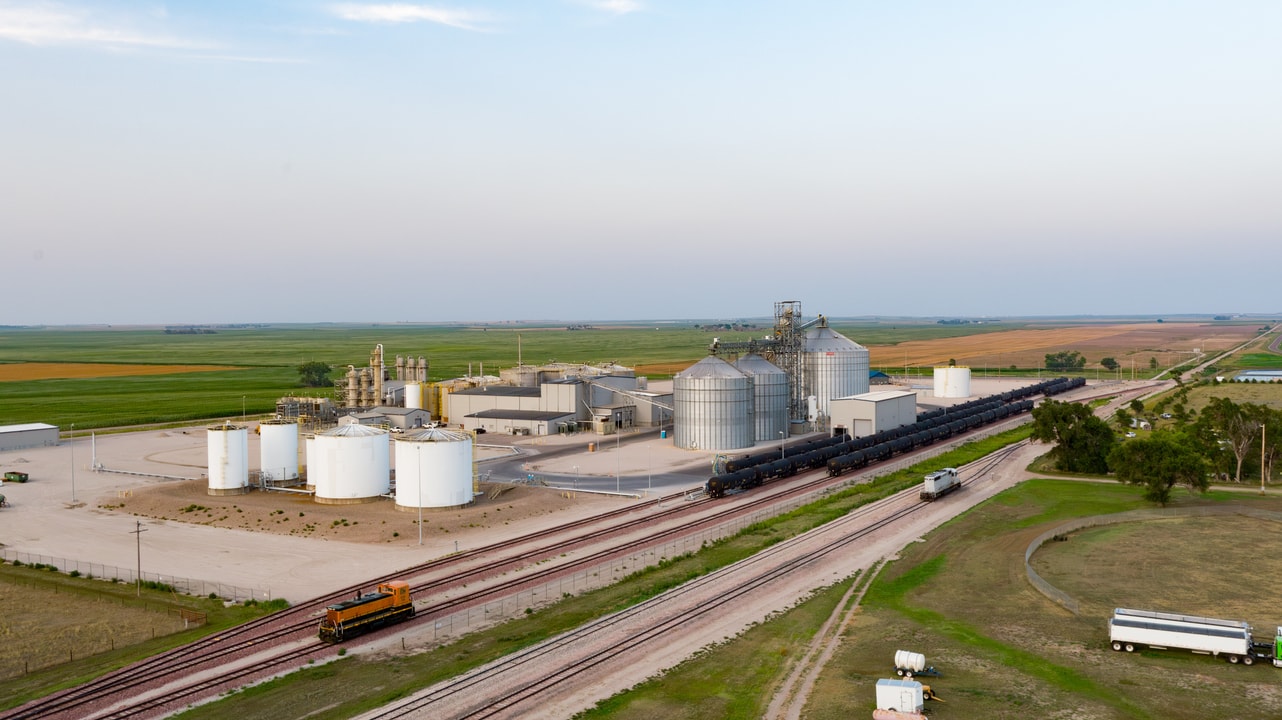
Over the past two decades, the Renewable Fuel Standard has transformed U.S. agriculture, and its legacy continues to influence how we grow, store and export crops like corn and soybeans. Pictured at top, Mid America Agri Products/Wheatland’s ethanol plant in Madrid, Nebraska. (Courtesy photo.)
The 4-Rs+1: A framework for U.S. agriculture
At the heart of U.S. agriculture’s success lies a robust supply chain defined by what I call the “4-Rs+1”: Reliable, Resilient, Resourceful, and Redundant plus Regenerative. These principles encapsulate the strength and adaptability of the U.S. agricultural system.
The supply chain is reliable, with an established and integrated network that ensures consistent delivery from farm to market. It is resilient, offering multiple pathways to navigate disruptions. It is resourceful, handling high volumes with efficiency, and redundant, allowing seamless participation across the system. Wrapped around the supply chain is the plus one, regenerative, emphasizing sustainable practices that “grow back and give back” to the land. This framework has enabled U.S. agriculture to meet domestic and global demands while supporting the growth of biofuels.
Impact of the Renewable Fuel Standard
The U.S. Renewable Fuel Standard, now in its 20th year, has been a game-changer for corn and ethanol production. Since its inception, the RFS has spurred the construction of ethanol plants, boosting production to fuel both domestic consumption and export markets.
By 2025, U.S. ethanol production has reached significant levels, with exports playing a growing role in global energy markets as shown in Figure 1. However, corn use for ethanol peaked in 2012 and has since trended lower, stabilizing at around 35 to 40% of total corn use. This shift has allowed surplus corn supplies to support feed, food and industrial markets, reinforcing the reliability of U.S. agriculture.

Meanwhile, renewable diesel has driven a surge in soybean oil production. As demand for renewable diesel grows, soybean oil’s share of total soybean production has increased, reaching approximately 19% in recent years as depicted in Figure 2. This trend highlights the resourcefulness of U.S. agriculture, as farmers and processors adapt to meet new market opportunities while maintaining robust supplies for traditional uses like food and feed.

A century of resilience in crop production
Over the past 100 years, U.S. crop production has proven remarkable resilience. Corn yields have surged due to advancements in technology and farming practices, while soybeans have expanded through increased plantings and improved yields. The relationship between planted acres, production and yield are shown in Figure 3.

Corn yields have steadily expanded, keeping plantings in a narrow range as production increases. Soybean yields have evolved more slowly than corn, requiring more planted acres to expand production.
This productivity has created surplus supplies that reliably feed and fuel the world. For example, U.S. crop production consistently outpaces domestic consumption as shown in Figure 4, with surplus grains and oilseeds supporting exports to countries across Southeast Asia and beyond. Farmers in the U.S. readily adopted technological advances to steadily surpass successive 100 million metric ton benchmarks since 1964, more than doubling production within 50 years.

Despite this abundance, challenges remain. Grain storage capacity has plateaued in recent years, even as supplies have surged. This bottleneck underscores the need for continued investment in infrastructure to maintain the redundancy and resourcefulness of our supply chain. Nevertheless, U.S. crop exports, particularly corn and wheat, are recovering strongly, with total exports projected to be the fifth largest in U.S. history in 2025.
Global context: Feeding a growing world
The global demand for calories continues to rise, driven by population growth and increasing per capita income. In Southeast Asia, countries like Indonesia, Thailand, Vietnam, and the Philippines are seeing steady increases in daily per capita caloric supply, correlating with rising gross domestic product.
The relationship of daily per capita supply of calories and gross domestic production (and population) is shown for various Southeast Asia countries in Figure 5. For instance, Vietnam and Thailand have made significant strides in caloric intake, reflecting improved economic conditions and access to food. The U.S., with its abundant crop production, plays a critical role in meeting this demand, exporting grains and oilseeds to support food security and economic development worldwide.

However, competition in global markets is intensifying. Other agricultural powerhouses are expanding production, and U.S. farmers must continue to leverage the 4-Rs+1 framework to keep their competitive edge. By staying reliable, resilient, resourceful, and redundant, plus regenerative, U.S. agriculture can continue to lead in feeding and fueling the world.
The future of U.S. agriculture
Looking ahead, the future of U.S. agriculture lies in balancing biofuel production with food and feed demands. The decline in corn use for ethanol since 2012 has freed up supplies for other uses, ensuring flexibility in the face of changing market dynamics.
Similarly, the rise of renewable diesel has expanded opportunities for soybeans, but careful management is needed to avoid over-reliance on a single market. Investments in grain storage, transportation and processing infrastructure will be critical to maintaining the efficiency and redundancy of the supply chain.
Sustainability remains a cornerstone of the regenerative principle. Practices like cover cropping, precision agriculture, and soil health management are essential to ensuring that U.S. agriculture continues to “grow back and give back” to the land. These efforts not only support long-term productivity, but also enhance the sector’s resilience against climate and market uncertainties.
Conclusion
The interplay of biofuels, ethanol, and U.S. agriculture underscores the strength and adaptability of the U.S. agricultural system. The Renewable Fuel Standard has reshaped corn and soybean markets, driving innovation and creating new opportunities while maintaining surplus supplies for global food and feed needs.
By adhering to the 4-Rs+1 framework, Reliable, Resilient, Resourceful, and Redundant, plus Regenerative, U.S. agriculture is well-positioned to meet the challenges of tomorrow.
As we look to the horizon, the opportunities are clear: Expanding export markets with whole grains or soybeans, or through value added commodities and products, advancing sustainable practices, and investing in infrastructure will ensure that U.S. agriculture remains a global leader. The road ahead may have its challenges, but with a robust and adaptable supply chain, American farmers are ready to anchor the future of food, feed and fuel.
Ken Eriksen can be reached at [email protected].