Cover crop panel at HPJ Live shares experiences with soil health
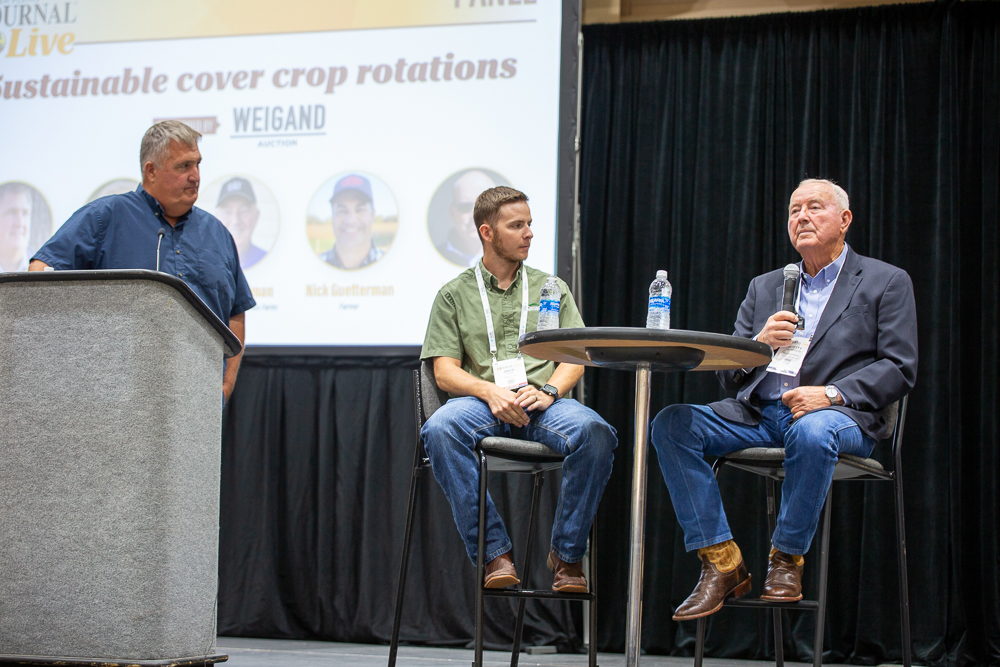
For one it was conservation remedies. For another it was breaking up compaction and saving the soil. For another, it was one more crop to diversify the operation. While the last one sells cover crop seed mixes and farms.
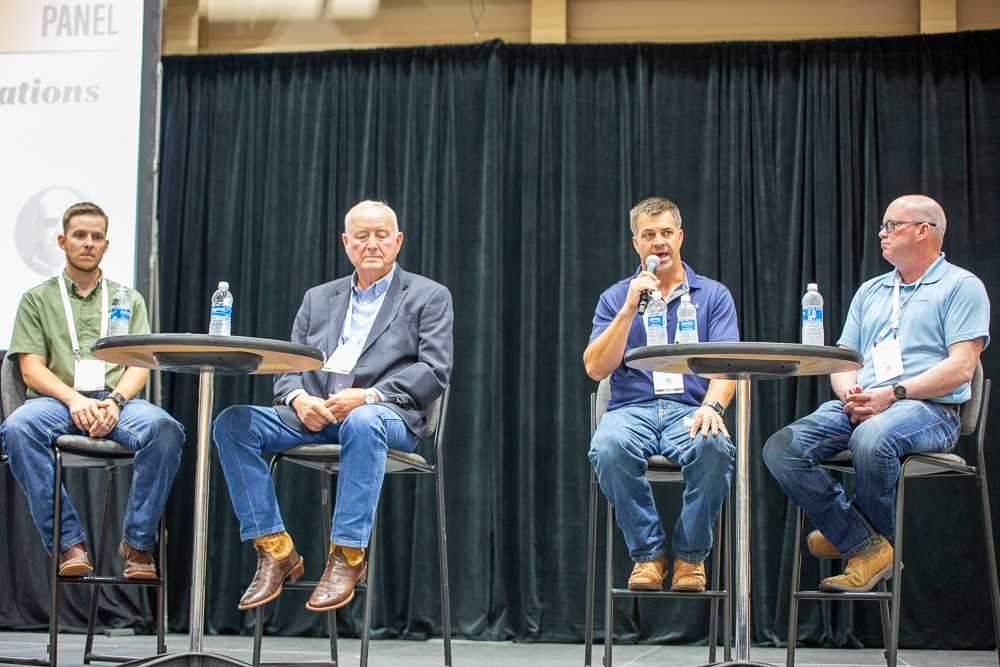
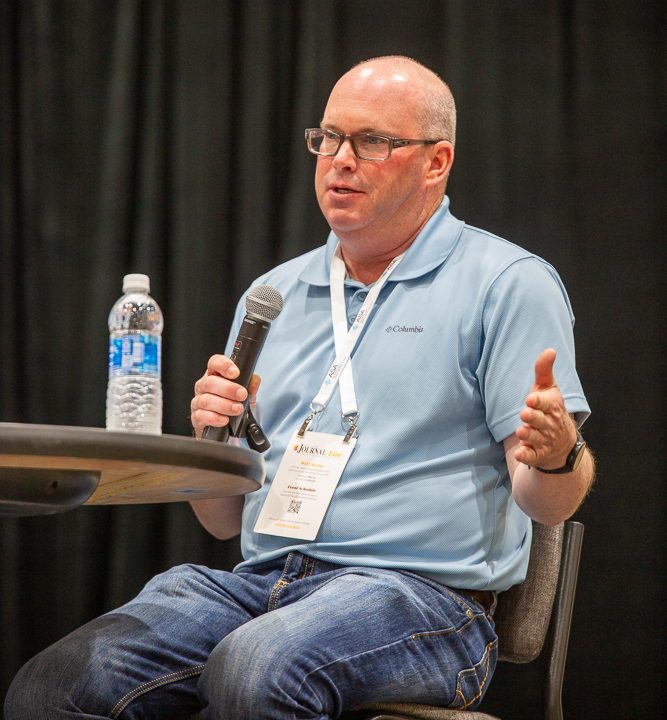
A panel of four farmers discussed their experiences with cover crops and soil health at HPJ Live in Wichita, Kansas, this past summer. Zach Louk, Scotty Herriman, Nick Gutterman, and Ben Cramer were the panelists and they were moderated by Steve Tucker. Each has varying involvement with planting and utilizing cover crops on their farming operations in Kansas and Oklahoma.
Louk lives near Iola, Kansas, and farms with his family in addition to working for Green Cover seed. He has been selling cover crops for about eight years and is the company’s seed purchasing lead. Louk visits with farmers across the country and makes cover crop recommendations to assist them.
Herriman is a northeast Oklahoma farmer who is about 50 miles from the Missouri border and two miles from the Kansas border and has what he calls “quite different” country than others on the panel.
“I farm a couple thousand acres, mainly river bottom,” he said. “I have worked with no-till since 2010 and cover crops since 2016, so I got quite a little bit of up and down experience with cover crops.”
Gutterman farms in east central Kansas near Bucyrus, where his farm receives nearly 38 inches of rain a year.
“Eight, nine months out of the year, we’re too wet, except for July and August and sometimes September. September can be a wild card,” he said. “Last two years, summer hasn’t broke in September, so it kind of took the top end off our soybean crop.”
His farm is predominately corn/soybean/corn/soybean rotation, with some wheat and cover crops grown. No-till was introduced to the farm in 1982.
“(We) planted some soybeans—the 30-inch row planter into some corn stalks, and I think about four neighboring pickups stopped on the road, looked out there. What in the world is he doing out there no-tilling right into the corn stalks,” he said.
Cramer hails from the western part of Kansas, farming near Healy. He’s in “more of an 18-to-20-inch rainfall type place.”
He started no-till practices in 2006 and using cover crops since 2012 with hits and misses.
Cover crop impressions
Tucker asked them about the first time they heard the term cover crop and what lead them to start using them.
Herriman said his dad and grandfather both used what they called “green crops” or ones they would plow under and act as fertilizer and it instilled in him the importance of conservation.
“For me to start using cover crops, I had asked myself why, and eventually I learned why, but that was what introduced me to cover crops.”
When Cramer first heard about them, he was intrigued being his farm was in a lower rainfall environment.
“The thing pops into your head with those, obviously, is do we have the rain to support it,” he said. “I guess over time, we’ve learned that sometimes we do (have enough).”
Gutterman said it was in high school in the early 2000s when he was first introduced to cover crops and attended no-till events where specifics were being discussed.
“First thought in my mind, well, legumes could make nitrogen or reduce soil erosion in general, which probably transitioned to we’ve learned the value of organic matter on our farm when we break out of our own pasture, fescue pasture,” he said. “Noticing how that has more water-holding capacity and yields (were) more than just tradition.”
Gutterman said building organic matter was probably the biggest opportunity he found with a cover crop early on.
Louk said he first heard of cover crops when he was in a job interview following college graduation. He asked the interviewer what his favorite cover crop was.
“And the guy said, ‘Oh, well, we like to plant diverse mixes.’ And my initial reaction was, that’s absolutely crazy, which I think is a good way to say, like, the first time I ever heard about cover crops,” he said.
From the first time hearing about cover crops to the first time planting them, Tucker asked each if they thought it was ridiculous or that “crazy decision” to put in a cover crop paid off.
Gutterman said in 2011 he needed that extra kick in the rear to start on the soil health/cover crop path. He called Dave Brandt and quizzed him about what his needs were and what should be planted. Brandt provided him with the specifics he needed.
Drought in 2011 caused a failed corn crop, and he didn’t want the field sitting idle with nitrogen until he planted soybeans the following spring and covering the soil made sense.
When Cramer started no-tilling in 2006, eventually he wanted to get away from having to do chemical fallow.
“That’s what we first and still where we mostly use our cover crops, is to bridge that gap between the corn and milo to get back to wheat that next fall,” he said.
The first year he tried was 2012, a “super dry year for us” and Cramer called the result bad and 2013 wasn’t any better.
“We planted an oat-based mix in the spring, and it got about 6 inches tall, died, turned around, did the same thing in ‘13, same result,” he said. “And so, we kind of licked our wounds and thought about it for a couple of years we tried it again. At that point we started working more with warm season sorghum and millets and things like that and that’s worked for us a lot better.”
Herriman started out with rye and turnips and at the time he really wasn’t sure what it was all about, but he did know he should do it again.
“I’m conservation minded, so that’s the thing we got to do, even in the river bottoms, break up soil,” he said. “But I didn’t know if I was doing right or wrong, but I was going to do it and it turned out to be the right thing to do. I’ve not turned back.”
He’s up for the challenge and has found ways to incorporate more, improve timing, drilling and dealing with precipitation. Even with flat river bottom ground, a flood means soil is going to move.
“We also farm some rolling hills and so from a conservation aspect, I know that is the right thing to do,” he said.
Advice to others
Along the way, each of the panelists has found what works for them and they offered suggestions to those in attendance. Gutterman said farmers need to be self-conscious and aware of their budget restrictions as well as environment.
“There for a while I was doing cereal rye on every acre, just because I knew if I planted cereal rye, I was going to get a stand,” he said. “I got discouraged at times. For awhile when I would go plant five or six things nothing performed. I always knew cereal rye at the end of the day I get something out of it—at least get my money back.”
The root mass from cereal rye sold him on its effectiveness, but he’s had good luck with hairy vetch after beans ahead of corn.
“I’ve got a few hundred acres out. Last year, I just seeded 5 pounds with hairy vetch interceded in standing soybeans, and got pretty darn good performance,” Gutterman said. “You got to be real. First time you grow hairy vetch, you’re not going to get much because you don’t have the rhizobia to make it nodulate.”
Cramer said he learned was that he needed to find a cover crop that fits his environment. For him, the mixes weren’t quite right.
“We get too hot too quick most years,” he said. “If we get the rain, we can get something in the fall. We like the rye. That works really well for us. If we don’t, we’re going to do it to bridge that fallow gap the next year. We’re going to go in with something like a sorghum or a millet.”
You have to know what your end goals are, according to Cramer.
“And for us, it’s almost always long-lasting residue and something to maybe help break a compaction,” he said. “It’s got to be cheap. I mean, I can’t justify going out and spend $40 or $50 an acre for a cover crop. The return isn’t there on that. So, we stick with whatever fits our environment that we can access. And it’s got to be relatively inexpensive.”
Kylene Scott can be reached at 620-227-1804 or [email protected].