Asian longhorn tick, theileriosis concerning to K-State professor
Livestock producers need to be aware of the Asian longhorn tick and what it can do to their cowherds.
That‘s the assessment of Greg Hanzlieck, professor in the College of Veterinary Medicine at Kansas State University, associate director of the K-State Veterinary Diagnostic Laboratory, and section head for the field disease investigation program and outreach. He addressed attendees at the Kansas Livestock Association convention in Manhattan during late November.
“Thanks for the opportunity to talk about a truly emerging foreign insect, and unlike the screw worm, this insect is here,” he said. “This tick is here, and it’s moving west across the United States.”
Origins
The Asian longhorn tick is native to Japan, China, Korea, and parts of Russia. Australia and New Zealand imported the tick a long time ago and based on genetics tests officials believe it came from Japan. In the U.S., they’re not nearly as sure, but genetic testing is leaning toward Japan as well.
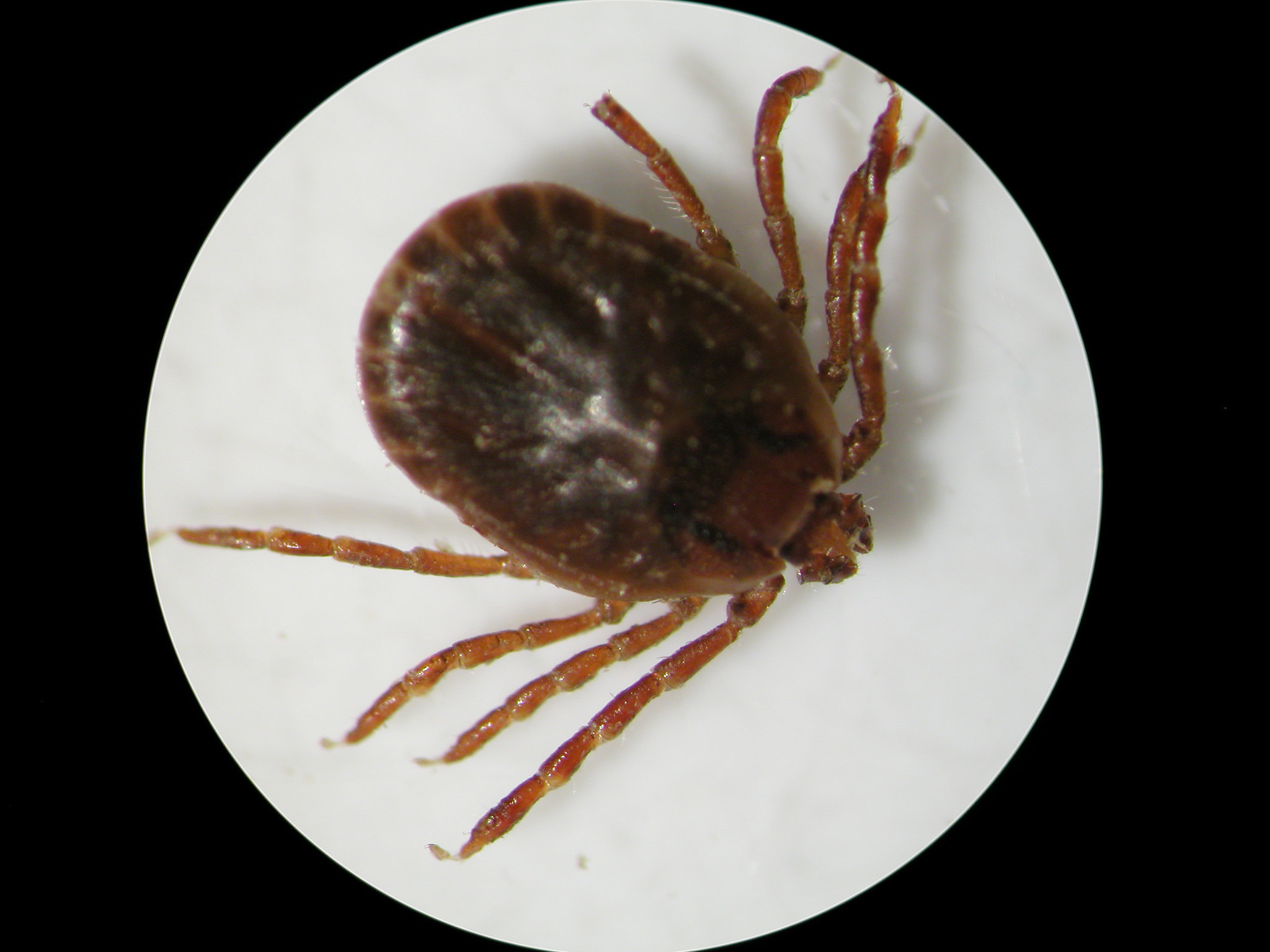
Longhorn ticks are noted by a hooked “horn” on their head and are relatively small compared to other tick species. But the most concerning characteristic is how this tick reproduces.
“One of the most disturbing things about this tick is that it’s called parthenogenic, which means it does not need males to reproduce,” Hanzlieck said. “Most of our ticks, they blood- feed females. They have to wait around for a male to find them and then impregnate them and then lay their eggs. These ticks do not need a male, and so it makes them a lot more efficient.”
A single female longhorn tick can produce anywhere from 1,000 to 5,000 eggs.
“These ticks live in these heavy infested nests in the pasture area so they can attach to a lot of individuals when they move through that area,” he said.
Hanzlieck said in Kansas, Asian longhorned ticks have been found in Labette County and on a dog in Harvey County.
“It’s our expectation that this tick will be moving more across the United States,” he said. “It does have very specific environmental needs, and the people that are looking at this, believe that this tick will end up becoming native.”
He expects eastern Kansas to be more likely to have the tick and become native. All common insecticides are effective in controlling it. Repellents like organic phosphates or pyrethroids or avermectins are all effective.
No product in the U.S. is labeled for the tick, he said. There are labeled products in New Zealand and Australia. In New Zealand and Australia their recommendations call for insecticide applications every 7 to 28 days.
“That may work in Australia or New Zealand, but I’m not so sure it’s going to work too well here,” he said. “We’ve got a lot of things that we do not understand about this tick and certainly about this disease.”
The disease
The Asian Longhorn tick carries a disease called theileriosis and Hanzlieck said one of the most important things to realize about this is not a bacteria or a virus carried by the ALT, but instead a protozoa.
“So it’s more closely related to our Coccidia and our crypto that I’m sure all of you are aware of,” he said. “It is a red blood cell parasite. For those of you that understand anaplas(mosis), this disease is very, very similar to anaplas, but has some very important distinctions.
Common signs of infection often include weakness, fever, reluctance to walk, loss of appetite, difficulty breathing, reduced milk production, foamy nasal discharge, and abortion. Symptoms of theileriosis includes things like anemia, yellowish or pale mucous membranes, and like Hanzlieck said signs and symptoms may mimic bovine anaplasmosis.
“Any age of bovine can become clinical. (With anaplasmosis) we rarely see it in young animals,” he said. “What we’re seeing in Kansas today are calves that have theileriosis that are brought in from other places.”
Hanzlieck said theileriosis is more common in cattle east of Kansas. Many go through bovine respiratory disease too.
“It’s caused some major concerns there,” he said. “I think we’re up to 100 different cow calf operations and feed yards that we have dealt with over the last eight months with this disease.”
Beef producers and Hanzlieck are continuing to learn about theileriosis, he said.
“What we’re seeing is that cow-calf pairs if they’re infected, it’s usually the cows that show clinical signs. It’s rare for the calves that show clinical sign,” he said. “This is opposite of what they see in Australia and New Zealand, and they’ve been dealing with this thyleria for over 100 years.”
Hanzlieck and others are seeing theileriosis occurring more in weaned beef calves that have been imported to Kansas from states east of the Sunflower State—including Missouri to Virginia.
“Those are the calves that are coming into the feed yards, the stocker units, and then all of a sudden, all hell breaks loose on those,” he said. “The morbidity or the amount of sickness varies from very, very lowpercentage to a high percentage. We can also have very low to very high mortality rates in these herds that we’re dealing with.”
There’s no treatment approved in the U.S. and Hanzlieck said many veterinarians are going to try to use antibiotics or anti-microbial to attempt to treat theileriosis, but this isn’t going to have any effect on this coccidial type organism.
“We are hearing some veterinarians that believe maybe early in the course of the disease and oxytet injection helps,” he said.
Hanzlieck said the best treatment is a topical banamine two to three days in a row to help get calves back on feed.
“Really the treatment for this disease is supportive care—feed, water, bedding, shade, and those kind of things help these animals recover,” he said. “In other parts of the world, there is a product out there that is very effective, at least for other types of this theileriosis. But the downside is, at this time, to my knowledge, the recommended withdrawal on that is 18 months after treatment.”
There has been a big push in the U.S. with the U.S. Department of Agriculture to put a label on that product.
“But if it’s 18 months withdrawal, I’m not sure how beneficial that’s going to be going forward anyway,” Hanzlieck said.
Because it is a blood-borne disease, transmission typically occurs by anything that can transmit blood from a positive animal to a negative one.
“Basically, any insect that feeds on blood—horse flies, lice, mosquitoes. There have been people that are able to find the bilateral organism in their mouth parts,” he said. “No one has proven that these insects can transmit the disease, so there’s an important thing there. We’re beginning to believe that actually flies do have an impact because of the way this disease is spreading from operation to operation.”
Sucking lice is a new one they’ve found and if there’s lice present, Hanzlieck said it “is really going to rock our world.”
Needles can be transmitters as well.
“But in our mind, who’s to say that once a cow becomes infected, if one of our normal native ticks feeds on her, who’s to say that that tick won’t be able to spread the disease?” he said. “This thing may go past the Asian longhorn tick in the United States, and that’s one of our major concerns.”
Hanzlieck said when it comes to diagnostic tests, there’s only one out there, the PCR. It looks at the DNA of this organism and it’s very sensitive for detecting theileriosis. The downside of the test is its expensive—between $25 and $35 per sample.
The ELISA test is inexpensive, but there hasn’t been one made yet for theileriosis.
“Our group in the diagnostic lab have been working to develop an ELISA test that will target this bilateral orientalis. The problem is, it’s a protozoa,” he said. “It’s easy to dive over to design a test that’s targeting viruses or bacteria. Protozoa are totally different organisms.”
Hanzlieck said it’s been a struggle, and his team has been working to get outside help to try to design a license.
“Our hope is that it will be sensitive, it’ll be specific, it’ll be extremely cheaper compared to PCR, so that we can, we can do more surveillance and plan more testing,” he said.
Hanzlieck warns producers to be aware of the tick and what it can cause, especially to those producers who are bringing calves and other animals from east of Kansas.
“I’d be very wary of doing that, and think twice about what I’m saying, because we’ve seen some major, major wrecks from this,” he said.
Kylene Scott can be reached at 620-227-1804 or [email protected].