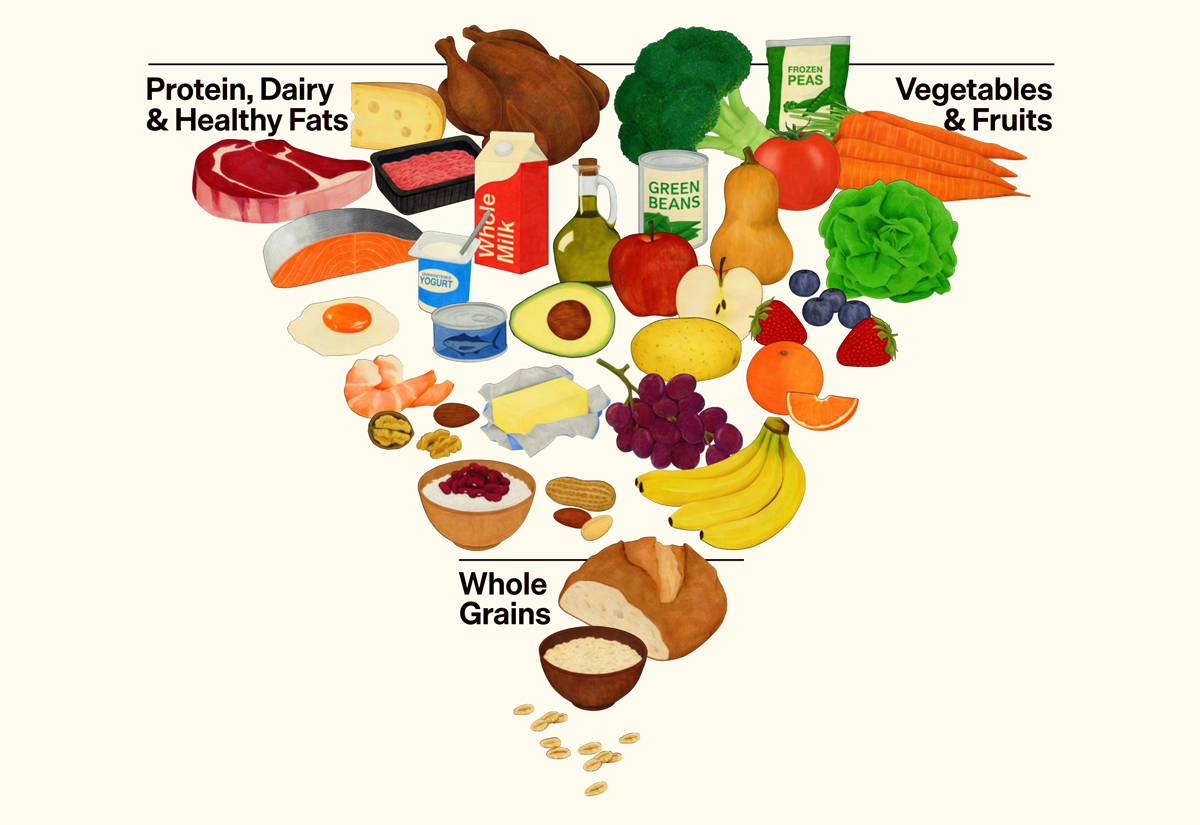
By now everyone has heard the news the federal government flipped the food guild pyramid upside down.

Milk, meat and eggs will finally be recognized as a vital part of the human diet. Or will they? It seems there is a problem inside this news. The rest of the story once again shows the Trump team taking credit for things they didn’t actually accomplish. I believe it is time that we really take a look at food, or to be more exact, the food that we consume as the vehicle to get the nutrients our bodies require.
Honestly, it should not matter if that is a ribeye steak or a pile of beans, but clearly people have preferences here.
This “debate” comes down to fat. How important is fat to human health? Since 1961, we have been conditioned to believe that saturated fat, particularly that from an animal product, is going to kill you. All of this reminds me of a school nutritional consultant I sat next to on a plane once. He said, “nutrition has gotten to be very complex.” My response to him was that it really hasn’t as it is the same as it was when my grandfather was born in 1918, but the policy makers have made it confusing. He paused for a moment before admitting that I was right.
So back to the nutritional announcement of the Dietary Guideline for Americans. The key component is this statement:
Prioritizing Protein: While previous Dietary Guidelines have demonized protein in favor of carbohydrates, these guidelines reflect gold standard science by prioritizing high quality, nutrient-dense protein foods in every meal. This includes a variety of animal sources, including eggs, poultry, seafood, and red meat, in addition to plant-sourced protein foods such as beans, peas, lentils, legumes, nuts, seeds, and soy.
In fact, I think the largest advance of this action was the increase from a suggested minimum of 0.8 grams of daily protein per 100 pounds of body weight up to 1.2 to 1.6 grams per 100 pounds. That is great news and we finally seem to be living in an era of understanding the value of protein consumption.
Now for the fat problem: All fat is healthy for the human body.
The issue continues to be that DGA says only 10% of total caloric consumption can come from saturated fat. Why? Data does not exist to document that saturated fat is anything but essential for life, in my opinion. Let’s look at just two studies discussed in the National Institutes of
Health. First, from 2010: Saturated Fat and Health: Recent Advances in Research by Richard D. Feinman:
Two recent publications highlight the importance of this issue. A meta-analysis by Siri-Tarino et al. [1] showed that there was no significant evidence for concluding that dietary saturated fat is associated with an increased risk of cardiovascular disease (CVD). In addition, whereas some dairy products contribute to the intake of dietary saturated fat, a meta-analysis in this theme issue of the available prospective studies showed that dairy consumption is associated with decreases in CVD risk. The latest prospective cohort study confirms this conclusion for full fat dairy.
Hello world! Whole fat dairy products are associated with decreased cardiovascular disease.
Now from 2020: Saturated Fats and Health: A Reassessment and Proposal for Food Based Recommendations.
Several foods relatively rich in SFA’s, such as whole fat-dairy, dark chocolate and unprocessed meat, are not associated with increased CVD or diabetes risk. There is no robust evidence that current population-wide arbitrary upper limits on saturated fat consumption in the United States will prevent CVD or reduce mortality.
One final tidbit of information was posted in the National Institutes of Health from Nina Teicholz who spoke in front of the DGA committee back in 2022. She has been the champion of changing the limits on saturated fat.
Teicholz in 2022 at NIH:
In conclusion, the DGA process has never systematically reviewed either the ‘core trials’ on saturated fats directly or the subsequent external review papers of those trials. The major change in thinking on saturated fats that has occurred among independent teams of scientists globally over the past 12 years has therefore not been reflected in U.S. nutrition policy. As a result, the Dietary Guidelines must be considered outdated on this topic.
My conclusion is that the federal government is beholding to the corporate interests instead of the citizens of this country. There is zero evidence-based research to suggest that eliminating fat or even restricting it will improve human health.
We need to fix America’s health problem the way God intended, by eating a balance of natural, healthy and locally grown meats, fats, animal products, fruits, grains, and vegetables. Leave the processed foods in the store where they will last forever.
Editor’s note: The views expressed here are the author’s own and do not represent the views of High Plains Journal. Trent Loos is a sixth-generation United States farmer, host of the daily radio show “Loos Tales” and founder of Faces of Agriculture, a non-profit organization putting the human element back into the production of food. Get more information at www.LoosTales.com, or email Trent at [email protected].