Ask a soybean producer and he will shudder when he hears about SCN.
Soybean cyst nematode was becoming a fixture when Greg Tylka arrived at Iowa State University in 1990. Today he represents Iowa in the SCN Coalition. Untreated, production losses have been known to reach 50%. With current prices and higher input costs, he said that means every bushel needs to count.
Beginning in the late 1980s, it was managed by growing the few available SCN-resistant soybean varieties in rotation with non-host crops like corn, he said. Nematode-protectant seed treatments for soybeans first became available in the mid 2010s, and they provide some yield protection against SCN, too.

One of Tylka’s first tasks was to compile a list of commercially available SCN-resistant soybean varieties for sale in Iowa in the early 1990s. In the mid 1990s, he started a university variety trial program that evaluated the yield and SCN control provided by commercially available SCN-resistant soybean varieties. Work on the variety trial program and the annual list of SCN-resistant soybean varieties is supported by soybean checkoff funds provided by the Iowa Soybean Association.
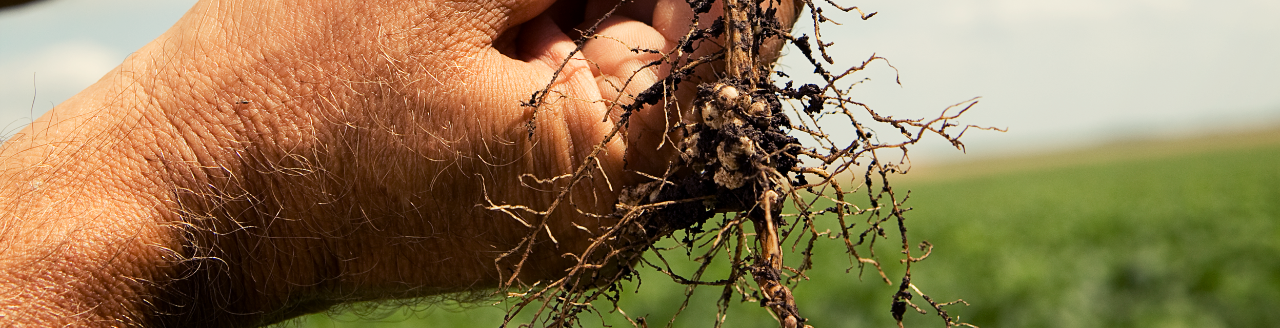
He remembers the first resistant variety list had 29 varieties. Those first resistant varieties were developed with the PI 88788 breeding line, which was effective at the time. (Pictured at top is a low angle view of soybean in field, organic crops growth. Photo courtesy of Igor Stevanovic/Adobe Stock.)
“Once several dozen of these varieties became available, the industry seemed to go on autopilot as far as SCN resistance genetics,” he said.
Focus on soybeans in the industry seemed to shift to herbicide resistance to improve and simplify weed control, he said.
“The result was that we ended up in a ‘rut’ that lasted about 20 years during which virtually all resistant soybean varieties had the same source of resistance, from the breeding line PI 88788,” Tylka said.
As Tylka and others started to warn about efficacy of PI 88788 diminishing, it came at a time as farmers were starting to see the impact of SCN.
The parasite was building up resistance to PI 88788, he said.
“I started to tell farmers you are going to start losing more yield,” Tylka said. “I suggested that they were the customer and they should insist on additional, different SCN resistance genetics.”
Greater emphasis led to use of the breeding line Peking in development of new varieties. Producers now have a choice, and he recommends they alternate growing varieties with the two sources of SCN resistance in their cropping practices and also, if they have the capability to grow corn or wheat or some other crop that is not a host to SCN, they should do that as well.
Without rotation, SCN numbers could continue to build, he said.
With soybean prices in the $10-per-bushel range, a 10 to 50% yield reduction would be a double whammy, he pointed out. Ideally, if a farmer could have a rotation of 50% soybeans and 50% corn or other nonhost, that would be advised.
Proof in the paper
In the 1990s a research paper authored by researchers from several midwestern universities found that SCN could cause up to a 30% yield loss without any obvious symptoms of sickness above ground to the plant.
Recently, variety trials conducted by Tylka’s program with varieties with PI 88788 and with Peking resistance reveal that those with Peking resistance can be much more effective at keeping SCN numbers in check while also producing high yields. One study found that yield of 67 different varieties with SCN resistance from PI 88788 yielded, on average, 22 bushel per acre less than varieties with Peking SCN resistance.
Partners in the SCN Coalition include seed companies and seed treatment companies. The coalition works with industry to educate farmers and those who advise them about emerging management strategies such as transgenic SCN resistance and new seed treatments. It leverages soybean checkoff dollars with industry funds for the ultimate result of benefiting soybean farmers.
That requires research and testing, and there is excitement about potential success, he said. One of those is a new type of SCN resistance being developed by BASF.
“It is based on Bt technology” Tylka says. Researchers found a strain of Bt with a protein that was toxic to SCN and they engineered soybeans to produce that protein.
BASF is projected to have seed for limited acres available in 2028, and then an unlimited release in 2029, he said. If it works as promised, it will be a great new tool in the SCN toolbox. The development schedule is also a reminder that research is important because it takes time to soybean varieties into the hands of farmers.
His advice to farmers is to stay on top of SCN and that PI 88788 can still be a useful source of SCN resistance depending on their situation because there are other variables to the equation.
A free and useful tool
The SCN Coalition has an online profit calculator that farmers can use to help them with each individual field.
They can enter four pieces of information and one being an SCN egg count for a field. The calculating formula is based on the results from more than 35,000 Iowa State University research plots with soybean varieties containing PI 88788 SCN resistance over 20 years.
“It calculates a percent yield loss, and the farmer can indicate what their yield expectation for the field is and a (projected) sale price and the calculator will estimate the dollars lost,” Tylka said.
The free profit checker is available at https://www.thescncoalition.com/profitchecker/calculator/.
Producers must take SCN seriously, and Tylka said they should focus as much on it as they do on weed control.
“We call that active management,” he said. Farmers should actively think about SCN and everything it encompasses. This means knowing what fields have it and what fields don’t. Knowing if they are growing resistant varieties with Peking SCN resistance or PI 88788 resistance or some of each. And knowing what seed treatments are they using.
He likens SCN to farmers who recognize the importance of taking care of themselves and their family from a health perspective. They don’t ignore warnings about high blood pressure and other chronic human health challenges, and they use all available treatments to manage those health problems.
Knowing that SCN is a potential threat to a soybean field must be addressed in a proactive manner.
“It’s best to know you’ve got it and actively embrace the management rather than not thinking about it or addressing it,” he said.
Besides testing, a management program includes rotating resistant varieties, rotating non-host crops, and using a nematode-protectant seed treatment.
Dave Bergmeier can be reached at 620-227-1822 or [email protected].
What is SCN?
By Dave Bergmeier
Soybean cyst nematode is a plant parasite that feeds on plants and is counter to the production of crops.
Nematodes are microscopic worms that occur in soil, water, fresh and salt water, said Greg Tylka. There are several types that can eat fungi, bacteria and organic matter and those all are healthy for the soil.
SCN, though, is among the most damaging of the plant-parasitic nematodes and is specific primarily to soybeans although it can impact other crops including edible beans that are important to North Dakota and southern Minnesota.
Historically, SCN can be traced back to Japan in the early 19th Century, although Tylka said research has indicated ties to China, too. It was first discovered in the United States in 1954 along the coastal areas of North Carolina where researchers believe SCN was present in soil that was brought over from Asia with ornamental plants. About five years ago Tylka traveled to a conference in the state and went to the site where it was first discovered, which was about 15 miles from the coast.
From where it was initially discovered in 1954, SCN spread slowly north and south from North Carolina and eventually also was found in the Bootheel region of southeast Missouri. From there it spread northward, perhaps in soil carried on farm equipment, to northcentral Iowa and southcentral Minnesota.
While SCN spreads slowly, it continues to have the capacity to do so because it can be present on soil on equipment and has been found in windblown from soil collected from snow drifts in late winter.
SCN is in every soybean-producing state except West Virginia, Tylka said.
Tylka and his staff are the “unofficial” keeper of records of in which counties SCN has been found in the U.S. and Canada, and he notes that it has been found in every county in Iowa and Illinois and all but two counties in Indiana, which is not unexpected because those states are historically leaders in production.
Dave Bergmeier can be reached at 620-227-1822 or [email protected].