
FFA chapters seeing growth in Kansas
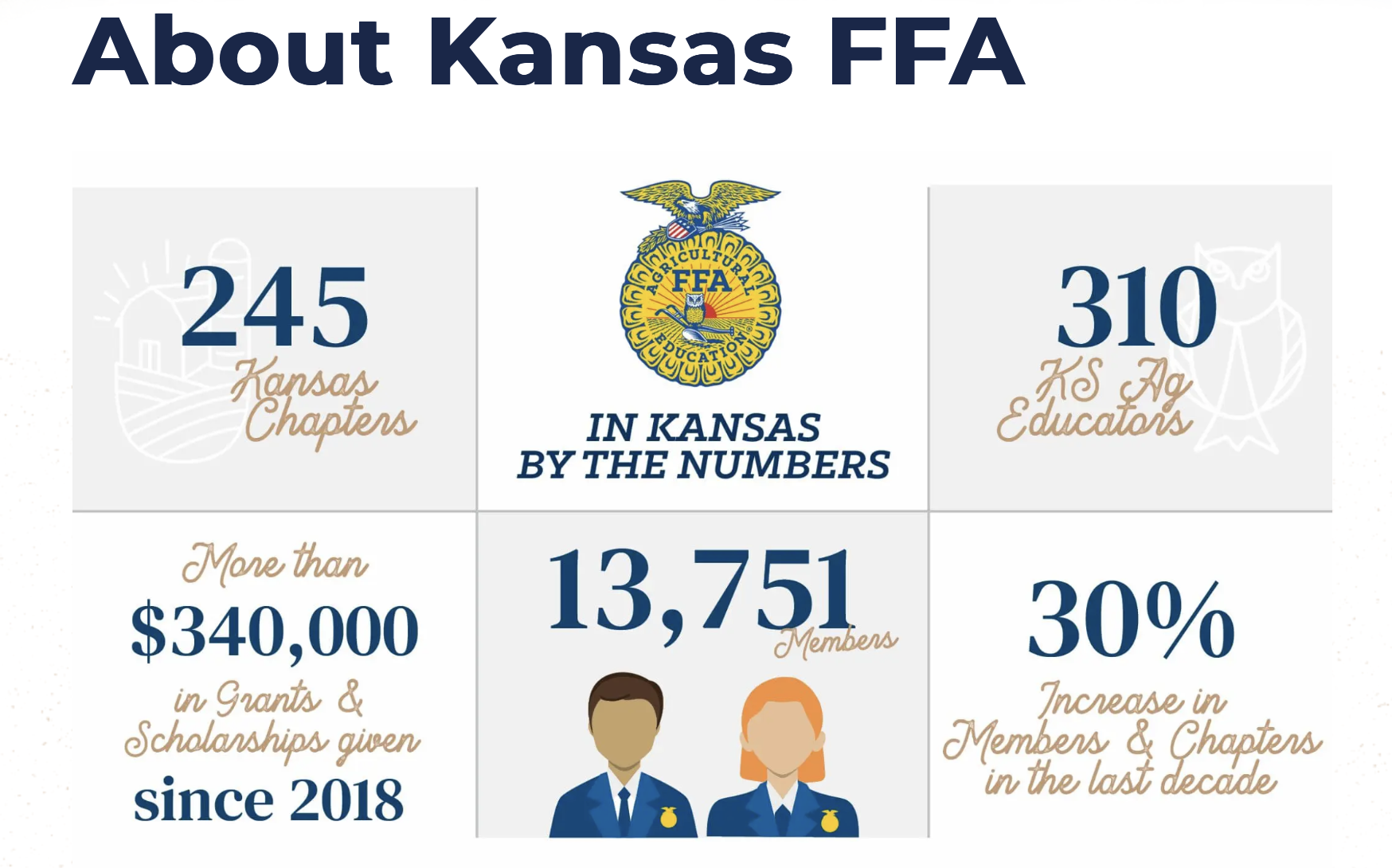
Kansas FFA chapters are growing.
Since 2020, the organization has added 46 new chapters, according to Beth Gaines, Kansas FFA Foundation executive director. Eight have been added in the 2025-2026 school year, with 242 chapters and 14,151 members in the state.
“Kansas FFA is growing—and it’s been a steady, statewide trend, she said. “That growth has pushed us into almost every county. We now have programs in 104 of 105 counties and it represents more than a 35% increase over the last decade.”
Many new chapters are in small, rural communities that previously didn’t have ag instruction or an FFA chapter.
To start a new FFA chapter, the school must first have an agricultural education program, Gaines said. Paperwork for a charter includes filing an application, submitting a roster, a chapter constitution, bylaws, a program of activities and payment of dues.
“Beyond the paperwork, it really is about people and partnerships: an interested school administrator, a committed teacher (or plan to hire one), student interest, and community/business support make a program viable,” Gaines said. “The program and the people must both be in place for success.”
Ag education and FFA can be effective in both large schools and small ones, there are really no limits of effectiveness, she said.
Southwest District FFA Advisor and Bucklin FFA Advisor and instructor, Eric Martin believes growth is important, especially when the agricultural community has such an influence on Kansas’ economy.
“It’s important to give students a foundation in agriculture,” he said. “When I started teaching ag almost 20 years ago, there were 14 chapters in the southwest district. Now, we’ve grown to 31 chapters, so communities in southwest Kansas have found a benefit of growing leaders through FFA.”
In his district, Spearville, Kinsley-Offerle and Pawnee Heights were added in 2025-26, and to him it’s a tremendous opportunity for those kids and communities.
“A good ag program is based on the three-circle model where classroom, FFA and Supervised Agriculture Experience all come together to provide a well-rounded education in agriculture,” Martin said. “Classroom education is the skills they learn during the school day like animal science, welding or ag business. FFA allows students to compete in career development events and grows their leadership skills. SAEs allow students to apply the skills they learned in the classroom and FFA to a project of their own.”
It wasn’t long ago that Martin’s Bucklin program was the new kid on the block. Started in 2012, the community and school district worked many hours behind the scenes to get the program established.
“I grew up in the Bucklin school district and through the years, at different points, community members were supportive of an FFA chapter,” he said. “The stars finally aligned with community, school board and administrative support in 2012. They worked for over a year to have an approved program.”
Even though Martin wasn’t an FFA member himself, he did start his teaching career at Dodge City and was hired to be the advisor at Bucklin. But the benefits far outweigh any challenges.
“The biggest challenge of starting a new chapter in a small school is fitting into a class and activity schedule that had not changed in generations,” Martin said. “It’s also important to be flexible. We had to work with teachers, coaches and sponsors to fit our activities in with already established ones.”
Teacher shortage
Although Kansas is seeing growth in ag programs in schools and FFA chapters getting started, there are places in the United States where programs are in jeopardy partly because of a shortage of ag education teachers.
According to an AgDaily article released Feb. 13, Travis Park, National FFA advisor and director of agricultural education, and chair of the National FFA board of directors, is feeling the crunch.
“We look over the history of agricultural education, and the identification and recruitment of high-quality, talented ag teachers have been a longstanding challenge,” Park told AgDaily “Especially as FFA membership and ag programs have grown in the last 10 years, we really feel the pinch for ag teachers.”
Growth is the primary factor for the shortage, and according to Park, about 150 new FFA chapters are chartered each year, and from 2023 to 2024 there was a net increase of almost 300 agriculture teaching positions nationwide, representing a 2% growth rate.
In Kansas, Gaines is seeing it too.
“The shortage of qualified agricultural education teachers is a real, national problem, and Kansas feels it too,” she said. “National FFA has identified ag teacher shortages as a long-running issue, and Kansas has experienced specific vacancy/at-risk situations, some schools have struggled to hire teachers and have resorted to securing a long-time sub—or bringing teachers out of retirement to keep a program going until the next group of new graduates become available.”
It also limits districts wanting to add a second teacher, she said.
“Another challenge related to teacher availability is the growth within existing programs. Schools are interested in adding a second or even third teacher to expand offerings or include middle school classes,” she said. “They aren’t always able to accomplish those growth goals because they can’t find a teacher.”
Gaines said Kansas has invested in support systems—programs like the Beginning Educator Support Team pre-service scholarships and other pipeline efforts—and why the foundation’s endowment work prioritizes teacher support and retention.
“Those efforts are aimed at preventing program closures as well as supporting growth of new programs,” Gaines said.
For more information about Kansas FFA visit ksffa.org.
Kylene Scott can be reached at 620-227-1804 or [email protected].



