Panelists: Marketing depends on transportation

Expanding options for grain producers require transportation infrastructure to support new markets.
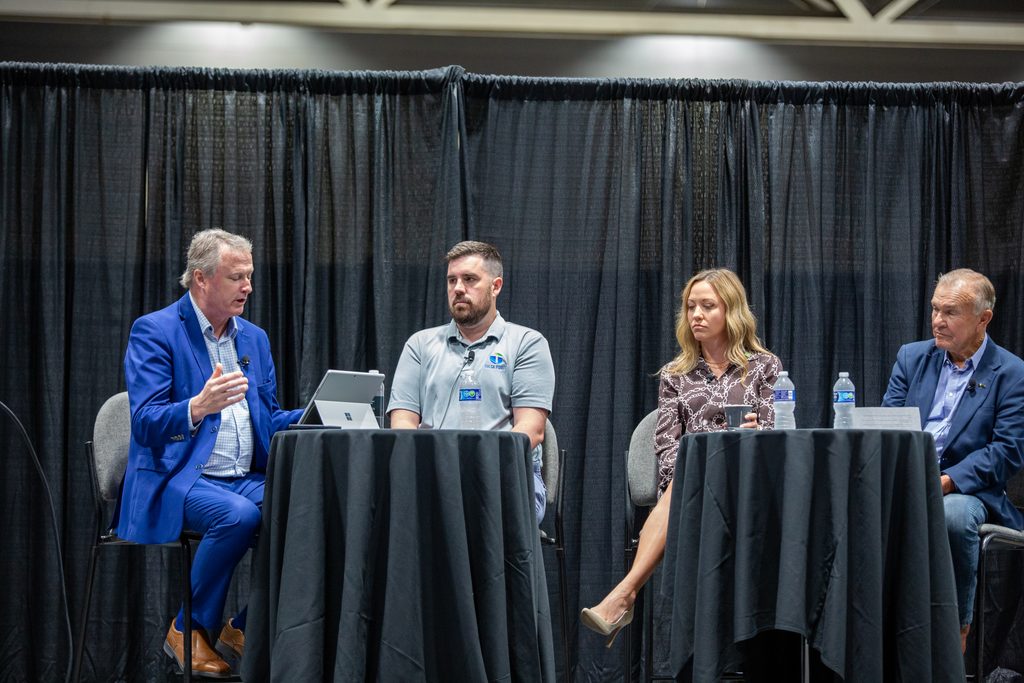
That is the assessment of panelists who spoke during a grain marketing presentation at High Plains Journal’s Crops and Cattle Conference and Ag Expo in Kansas City, Missouri.
Offering their insight were Ron Suppes, a wheat farmer from Dighton, Kansas, and a member of the Kansas Wheat Commission; Bree Baatz, Terrain grains and oilseed analyst; and Jacob Mauldin, manager of safety and security with Tulsa Ports. Moderated by Ken Eriksen, with Polaris Analytics and Consulting and a contributor to High Plains Journal, he guided the panelists and offered his perspective, too.
Suppes said farmers are often competing against their neighbors for quality and price in a commodity-driven marketplace. Besides having limited options when it comes to buying inputs, it also applies to marketing their crop. Wheat has less flexibility than corn and soybeans, he added.
“Most of our wheat is used domestically, and what isn’t goes for exports,” Suppes said, adding freight costs hit producers hard. “Freight from the middle of western Kansas to a mill in Kansas City is 80 cents a bushel most of the time. So, if you take the 80 cents (a bushel) out and you take at least that much to bring your inputs in, you’ve got $1.60 (a bushel).”
When a producer only receives $5.50 a bushel it is easy to see why margins are thin, he said.
Baatz, who at one time worked in the ag division of Union Pacific, said the United States still has a competitive advantage over other countries as a global exporter because of transportation and logistics. At Terrain she not only looks at pricing commodities on a three- to six-month window, she and economists are also focused on what the grains picture is going to look far into the future.
She said the last 30 years, many in U.S. agriculture have been focused on China. She agreed with C&C keynote speaker Seth Meyer that strategy has to change. Baatz said the global marketplace is already changing and finding new countries is a better strategy and diversifies the U.S. customer base.
Linking the marketplace
Mauldin said the Tulsa Port of Catoosa can be an important link. The Oklahoma port is a key player as it processes about 2 million tons a year of commerce. Mauldin said 90% of the commerce is ag-related —that includes imported granular fertilizer plus it also exports soybeans and wheat. The Bartlett Soybean Processing Facility in Cherryvale, Kansas, is an important customer with its soybean meal.
The South Kansas & Oklahoma Railroad has a direct line to get the soybean meal to the Port of Catoosa, he said.
Mauldin said the Tulsa Port is in the process of building a $20 million unit train facility that would allow shipments that can take grain to the West Coast and eliminate empty containers and that increases efficiency and builds profits. Midwest farmers will benefit, too.
“That’s the goal,” he said. “That’s the future.”
A complex system
Suppes often tells younger farmers they need to look at their farm storage options because he believes that with better transportation infrastructure they can redefine their marketing program.
“They need to try to get away from producing commodities and try to produce something called an ingredient—even though it’s wheat— it could be a different kind of wheat,” Suppes said, adding that’s where they could benefit from the Tulsa Port’s container plan.
Specialty crops are likely going to be stored on the farm, he said, adding the end goal is that product can get to someone who is willing to pay more whether it is in a domestic or international market to consider building a relationship with a local elevator for storage.
Mauldin said rail companies traditionally want to only carry large volumes, but the Port’s unit train plan with BNSF Railway can give them another avenue.
There are other opportunities particularly with non-GMO crops, such as sorghum and non-GMO soybeans on the international market and that’s been a point that has helped sell the project to the rail companies, he said.
Baatz said the marketplace is evolving, particularly for soybeans,
“We have a much more diversified buyer base,” she said. “Almost 70 countries buy soybean meal, and so having domestic processing built here in the United States is another feather in our cap.”
Those countries are also developing a middle class, and that means improved diets, Baatz said. Those consumers are eating more protein-based diets and that is good feeding animals and U.S. can meet that need because it has a competitive advantage.
“Those countries, because they are smaller, they don’t need unit trains or full boats of soybeans,” she said.
Those countries need smaller specialized shipments, whether that’s for dried distillers grain produced during the ethanol process, corn milling, gluten, or soybean meal.
Eriksen said railroads need volumes and agriculture helps them with that equation, and the rail industry is showing it can adapt. He acknowledges it can be expensive, particularly for producers who live in a small, rural community without rail service.
Farmers need to stay in contact with state legislators, who can direct state policy that can make hauling grain by semi-tractor trailers to be more efficient in getting their product to ports, Eriksen said.
Dave Bergmeier can be reached at 620-227-1822 or [email protected].