UADA Pit-less Tailwater Pump now commercially available to farmers
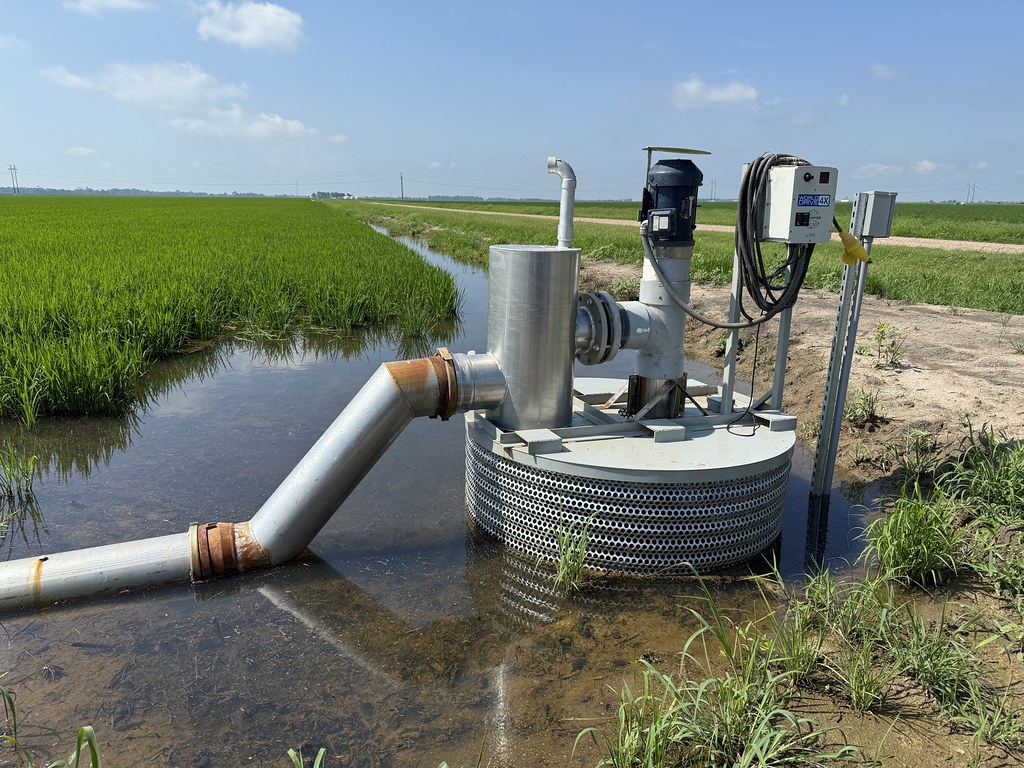
After more than a decade of research, engineering optimization, and on-farm testing, an irrigation technology developed in Arkansas to help farmers conserve groundwater and improve yields in furrow-irrigated cropping systems is now commercially available.
The Pit-less Tailwater Pump, which has shown significant improvements in water use and yield in furrow-irrigated rice, is now being manufactured and sold by Irrigation-Mart, Inc. with a license through the University of Arkansas Division of Agriculture’s Technology Commercialization Office.
“This is an important step because farmers can now purchase this technology and put it to work on their farms,” said Christopher Henry, inventor of the patented technology and a professor and water management engineer with the Arkansas Agricultural Experiment Station and the Cooperative Extension Service, UADA’s research and outreach arms.
Making row rice competitive
During the development of the irrigation system, researchers identified a few key advantages.
The system allows farmers to grow furrow-irrigated rice, or “row rice,” with no difference in yield compared to flooded rice. It also avoids a $95-per-acre or more cost of tillage and labor to convert flooded fields with levees back to a furrow-irrigated field in a rice-soybean crop rotation.
The costs of constructing and taking down levees can be higher on heavier clay soils, where some producers pull levees as many as six times to get them formed, said Brad Watkins, a professor in the department of agricultural economics and agribusiness.
Benefits would also extend into harvest season, Watkins added.
“The biggest difference in costs would be harvesting costs associated with moving a combine across a furrow-irrigated field faster than a levee field,” he said.
Another advantage of the system in row rice, Henry noted, was the ability to more easily incorporate cover crops, no-till or reduced-tillage practices, and biochar amendments into rice production. The practices can be difficult to integrate when fields regularly transition between soybeans and flooded rice, Henry said.
By the numbers
Previous UADA research found that conventional furrow-irrigated rice yielded 16.7 fewer bushels per acre than rice grown in a levee system. However, using the Pit-less Tailwater Pump with row rice, yields have not been different from nearby flooded fields.
“The system really solves many of the downsides of furrow-irrigated rice,” Henry said. “It gives farmers a practical tool that allows them to use less water, keep water on the field, plant sooner, have more consistent grain moisture from top to bottom of the field, harvest faster, reduce machinery cost, reduce energy cost for irrigation, and have improved yields in years with less summer rainfall.”
In a three-year comparison in rice, the pit-less tailwater irrigation system averaged 190.4 bushels per acre using 16.1 acre-inches of irrigation water, compared with 175.1 bushels per acre and 22.1 acre-inches under a conventional three-day irrigation treatment in furrow-irrigated rice. This translates to a 27 percent reduction in irrigation water, a 15.3-bushel-per-acre yield advantage and a 24 percent improvement in total water-use efficiency.
Stephen Hoskyn, an Arkansas farmer, used one of the first pre-production Pit-less Tailwater Pumps to win UADA’s Most Crop per Drop irrigation contest.
“I would not grow row rice without this system,” Hoskyn said.
Designed for farmer installation
The system was designed for affordability and ease of installation by farmers, Henry said. It consists of a prefabricated sump, lid, lightweight pump and standpipe assembly.
Given its relatively low power requirement, Henry noted that the pump can be installed by farmers at a considerable distance from utility power using smaller, direct-bury wires. The entire system has also been engineered to be semi-portable for rotating between fields, he said.
NRCS incentives program deadline Nov. 20
Arkansas farmers interested in adopting the technology may be eligible for financial assistance through the U.S. Department of Agriculture’s Natural Resources Conservation Service Environmental Quality Incentives Program, also known as EQIP. The application deadline for submissions is Nov. 20.
Cooperative Extension Service offices in each of the state’s 75 counties are available for assistance in learning more about the patented technology.
Producers interested in the Pit-less Tailwater Pump, or in applying for EQIP assistance, may also contact Joe Schafer, an irrigation program associate with UADA, or their local USDA NRCS office. Schafer or Henry will visit the site, develop a plan and help with the NRCS EQIP application process, thanks to support from the Arkansas Natural Resource Conservation Service.
Research, development and commercialization of the irrigation system have been supported by the U.S. Department of Energy, the Arkansas Rice Research and Promotion Board, the NRCS in Arkansas, and the Arkansas Soybean Promotion Board.
PHOTO: The patented Pit-less Tailwater Pump was recently licensed through the University of Arkansas Division of Agriculture’s Technology Commercialization Office to Irrigation-Mart, Inc. for manufacture and sale. (UADA photo)