
Candid advice from high yield commodity winners
It’s the goal of most commodity growers—to raise a crop that tops all others in their state or even the nation. However, all the pieces must come together just right for a plot of land to win a yield contest—some of it is timely weather—but a great deal is decision-making on the farmer’s part.
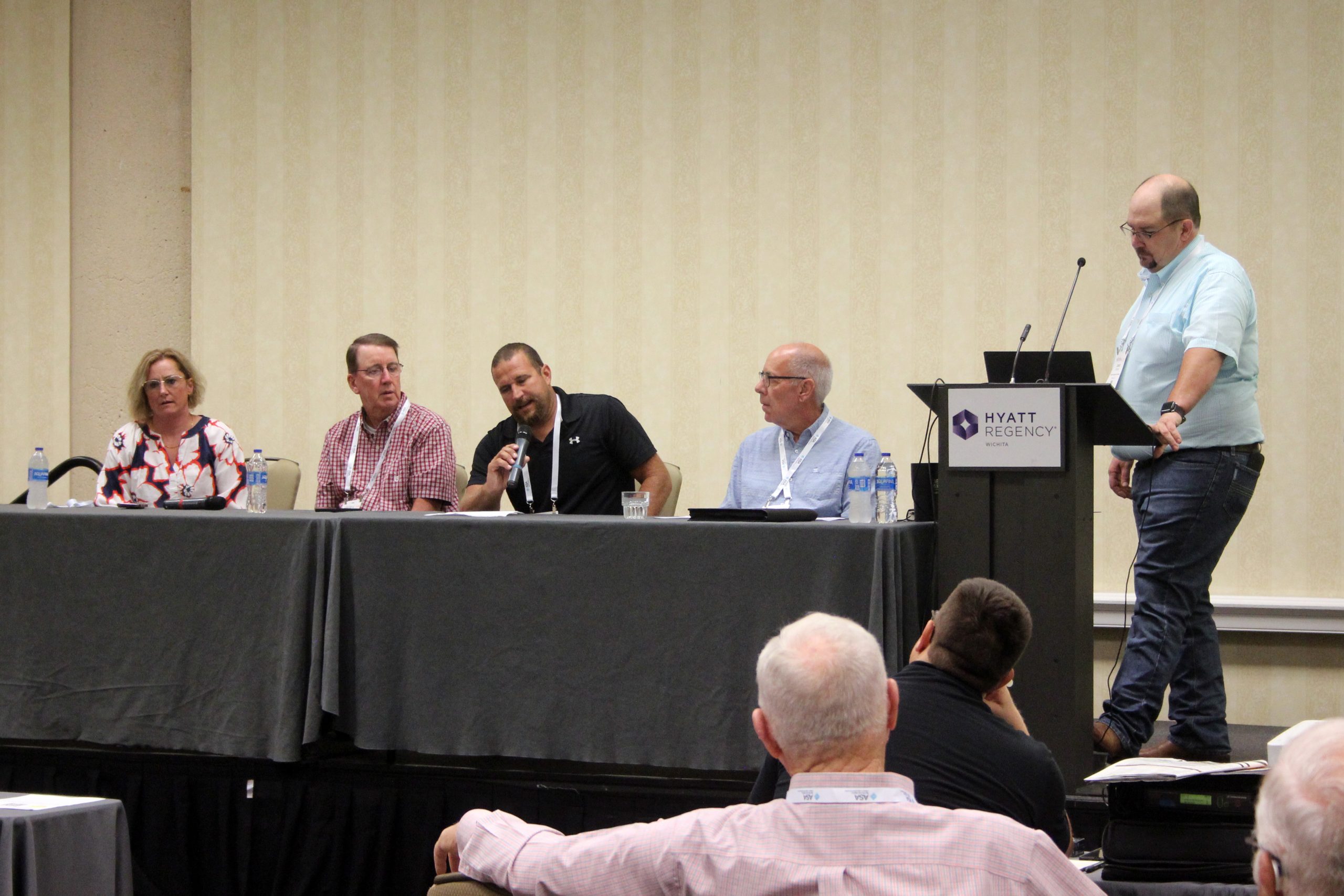
During one of the breakout sessions at the HPJ Live event in August, four past yield contest winners in the areas of wheat, sorghum, corn, and soybeans discussed how they have improved yields for their entries, which has translated to improved overall profitability on the farm.
Farmer panelists
Amy Peterson, Alex Noll, Rod Stewart, and Darwin Ediger served as panelists for the session on high yield, while Dave Deken, president of AgNow Media LLC, moderated the panel.
Peterson hails from Stanton County, Kansas, and farms with her husband, Brant, on an operation called Winsome Farms. The Petersons grow corn, wheat and sorghum and have won the National Sorghum Producer yield contest, as well as the Bin Buster Award for 245.80 bushel per acre sorghum in 2023.
Noll lives in Jefferson County, Kansas, and grows corn, soybeans and soft wheat. He received first place in the 2023 Kansas dryland wheat yield contest with a yield of 103.99 BPA. He also won the Kansas Corn Yield contest, setting a state record in 2024 with a dryland entry that yielded 340.39 BPA. In addition, his wife Traci took the top overall irrigated placing with 328.98 BPA corn the same year.
Stewart farms with his family in Washington County, Kansas. He produces corn, soybeans and grain sorghum. He has placed multiple times in the Kansas Soybean Yield and Values Contest, including winning the 2022 north central conventional-till division with a yield of 61.09 BPA.
Ediger hails from southwest Kansas, and farms with his son, Tyler, and two grandsons. They raise dryland wheat for seed, sorghum and corn. Ediger received first and second place in the 2021 Kansas division for the National Wheat Yield Contest. Their dryland-winning entry yielded 125.66 BPA, and the second-place entry was 123.48 BPA.
Lessons these producers have learned
Deken started off by asking the panelists what advice they could give to other producers to improve their overall crop yields. Noll said he has learned over the years to ignore what his neighbors say or think and do what works for his operation.
“In the grand scheme of things, I could really care less if they have an opinion on what I’m doing,” Noll said. “What probably separated us 10 to 12 years ago on high yield, is that we got rid of those preconceived notions and tried to think outside of the box, and not going with the flow with what everyone’s grandfather did.”
Stewart said paying attention to detail and getting the job done right in the first place has helped him most in improving yield on his operation.
“I’m meticulous about my planter,” Stewart said. “I want everything to work properly, like it’s supposed to. A lot of guys want to be the first one in the field, but we just want to do a good job.”
For Peterson, being intentional and efficient with input application improves yields and profits, which are intrinsically tied together. Every field requires a strategy on behalf of the farmer to give it the best path forward to its highest potential yield.
“You’ve got to put your money where the good spots are on all your fields,” Peterson said. “I think we can all agree that you’re not going to get high yielding sorghum on your crappiest ground. We took over some acres a few years back that my husband’s grandpa had been farming for a long time, and you can tell who takes care of their stuff and really gives back to it, and when you take over a new piece that has not been treated that way, you’re not going to be winning a yield contest with that any time soon.”
Fertility is the foundation
All of the panelists agreed no field will win a yield contest if the fertility is not properly balanced, setting up the crop for the best possible outcome. Ediger said when it comes to wheat production, a proper understanding of soil fertility and geographic location is key.
“It takes 200 pounds of nitrogen to raise 100-bushel wheat,” Ediger said. “Sometimes it takes more, depending on what’s in your soil.”
In addition, he recommended every producer grid sample their fields as a first step.
“I’m talking about balanced fertility, not necessarily high fertility, because your phosphorus and zinc ratios need to be right,” Ediger said. “If you have too much phosphorus, your zinc is not going to get taken up. If you haven’t grid sampled, you need to do that. It’s $12 to $15 an acre, and you need to do it at least one time.”
Noll agreed and noted the value of precision agriculture in applying nutrients only where they are needed. He said he started using full-variable rate fertility on his operation in 1998, and it has helped him become more efficient and raised his yields.
“We started with 2.5-acre grids to kind of establish a benchmark,” Noll explained. “Then we progressed to 1.6 acres, and then 1.1-acre grids. And at this point in time, we’re told that’s the highest refinement we can get out of a piece of equipment that travels across the field, but we are utilizing that on our nitrogen as well. We overlay those with vertical rate planning maps, and we’ve gotten into doing a lot of foliar feeding to compliment it in areas where we have soil deficiencies.”
Stewart said in addition to grid sampling, he also implements two rounds of tissue sampling each year. Then his son, who owns a drone spraying business, can use the data to isolate nutrient deficiencies in the fields and foliar feed those areas of the crop.
Plant spacing and seed selection
Sometimes minor changes, such as row spacing and seed variety, can give a field a bump on the yield monitor. Noll said he plants his corn on 30-inch rows, and he credits an ExactEmerge John Deere planter for equally spaced seed every time.
“Essentially, if you go out and mark off a 1,000th of a row, you’re going to find that your common denominator on your smaller ears or your lower ear weights are plants that are not equally spaced,” he said.
Stewart said adjusting row spacing can also help improve weed pressure in multiple commodities. He plants corn on 30-inch rows, and his sorghum and soybeans are on 15-inch rows. Peterson said she has seen great improvements in weed control with strip-tilling as well.
“Over the last 15 years, strip-tilling into wheat stubble has been a big deal for us, as far as going right back in and being able to plant the sorghum right into that stubble and keep the weed pressure down,” Peterson said. “It’s been a game changer.”
Ediger said knowing the characteristics of the seed you plant and its yield potential is also crucial.
“Any wheat variety can make 70-, 80-, 90-bushel wheat, but when we’re talking about high yield, we mean 100-plus,” Ediger said. “For that, you need a variety that has the capability to do that. You also need a variety that can stand up when you push the nitrogen to that crop to make 120-bushel wheat. If you’re throwing seed out there by the pound, and you don’t know the characteristics of the seed, the tillering ability and the seed size, you’re just gambling.”
Rainfall challenges
Moisture is the is the most important factor for dryland farmers. Peterson said most of the time it’s not about how much rain is received, but the timeliness of it.
“On our yield-winning year, it was the timely rains that really made a big difference in a short amount of time,” she said. “When you’re dealing with water, it’s a pretty limiting factor. You’ve got to have it to get there.”
Peterson said newer technologies, such as Dragon-Line mobile drip irrigation, have allowed producers in arid regions like southwest Kansas to increase yields and conserve water simultaneously. She sees great potential for irrigation strategies like these in the future.
Stewart, who is mostly dryland, credits his no-till program and the hybrid seed and emerging plant varieties that provide drought tolerance for helping him conserve water on his operation. He said his decision to plant in narrow rows has also helped improve moisture retention.
“We shade those rows, so we don’t lose water as quickly,” Stewart said. “Basically, the only way we can water our crops is when it rains. We have to rely on what Mother Nature gives us and we can conserve it.”
Ediger noted how much higher yield averages are today compared to 30 to 40 years ago, even with the same rainfall amounts. He said that means it’s more about fertility than how much rain falls from the sky.
“If you’ve got water use efficiency with no-till, you gather more moisture when you have a good fertility program,” Ediger said. “Your wheat is much more efficient at taking in water. If you’re short a fertilizer element, your plants are going to pull in moisture to try and get that element that is missing. If all the elements are there, the wheat kind of relaxes and sips a little water, so your water use is a lot more efficient.”
Lacey Vilhauer can be reached at 620-227-1871 or [email protected].
PHOTO: High yield panelists at HPJ Live included Amy Peterson, Rod Stewart, Alex Noll, and Darwin Ediger. Dave Deken served as the moderator. (Journal photo by Lacey Vilhauer.)
Related coverage and resources
- Related on HPJ: Corn yield record-breakers are a team
- Related on HPJ: NSP announces 2024 Sorghum Yield Contest winners
- Outside resource: USDA ERS — Wheat



