Corn growers, like soybean and sorghum farmers, have a keen interest in controlling weeds. They know the task is not easy.
Chad Godsey, with Godsey Precision Ag, Eckley, Colorado, said scouting and identifying weeds that include waterhemp and palmer amaranth remains an important task. Catching them early in their growth cycle is the best plan for success. He said producers who work proactively with a crop consultant to have a residual plan tend to out-perform farmers who only react.
Rotating crops can help break up the effectiveness of weeds, he said. He also stressed that producers should not overly rely on certain chemistries, because weeds quickly build resistance. A different mode of action each year can help.
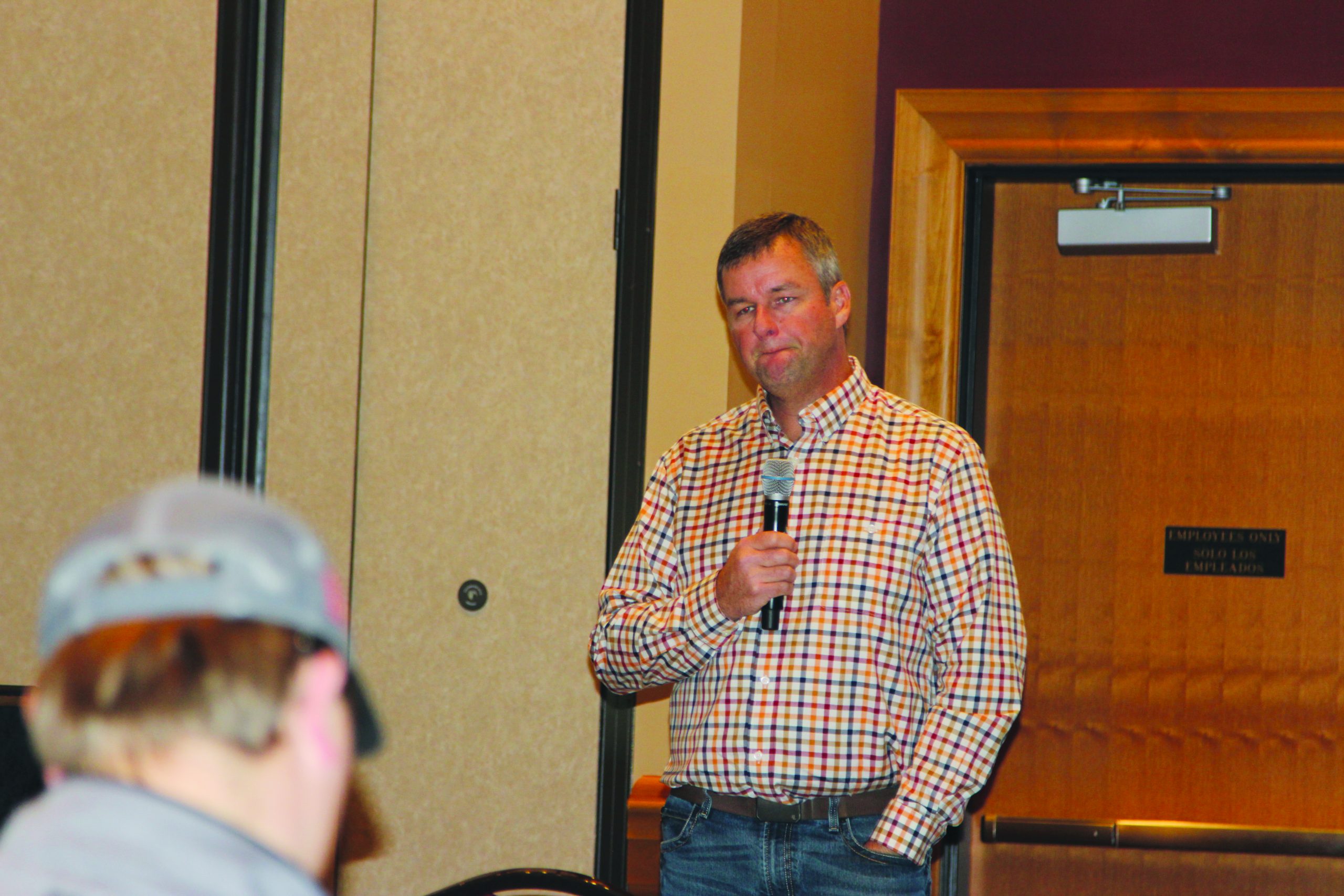
Godsey, pictured at top, was a presenter during the recent Kansas Corn and Soybean Agronomy series at the United Wireless Arena in Dodge City.
He also looked at newer technology where spray equipment uses sensors to apply herbicides. Godsey said John Deere’s See and Spray is one of the best-known products, but there are others available.
“The systems have been around for awhile,” he said, which can give producers a sense of confidence in their effectiveness. “There are a lot of options out there,” Godsey said. “They all work.”
Most manufacturers have adjustable boom heights and they and they can travel at speeds of 12 to 15 miles per hour in fields. The best efficacy is when made the weeds are considered in the low-density stage.
“Herbicide savings depend heavily on seed pressure,” he said.
Godsey said that with price of corn and tighter margins expected in 2026, it may be a year where large-scale investment in spray technology may not be feasible for many, but he encouraged producers to do what they can control and keep an eye on the long-term strategy because weed pressure is here to stay.
Godsey said herbicide savings is a question he gets particularly when corn prices are low; however, producers should avoid a “set and forget” strategy.
“The best results come from pairing a strong residual foundation with targeted post application,” he said.
In northeast Colorado, where the ideal planting date was April 20, growers have found that waiting an additional five to seven days before planting, they can actually experience better efficacy.
“The earlier planted corn and beans is where weeds were the worst,” Godsey said. “I know weed control is not easy, but we have products available to be 85 to 90% effective.”
Godsey also reviewed nitrogen and other nutrient application strategies.
Other corn challenges
Sophie Filbert, a research associate in the department of plant pathology at Kansas State University, discussed how growers can identify several types of leaf hoppers. Corn leafhopper does reduce yields because it intervenes with kernel development and interrupts sugar flow. The plant turns purple.
“Not all leafhoppers are corn leafhoppers,” she added.
She also said that a purple corn leaf can also be an indication of pollinator challenges.
She encouraged growers to follow the Corn Disease Resource Center, a cooperative project with the K-State Plant Pathology Department and the Kansas Corn Commission that provides growers with regular updates.
Rodrigo Onofre, an assistant professor and Extension row crop specialist in the department of plant pathology at K-State, said tar spot is a crop disease that has a pathogenic infection. It can survive in corn residue and spores can be spread.
“Severe tar spot can reduce yields,” he said, adding that farmers who harvest it as silage can also see a reduction in production.
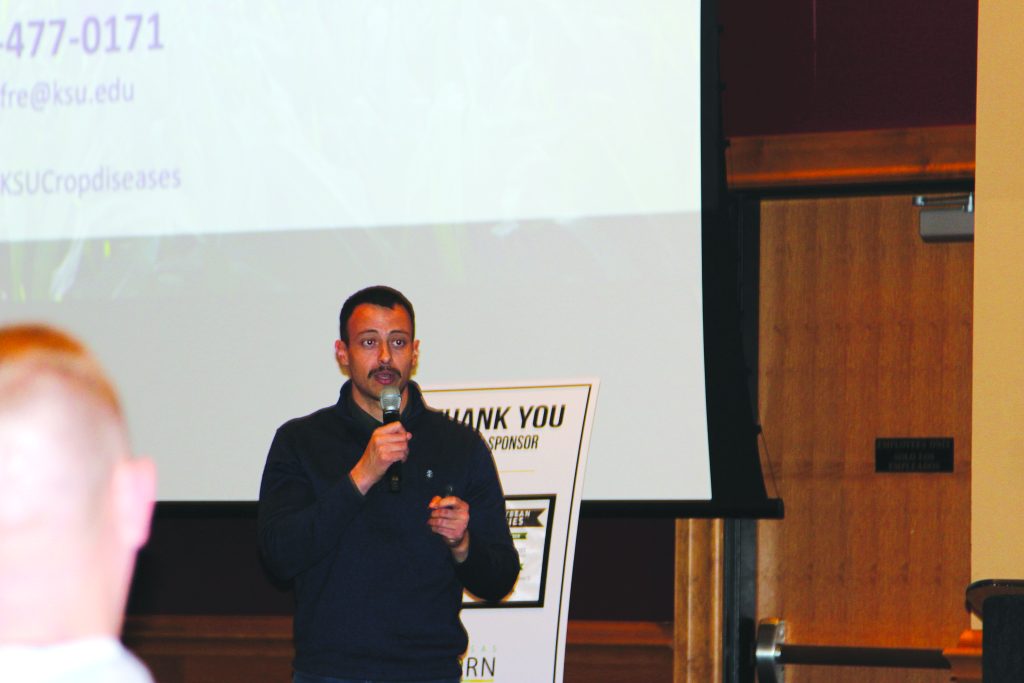
Tar spot has not been reported in southwest Kansas, but it is a disease that has expanded its boundaries. “Scouting will be important,” Onofre said.
He encouraged growers to look at hybrids that have resistance. He also discussed fungicide strategies for producers.
Other presenters included Chris Kasten with Agrimodis and Chris Perkins with Agrimodis/Banded Ag LLC, who talked about planting strategies applied in Indiana; and Matt Clark, a senior rural economist who provided an overall economy outlook with Terrain Ag. Also, Steve Watkins with Watkins Realty Insurance Agency, Hoxie, Kansas, provided an overview about crop insurance programs and what the One Big Beautiful Bill Act will mean for producers.
Dave Bergmeier can be reached at 620-227-1822 or [email protected].