February wildfire spread quickly across two states
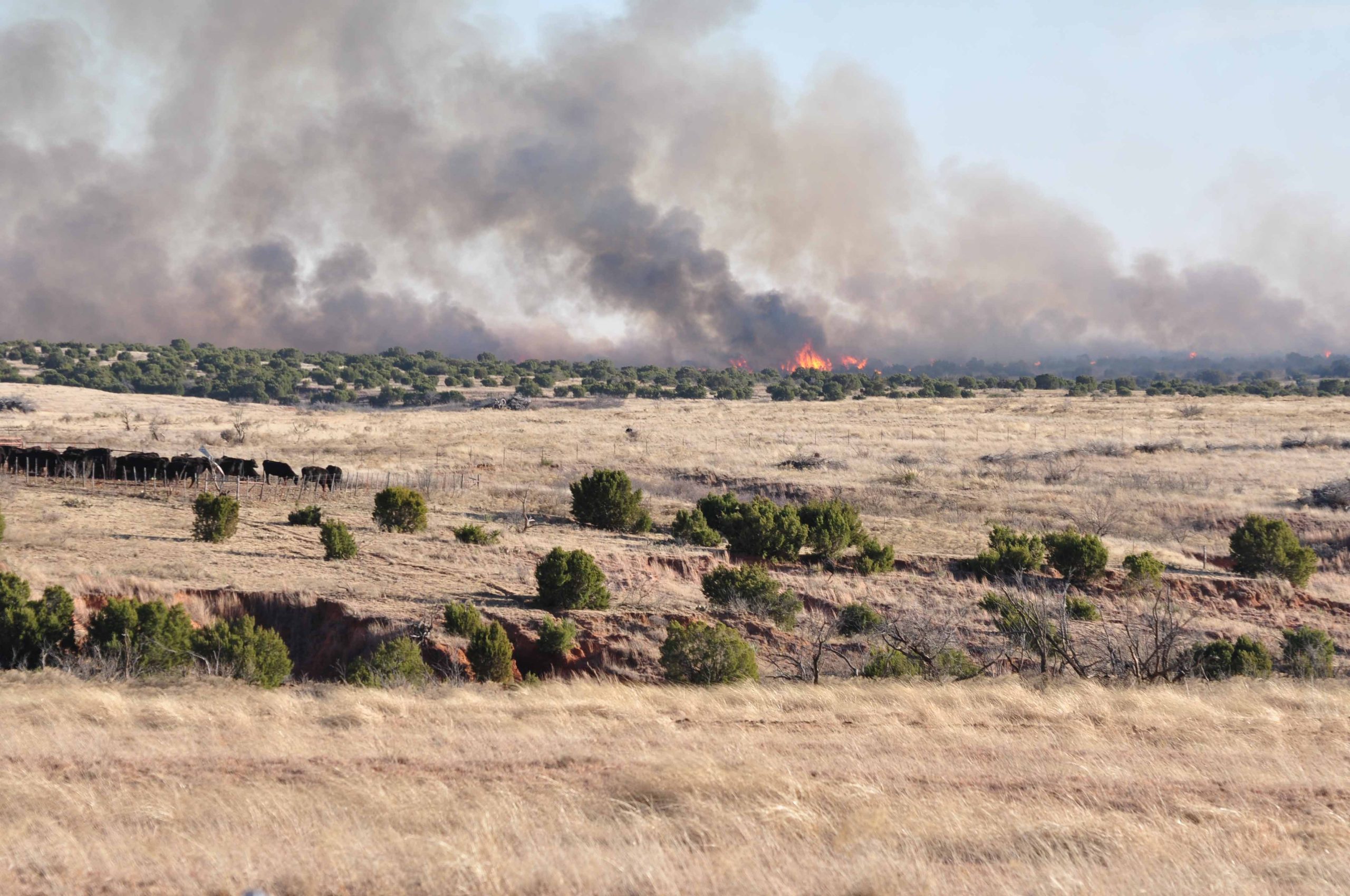
Weather conditions led to a large rangeland fire that consumed more than 280,000 acres in Oklahoma and Kansas and while it has not yielded any human deaths or injuries, there are reports of livestock and wildlife deaths.
The wildfire started Feb. 17 in Beaver County, Oklahoma, because of extremely low humidity and high winds, and it quickly spread from northwest Oklahoma to southwest Kansas.
Chip Redmond, Kansas State University assistant meteorologist and K-State Weather DataLibrary and Mesonet manager, said on a Facebook post before the wildfire that vegetation across Kansas is drying rapidly as warm temperatures and strong winds continue. “As conditions degrade throughout the week, fuels will become more receptive to fire. We are transitioning into the typical spring fire season pattern — when fires can start easily and spread quickly.”
Firefighters have spent many hours over multiple days on control efforts. On Feb. 17, the scope of fire led authorities to evacuate Englewood and Ashland, in Kansas, and Tyrone, in Oklahoma.
More favorable weather on Feb. 18 allowed aerial and ground firefighting efforts to help knock down the fire.
Gardiner Angus Ranch, in Clark County, noted the fire’s impact in a Facebook post.
“We are thankful for all the messages of concern and comfort these past 24 hours. Although we have lost pastures, our structures are safe. Although we lost cattle, unlike the Starbuck Fire nine years ago, we were able to save most of the herd yesterday. Our employees and their families, and our families are safe. Clark County and Ashland, Kansas, is our home.
“We are thankful to be safe and truly believe it is a privilege to get to do what we do each day. We are grateful for your thoughts and prayers for our well-being. We are no less determined today than we were yesterday and will be tomorrow to embrace every challenge to be the best stewards of the land God intended us to be. We go forward.”
Oklahoma Gov. Kevin Stitt had declared a state of emergency in Beaver, Texas and Woodward counties, according to the Oklahoma Department of Emergency Management.
Six Oklahoma Forestry Services fire suppression teams were pre-positioned Feb. 18 in Beaver, Texas, Woodward, Henryetta, and Shawnee counties. Four of the teams responded to fires throughout the day.
OFS reports the following updated fire estimates:
- Ranger Road Fire (Beaver County / Kansas): 283,283 Acres – 15% Contained
- Stevens Fire (Texas County): 12,428 Acres – 50% Contained
- Side Road Fire (Texas County): 3,680 Acres – 60% Contained
- 43 Fire (Woodward County): 1,680 Acres – 30% Contained
- 206 Road Fire (Woodward County): 160 Acres
Additionally, on Feb. 18, the state’s emergency operations center received reports of 33 fires and hotspots in 23 counties, including: Atoka, Beckham, Blaine, Bryan, Carter, Coal, Custer, Garvin, Hughes, Kay, Lincoln, Logan, Love, Marshall, Mustang, Oklahoma, Okmulgee, Pontotoc, Pottawatomie, Stephens, Tillman, Woods, and Woodward.
Kansas also had multiple counties reporting fires. A dust storm caused a multi-vehicle accident that claimed the life of a Kansan on Interstate 70 in northwest Kansas on Feb. 17. A dust storm in southern Colorado near Pueblo on I-25 resulted in the death of five people and injured 29 people in a 36-vehicle pile up.
Another wildfire near the community of Herndon northwest caused authorities to urge evacuation of the Rawlins County town.
Kansas Gov. Laura Kelly issued a state of disaster emergency declaration before noon Feb. 15, for fires anticipated from Feb. 17 to 19. Many of these wildfires have resulted in agricultural losses, including the loss of livestock.
The Kansas Department of Agriculture has created a page on the KDA website to serve as a single location dedicated primarily to address agricultural impacts from wildfires where farmers, ranchers, and others in the industry can find resources to assist them in recovery. KDA continues to work with local, state and federal partners as well as agriculture organizations, all of which stand ready to assist as needed.
This page—www.agriculture.ks.gov/Recovery—will continue to expand and adapt as needs are made known.
Oklahoma Department of Emergency Management is asking residents impacted by the fires to report damages to their property at damage.ok.gov. Reporting damage helps local and state emergency managers better coordinate response and recovery efforts and can help connect residents with resources. Residents can report damage to homes, businesses or agriculture through the online survey.
The Federal Emergency Management Agency approved the state’s request Feb. 17 for three Fire Management Assistance Grants for the Stevens Fire in Texas County, the Ranger Road Fire in Beaver County, and the 43 Fire in Woodward County.
The FMAGs may help reimburse local governments, volunteer fire departments and other first responders for costs associated with responding to the fires. The authorization makes FEMA funding available to reimburse 75% of state, local and tribal government eligible firefighting costs for the designated fires. Fire departments and other agencies that responded to the fires above are advised to document all costs related to equipment and supplies (including fuel), labor costs, travel and per diem, temporary repairs of damage caused by firefighting activities, mobilization, and demobilization.
Dave Bergmeier can be reached at 620-227-1822 or [email protected].