
Significant rain hits High Plains
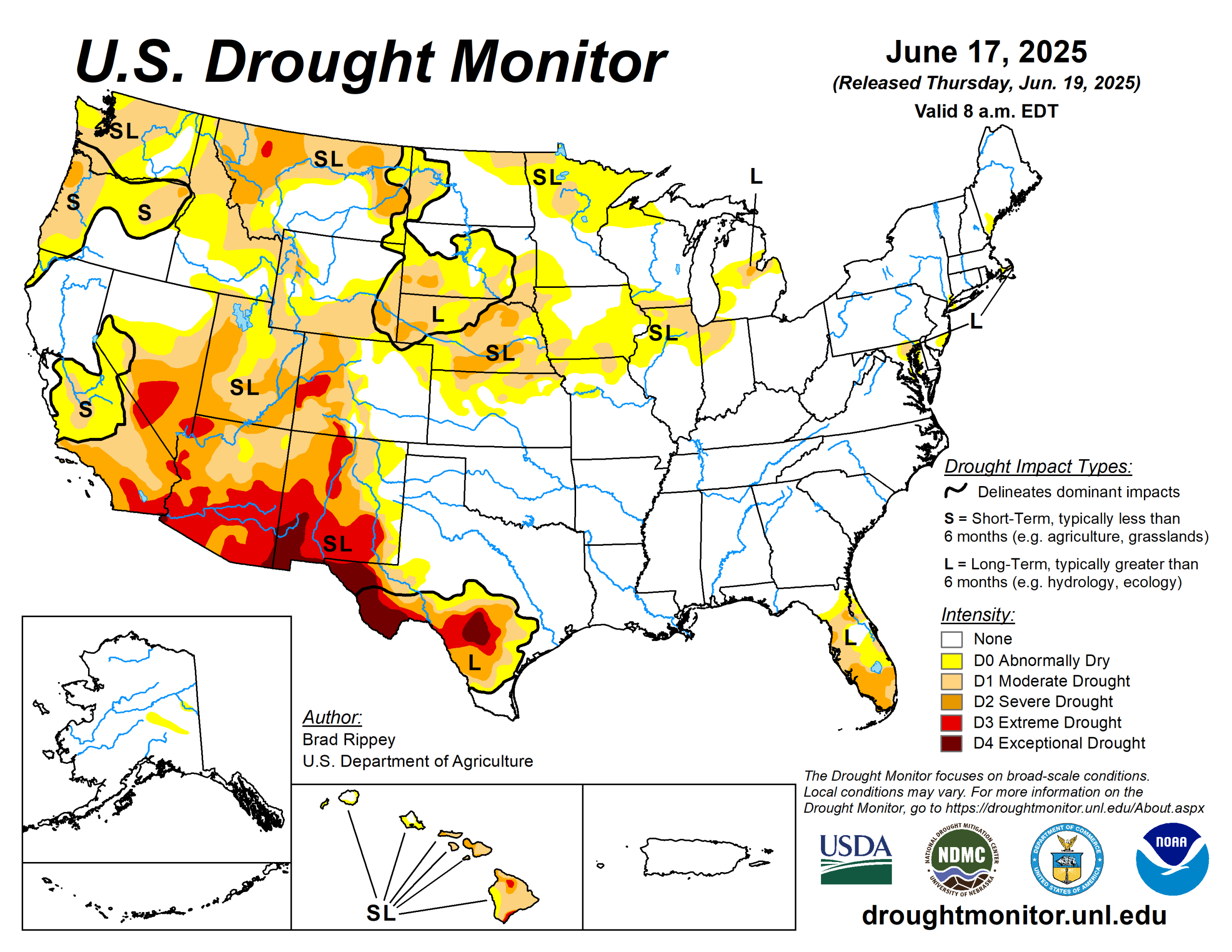
Active weather east of the Rockies led to significant reductions in drought coverage, especially in Florida, Texas, the northern and central Plains, and the upper Midwest.
Amid early-summer showers, drought-free conditions largely continued from the southern Plains to the Atlantic Coast, excluding parts of Florida. Meanwhile, a western hot spell—accompanied by short-term dryness across roughly the northern half of the region—was manifested in rapidly developing soil moisture shortages, declining prospects for summer water supplies, an elevated wildfire threat, a boost in irrigation demands, and increased stress on rain-fed crops.
The U.S. Drought Monitor is jointly produced by the National Drought Mitigation Center at the University of Nebraska-Lincoln, the U.S. Department of Agriculture and the National Oceanic Atmospheric Administration. (Map courtesy of NDMC.)
South
Downpours in parts of Texas, the only state in the region still experiencing drought, delivered significant relief but also sparked flooding.
In fact, deadly flash flooding struck the San Antonio area on June 12, when the official airport observation site received 6.11 inches—the second-wettest June day on record in that location, behind only 6.18 inches on June 3, 1951.
San Antonio also set a one-hour station rainfall record for any time of year, with 3.98 inches falling from 3 to 4 a.m. In drought-affected areas where heavier rain fell, some of the water was lost due to runoff, rather than absorption into parched soils.
Additionally, groundwater and aquifer depletion in south-central Texas and neighboring areas has developed over many years—and will require much more than a singular heavy-rainfall event for replenishment.
Midwest
The drought-monitoring period began with drought covering less than 9% of the Midwest. Showers and thunderstorms chipped away at existing dryness (D0) and moderate to severe drought (D1 to D2), although not all areas received significant rain.
Some of the most substantial drought relief occurred in the upper Great Lakes region and parts of the western Corn Belt. On June 15, Iowa led the Midwest with topsoil moisture rated 27% very short to short, according to the U.S. Department of Agriculture.
High Plains
Rain-related drought improvement dominated the High Plains, although some significant drought-related agricultural problems persisted. By June 15, statewide topsoil moisture ratings on the High Plains ranged from 19% very short to short in Kansas to 50% in Wyoming, according to the U.S. Department of Agriculture.
Wyoming led the region on that date with 36% of its rangeland and pastures rated in very poor to poor condition, followed by Nebraska at 30%. Elsewhere, significant rain bypassed a few areas, including northeastern North Dakota, where moderate drought (D1) expanded.
West
In contrast to areas east of the Rockies, mostly dry weather dominated the West during the drought-monitoring period. Rapid surface drying and prematurely melting (or melted) snowpack had led to a variety of agricultural and water-supply issues and concerns.
The Northwest has been especially dry in recent weeks, with topsoil moisture—as reported by the U.S. Department of Agriculture on June 15—rated 65% very short to short in Montana. Montana received some much-needed precipitation in mid-June—but continued to experience agricultural drought impacts. For example, Montana’s rangeland and pastures were rated 46% in very poor to poor condition on June 15.
Among major production states, Montana led the nation on that date in very poor to poor ratings for spring wheat (28% of the crop) and barley (25%).
Looking ahead
Active weather will shift eastward during the next couple of days, as a hotter, drier pattern envelops the nation’s mid-section and quickly expands. Additional rainfall could total 1 to 3 inches across the eastern one-third of the United States, with some of the highest amounts expected from the lower Great Lakes States into northern New England.
However, by the end of the week, any significant precipitation should be limited to parts of the North, with hot, dry weather dominating the remainder of the country. During the weekend, high temperatures should top 100 degrees Fahrenheit in the western Corn Belt as far north as South Dakota, while readings will reach 95°F in nearly all areas of the Midwest.
By Sunday, however, cooler air should spread as far east as the northern High Plains. During the transition to cooler weather, showers will develop from the Pacific Northwest to Montana.
There are some indications that, by early next week, remnant tropical moisture once associated with Eastern Pacific Hurricane Erick could be entrained by a cold front, leading to an increase in shower activity from the southern Rockies into the upper Midwest.
The National Weather Service’s 6- to 10-day outlook for June 24 to 28 calls for the likelihood of above-normal temperatures across much of the eastern half of the country, as well as the northern Rockies and environs, while cooler-than-normal conditions will be mostly limited to the Southwest.
Meanwhile, near- or above-normal rainfall can be expected nationwide, with an area stretching from the Southwest into the Great Lakes States having the greatest likelihood of experiencing wet weather.
Brad Rippey is with the U.S. Department of Agriculture.



