
Heritage, respect of bison at center of western Kansas ranch
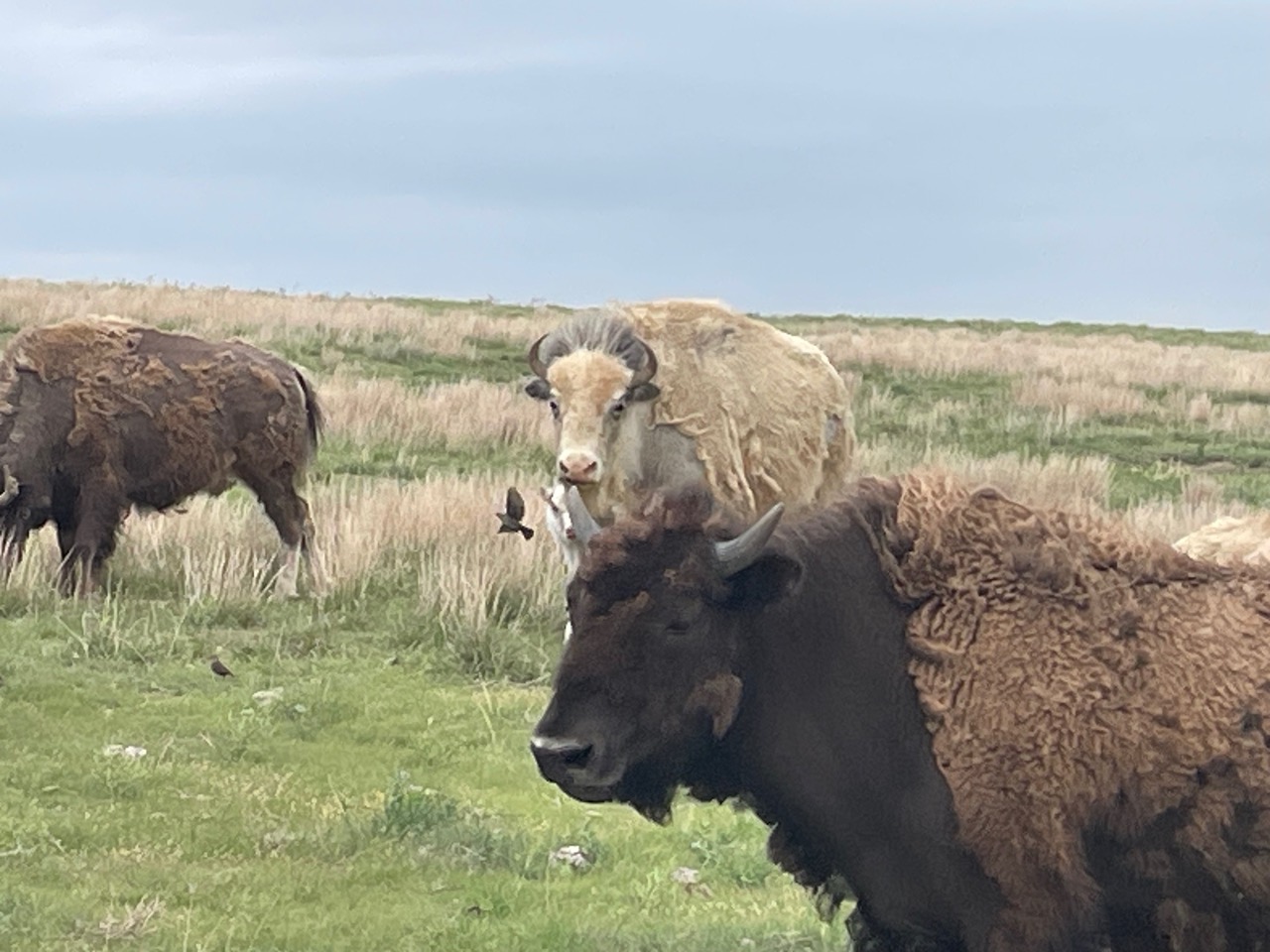
An interest in bison started innocently enough for Richard Duff.
He noticed several bison on the edge of a nearby town and made a mental note. Duff now has a herd of his own on his Logan County, Kansas ranch. He started gathering a herd in 1973.
“During that period of time, of course, things in my life were evolving so fast—when you’re younger, married, you don’t have kids,” he said. “But I had been spending time in South Dakota with an old medicine man on the Sioux reservation in the summer.”
Through his time with the medicine man, he became intrigued by the Plains history and Plains Indians. It didn’t stop when he was back in Kansas.
“There was a guy back here on the edge of town that had three head of buffalo. He had them in a corral, just a dry lot situation,” he said. “I remember sitting over there because I could park right along the main road and watch them. And I was just fascinated by them.”
He didn’t put much thought into owning his own bison at that time, but eventually he acquired the animals he admired from the roadside.
The creatures that once numbered around a thousand in the early 1900s. Now the National Bison Association says that number is at 400,000 head in North America.
His dad and brother-in-law came to help him load his new purchases and the trio was surprised at the speed of the animals.
“I think it was a 16-to-18-foot trailer. So, there was a little bit of time to get to the back of the trailer,” Duff said. “(His brother-in-law’s) job was to shut the trailer gate. Once they got in, they went in so fast that he didn’t have time to flex before they ran out. That was the start of it.”
After his first purchase he set out to learn as much as he could about bison and started purchasing books to educate himself.
“Ironically, the High Plains Journal was my go-to at that time,” he said. “My father had started a feed lot near Scott City, and I worked there full time and every time a new High Plains Journal would come out, I’d grab it and thumb through it quickly and try to see if there were buffalo anywhere.”
At first, the buffalo he was buying were mature animals that people were trying to get rid of. Eventually he made a trip to South Dakota and found some more suitable animals.
Duff had found a set of buffalo for sale in the Journal and instead of going to the bank for a loan to purchase he asked his dad if he’d be interested in purchasing.
“That’s what set the hook for him, because even though he’d always been a cattleman, he just fell in love with buffalo overnight, and he had the wherewithal to spread his wings a little bit,” Duff said. “He bought a couple sections of grassland in western Kansas, and we started stocking with buffalo.”
At the time, Duff didn’t know if there were any auctions to go to purchase or sell bison. Eventually they found other sources for more animals—like federal and state herds. The father-son duo started building numbers and eventually bought more land. In the early days of the bison industry, there weren’t many established meat buyers.
“But gradually, over time, some reputable businessmen came forward in the meat industry, people you could trust, which helped a lot,” he said.
The Duffs weren’t sure at the time when they acquired the bison what exactly it was they were going to do with them.
“You couldn’t take them to an auction, and so we would have to try to find somebody that wanted to buy some meat, and we’d butcher an animal, and we’d sell some, market that meat,” he said. “And then Ted Turner decided he wanted to get into the business, everybody is like, whoa. Maybe that’s the thing to be doing.”
People wanting to grow their herds started “chasing the heifers” to add to their herds. Duff would have visitors who would see their calves on the cows, and those calves were already spoken for.
“And they would contract for the calves that hadn’t even been conceived yet,” he said. “That was the heyday of the breeder market,” he said. “Back at that time, Dad had accumulated enough females (to sell extras).”
At that time Turner was buying bison calves and the Duffs had enough animals to be able to sell 200 heifer calves at a time. They sent him some of their calves and eventually managed to fulfill Turner’s need for a place to feed out the bison.
“He got in on a scale that he needed to do something with his animals, and dad had the feedlot and we’d already been feeding a few animals,” Duff said. “We had modified some of the pens that we could feed bison at the feed lot.”
They modified the neck rail, raised the fence, and geared up to have the bison in the yard.
“I think we’ve reached a point where we had 4,000 to 6,000 head bison on different owners,” Duff said.
Management
The Duffs have managed to keep a decent sized herd together, keeping “one eye open” for other grass pastures to keep the bison. The animals tend to use the grasslands differently than their bovine counterparts and are often able to adapt to the shortcomings. Duff said in the area where his ranch is, selenium can be a problem.
“But where we live, west of Hays on the Smoky Hill River, there’s a lot of fossil beds and rock formations,” he said. “And so, we’ve got excess of selenium. Almost every cattle feed or mineral or anything they put selenium in it because they they’re always concerned that the animals will be short of selenium.”
Excess selenium builds up in an animal’s system, unlike other minerals that are expelled in the waste. Cow-calf producers in his area don’t normally stay on the grass year-round and they don’t have much of a problem with it, but Duff has found that those with excess selenium may end up looking a bit “off.” His bison were no different.
“We could tell that there was something wrong with our animals that we didn’t like. They looked protein deficient,” he said. “The cows had really yellow hair in the winter. And so, it took us a long time to work through that.”
Kansas State University performed bloodwork and Duff started pulling hair samples off dead bison cows.
“I think they, at that time, (experts) considered 600 to 700 parts per million toxic. I don’t know that that’s the right quota, but the quota is proportional, to be considered borderline toxic,” he said.
The hair that came off the cow carcasses was around 3,500 ppm.
Another bunch of bison the Duffs had north of Leoti, Kansas, included a neighbor who was an Angus breeder who was having trouble with copper deficiencies. When Duff’s dad bought the pasture, there were places where the soap weed or yucca was so thick, they weren’t able to drive through it.
“Gradually the buffalo would start taking them out. They’d eat them. They’d eat the needles off them. And they’d also hook the plants themselves, and rip them out of the ground,” he said. “They’d start rubbing on them, almost like the yuccas poking them. It made them perturbed, and so, they get more and more aggressive.”
Eventually the bison in this pasture managed to get rid of the plants that were annoying them. Duff believes they were taking advantage of the copper source.
Conservation
The ranchlands are pretty special to Duff and his family, and amid cattle feeding country where he’s located near Scott City, Kansas, it goes back to the ranch’s roots. The ranch they lease is in a conservation easement and through the years, the descendants of the original landlords have kept it in the family.
“The young women that had inherited it, and one of the son-in-laws, they all really loved the ranch as it was and so we had the opportunity to get a conservation easement,” he said. “I don’t have anything against farming, but out in this area, we don’t have a lot of large tracts of grassland, and every time a ranch comes up for sale, there’s a certain portion of that that can be farmed, and so the farmer can outbid the rancher.”
Competition is fierce for available land, and Duff wants to protect it.
“In this area, we do our best to explain it to people and some people understand. (There are people) so leery of the government intervention or something like that—when you mention conservation easement, they just bristle up,” he said.
Fortunately for Duff his landlords agreed about how important and special the ranch land is, hence, the conservation easement. Their agreement allows the land to be sold or have oil wells or windmills on it, but it can never be farmed.
“We were in agreement totally with that,” he said. “At my age, I’m 71, it kind of gave me a little peace of mind, knowing that 150 years from now, it should look the same as it does right now.”
Kylene Scott can be reached at 620-227-1804 or [email protected].



