
Communities are only as healthy as their members.
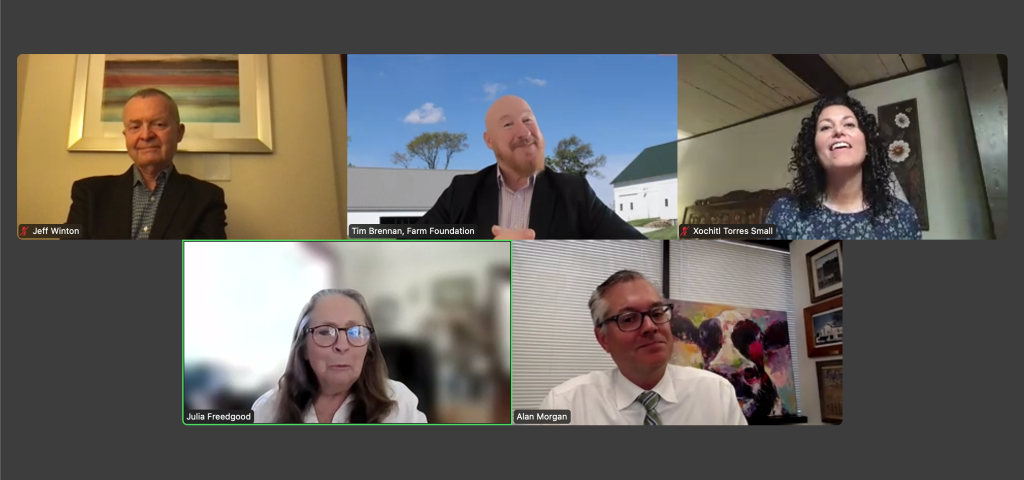
During the recent Farm Foundation Forum, Reviving Rural: Agriculture as the Heartbeat of Healthy Communities, a conversation about reviving rural health, prosperity and resilience was discussed by a slate of panelists.
Featured speakers included Julia Freedgood, senior fellow at American Farmland Trust; Xochitl Torres Small, the 15th U.S. Deputy Secretary of Agriculture; Alan Morgan, CEO of the National Rural Health Association; and Jeff Winton, founder and chairman of Rural Minds, a nonprofit dedicated to advancing mental health awareness and resources.
This article features Morgan and Winton’s thoughts on the subject. An earlier article detailed what Freedgood and Small had to say about protecting and enhancing rural communities and agriculture in those areas.
Morgan is the CEO of the National Rural Health Association and a leading rural health policy expert. Rural hospital closures are at the top of the list when people start thinking about rural America.
“In fact, over the last decade, more than 109 rural hospitals have had to close their doors,” he said. “Looking at our data right now, and I can’t believe I’m saying this, but nearly a little bit over half of the nation’s rural hospitals are currently operating at a loss.”
Morgan said that data is astounding.
The National Rural Health Association is a broad-based membership organization with member leaders in small towns. Morgan said members are educators and researchers, but NRHA is more known for its representation of 90% of the nation’s rural hospitals, rural health clinics and rural community centers.
“If you’re practicing in healthcare, chances are really good you’re a member of the National Rural Health Association,” he said.
Morgan believes there is a myth rural hospitals are closing because of declining life expectancy and workforce shortages.
“It’s actually in the areas where you have a clustering of patients with high health needs, and the inability to pay,” he said.
Those reasons are why the current discussion at the national level on Medicaid is so important.
“When you cluster patients with high health needs and the inability to pay, it forces these rural hospitals to pick up the bill, and in many cases, they simply aren’t able to do that and keep their doors open,” he said.
Morgan said workforce shortages need to be addressed.
“There is nothing wrong with rural America. Currently, less than 5% of incoming medical students come from a rural area,” he said. “Less than 5% of incoming medical students come from a rural area. So as a nation, we’re taking upper income urban kids. They’re going to school in urban areas. They’re doing the residency in urban areas, and then we’re dumbfounded.”
Communities need to do a better job of “growing our own and employing rural residency training programs.”
Closures
Rural hospital closures cause a declining access point of care, and as a result it creates a declining life expectancy in rural communities.
Morgan said almost every major innovation in the healthcare system during the past 20 years has its roots in rural America.
“This challenge is creating innovation hubs across our small communities,” he said. “In fact, if you want to see where healthcare is going to look like and how it’s going to be accessed 20 years from now, simply go to a rural community today. You’re going to see a high reliance on telehealth, on networking, and you’re going to see healthcare providers working in a community basis to make sure that you have access to high quality health care services.”
You can’t talk about innovation in a rural context without talking about telehealth, according to Morgan. This allows some of the state’s top specialists to come into the local community.
Increased usage of remote patient monitoring device allows patients to maintain their own health status. That is an example of innovation is being expanded into the urban context as well. Morgan has seen a rapid embrace of artificial intelligence into clinical practice.
“Utilizing AI and documentation is freeing up hours of clinical time that primary care clinicians can now refocus back on their community again,” he said.
He reiterated that the use of telehealth, remote patient monitoring and the use of AI—when used together—creates improved care in a primary setting and in an emergency room situation.
Morgan noted that in many rural counties health care is the largest employer.
Most often when the conversation is about economic development, healthcare is put off to the side, and many people don’t realize there is a lack of recognition that these economic engines in many cases in these counties could drive the community.
Working with ag partners
Morgan said when it comes to the importance and relevance of a cross-sector approach and collaboration at the federal level, NRHA is in constant communication with the National Farmers Union, American Farm Bureau Federation, National Rural Electric Cooperative Association, and the National Rural Education Association.
“I want you to know at the federal level, we are constantly partnering, because we recognize the importance of collaborating across sector,” he said. “I hope you all are doing that at the local and regional level as well, too.”
Everyone —healthcare, agriculture, small business, education—has a role to play in rural communities moving ahead.
“It’s really important to recognize the relevance and the importance for the access to the healthcare, to be able to keep our seniors in the community, to be able to keep our farmers and ranchers there doing the job they need to be done,” he said. “And also hopefully expanding OB care and maternity care so that way we can attract young families into the communities and build a future for rural America as well too.”
On the farm level
Winton is the founder and chairman of Rural Minds, a nonprofit dedicated to addressing mental health in rural America.
On a beautiful September day in 2012, an upstate New York farm and small town was the scene for one of the happiest days of the year for the Winton family, a wedding. Two days later, a young family member was gone. Winton’s nephew Brooks had ended his life.
“I approached my nephew Brooks’ home that he shared with his 3-year-old twins and his fiancé, and as I approached his house, I saw a fire truck, I saw an ambulance,” he said. “I saw police cars, I saw all kinds of things that I wasn’t expecting, as you can imagine.”
A family friend told him as he pulled into the drive said his nephew had been found unresponsive.
“As you can imagine, the rest of this story is one that was filled with sadness and regret and just questions that none of us could answer because my nephew was such an outgoing, gregarious, seemingly very happy young man,” Winton said. “There were no signs or signals whatsoever that he was struggling with mental illness, and he worked on our farm.”
Brooks was with his uncle every single day and there were no signs he was suffering in silence. He did leave a note for his twins to explain why he had to leave them.
“That’s really all we knew,” Winton said. “The next day, we go to the small United Methodist Church in our farming community, sit down with the pastor to now start planning a funeral for a 28-year-old farmer and the father of 3-year-old twins, after having just celebrated his brother’s wedding two days before.”
The pastor looked at Winton’s brother, their mother who had basically helped raise Brooks and said, “I don’t know how to tell you this, but there are people in this farming community that don’t think you should talk about what your family member died of, what Brooks died of.”
Winton’s mother said suicide had been going on in their farming community for “way too long, and no one will admit what is happening.” She told the pastor she will be keeping her grandson’s memory alive by talking about this—starting at his funeral.
Winton said everybody loved Brooks. If a person happened to have a down day, they wanted to be near him. Winton was asked to give the eulogy, and it wasn’t an easy task to accomplish, but “somehow, by the grace of God” he did.
Then the floodgates opened. The seeds for Rural Minds were planted. Winton ultimately decided to protect the then 3-year-old twins’ childhoods, waiting to launch until they were older.
Winton has worked in the healthcare industry for most of his career, in addition to dairy farming. He’s worked with biopharmaceutical companies who had medicines for those living with mental illness, and he thought long and hard about what he could do to help. So he reached out to his contacts.
“Basically, I said, OK, you know me as corporate Jeff Winton, but now I’m contacting you as a grieving uncle and as a rural dairy farmer in upstate New York,” he said. “What are you doing for the 46 million people who live in rural America, 14% of our population?”
Almost every question Winton asked was met with very respectful silence and an admission that they weren’t really doing a lot focused exclusively on rural America, because the fact remained, they didn’t necessarily know how to reach people like my family.
“It was with the support and with the encouragement of some of these other large mental health nonprofit organizations that we launched three and a half years ago, and they’re now our partners,” he said. “We’re working very closely and very collaboratively with them, and we’re really focused right now on storytelling, because we are a national organization.”
Winton said it doesn’t matter what part of the country he’s in; he finds similar stories to his own.
Most folks know it’s an illness, and oftentimes many consider it to be a character flaw or personality weakness. Those who grow up on a farm are often taught to pull themselves up by their bootstraps and not talk about their own problems.
“As a result, we have this growing epidemic in rural America where there’s a 65% more likelihood that people in rural America will die by suicide than in urban and suburban areas,” Winton said. “Young people that grow up in rural areas are 54% more likely to die by suicide than their urban counterparts.”
It’s a growing epidemic and Rural Minds is doing its best to tackle it as a young and growing organization, according to Winton.
“But we’re very encouraged after what we’ve seen after the last three and a half years, and this is why I start almost every talk I give with my family story,” he said. “Because we have to humanize this. We have to put a personal face on mental illness in rural America.”
There are many factors as to why there’s a disproportionate number of people living with mental illness in rural areas compared to urban and suburban areas.
“It’s the decline of some of these small towns we all live in. It’s the closure of rural hospitals,” he said. “It’s the lack of access, and while telemedicine, as the last speaker said, is certainly helping many people in rural America, the fact remains that 30% of families in rural America have no broadband because it’s not available. It’s not that they can’t afford it. It’s not available.”
Winton is concerned about the future of agriculture and the young people involved in it or around it.
“These people, our young people, are the ones who will be raising our food and our fiber in the next generation,” he said. “If we don’t do something about this before it’s too late, we will be in bigger trouble than we are right now in rural America.”
He is encouraged by the younger generation and how much more willing they are to talk about the mental illness.
“That’s what gives me great hope in Rural Minds, is in the process of launching a rural mental health youth program that will be focused on both suicide education, substance use disorder and mental illness among young people that live and work in rural America,” he said.
For more information about Rural Minds visit www.ruralminds.org.
Kylene Scott can be reached at 620-227-1804 or [email protected].



