USDA shifts farm income forecast as Rollins pledges better days ahead

The U.S. Department of Agriculture is lowering its initial forecast for farm earnings in 2025 as declines in the crop sector more than offset soaring incomes for cattle producers.
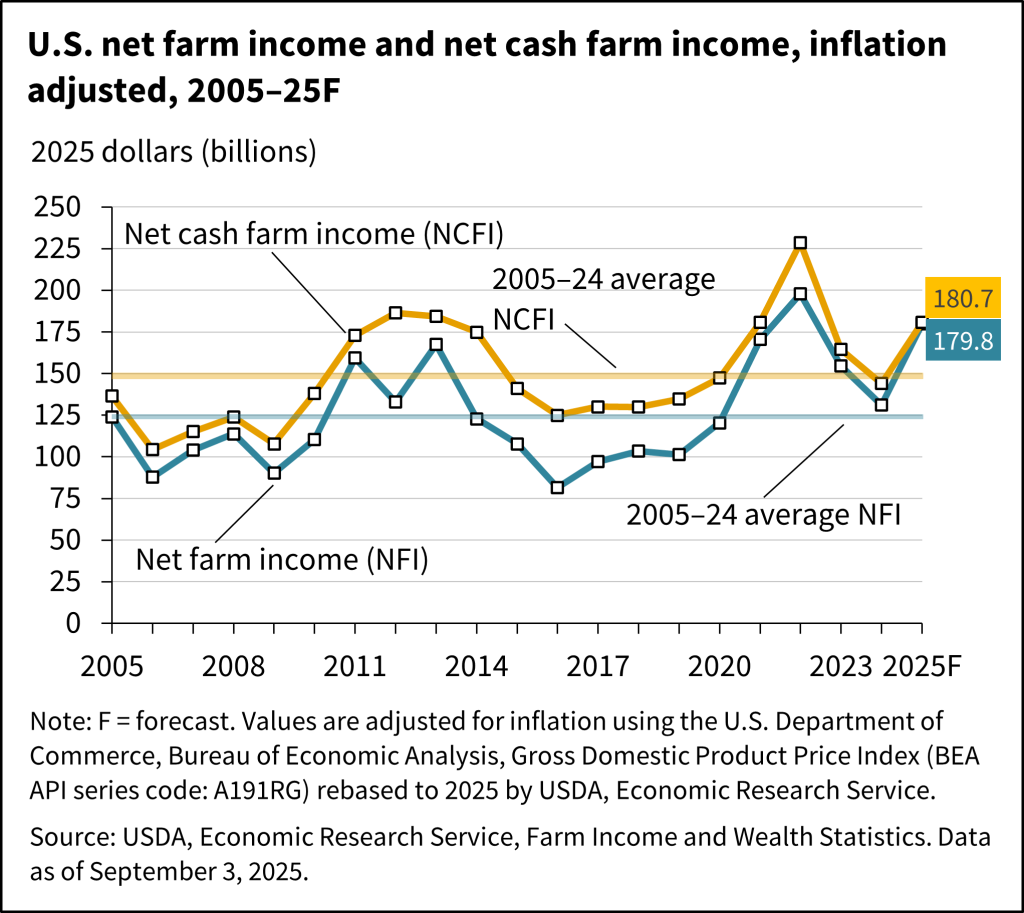
Net cash farm income, a measure of producers’ cash flow, is forecast at $180.7 billion for 2025, an increase of $36.5 billion, or 25.3%, over last year when adjusted for inflation, according to the September forecast issued by the Economic Research Service. In February, USDA had forecast net cash farm income for 2025 at $193.7 billion.
Net farm income, a broader measure of profits, is forecast at $179.8 billion for 2025, an increase of $48.8 billion, or 37.2%, over 2024 when adjusted for inflation. February’s forecast was for net farm income of $180.1 billion.
Even with the lower numbers, both the estimates for net farm income and net cash income this year are above the 20-year average, largely due to an influx of government payments to row crop producers. These income numbers include a significant bump in disaster and economic government assistance, which are expected to reach $42.4 billion — a 354.5% increase from 2024’s $9.3 billion. Without that aid, many row crop producers would be in much worse positions.
Net cash farm income is based on cash receipts from farming, plus government payments and other farm-related income, minus cash expenses. Net farm income also factors in depreciation and changes in inventory values.
Rollins says better days ahead
Secretary of Agriculture Brooke Rollins said the “unease with the current farm economy” that farmers are currently experiencing was part of President Donald Trump’s bigger plan to put America first and pledged that the farm economic outlook would improve with “even more exciting deals” on the way.
“These trade renegotiations, opening up the markets, cutting deals….. Bangladesh, just, I believe, yesterday, announced a massive purchase of wheat from America. We’ll have more of those coming soon,” she said during a recent interview on Fox Business Network. “The golden age for our American farmers is around the corner.”
Rollins said, “No one has been more supportive or passionate or dedicated to our farmers than President Trump” and blamed former President Joe Biden for the high cost of farm inputs and a trade deficit a trade deficit of $50 billion after having a surplus under Trump. “Just one thing after another that has hit the farm economy,” she added.
The USDA estimated the U.S. agricultural trade deficit would narrow in fiscal 2026 despite a projected plunge in sales to China, which has yet to reach a trade deal with Trump.
USDA’s quarterly trade outlook lowered the projected trade deficit for fiscal 2025 to $47 billion from the $49.5 billion estimated in June. The deficit is projected to drop to $41.5 billion for fiscal year 2026, which starts Oct. 1, because U.S. ag imports are expected to fall even more than exports.
The estimated deficit for FY26 would still be higher than FY24’s $32 billion.
Rollins was also asked about Trump’s plans to address the labor challenges farmers are facing. She said Trump is “hyper-focused on fixing this issue” and Labor Secretary Lori Chavez-DeRemer is “really working on it.” She described the current H2-A program as “so broken” and “unsustainable.”
The secretary acknowledged that new tools and equipment are helping to ease part of the farm labor situation.
“We have automation that is pretty remarkable. That’s going to start moving out in a bigger way. We’ll have an announcement of that coming soon,” she noted.
Concerns about foreign farmland ownership were also raised during the interview and Rollins explained the national security implications.
“In 1983 China and foreign adversaries owned about 2,000 acres of our farmland. Today, it’s almost 300,000 acres have been purchased by China and other foreign adversaries not friendly to us,” she said. “What’s really important about this is so much of that was purchased or purchased around our military bases,” she said.
“So, it’s not just preserving the great American farm. It’s not just about bringing a golden age to rural America and having real rural prosperity, but it is national security.”
Chinese investors reported holding 277,336 acres of agricultural land as of Dec. 31, according to the latest USDA data. This represents less than 1% of all foreign owned-agricultural land.
Investors from Canada, including entities owned entirely by Canadians and by U.S. corporations with Canadian shareholders, hold 15.3 million acres of land, or 33% of all the foreign-owned land reported to USDA. Investors from the Netherlands followed, accounting for 11% of all foreign-held landholdings, while Italy and the United Kingdom each made up 6%.
Editor’s note: Sara Wyant is publisher of Agri-Pulse Communications, Inc., www.Agri-Pulse.com.