Dry pattern returned to some states
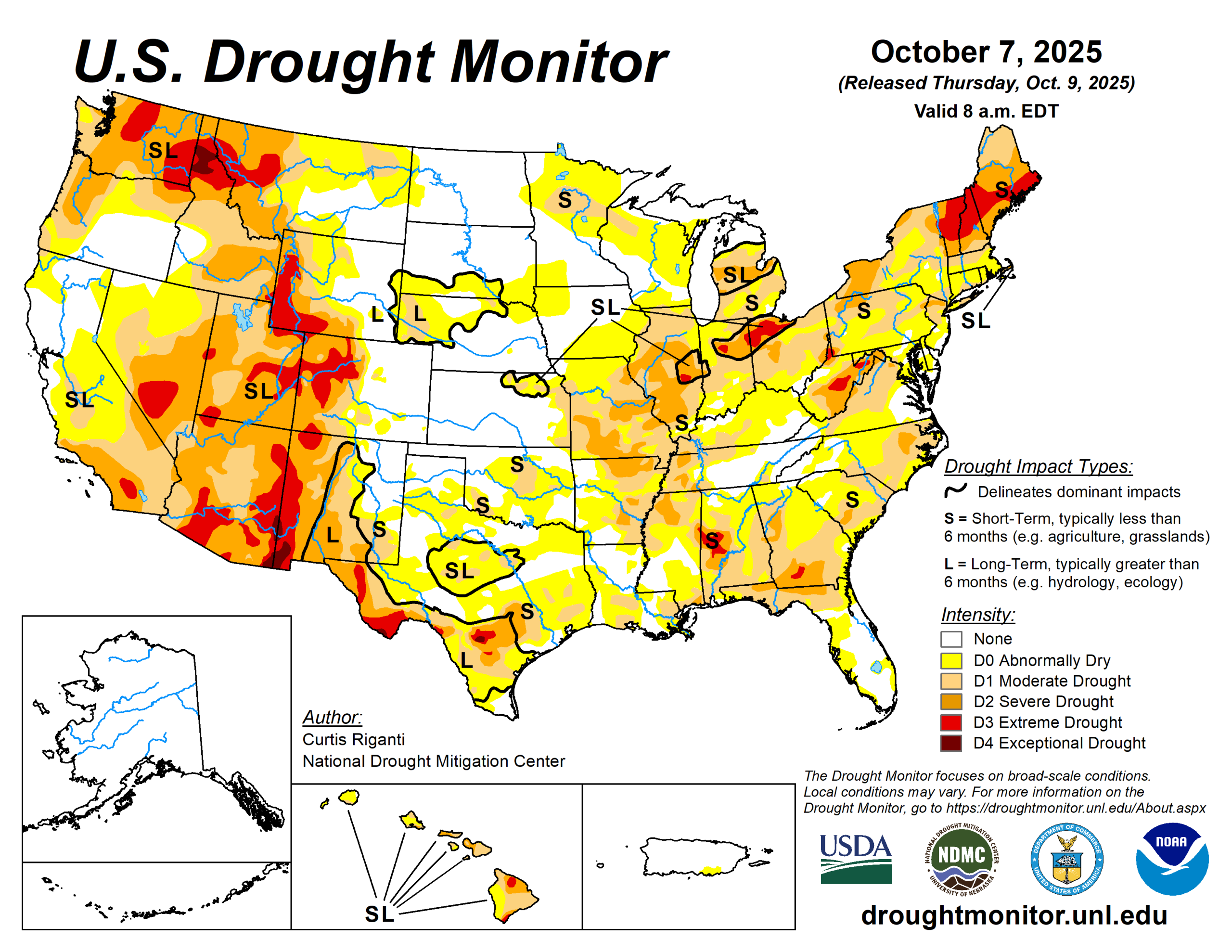
The recent pattern of numerous changes in the United States Drought Monitor continued with this week’s map release. Continued dry weather in the Northeast led to widespread worsening of drought and abnormal dryness there.
From Missouri northward to the Great Lakes states, many locations saw drought or abnormal dryness worsen. In particular, intense short-term drought continued to worsen in parts of Missouri, Illinois, Indiana and Ohio. However, in southeast Missouri and in the Ohio River Valley and some parts of the Mississippi River Valley, welcome rains fell, locally over 3 inches, leading to widespread improvements in ongoing drought and abnormal dryness in these areas.
In west Louisiana, Oklahoma and Texas, dry weather led to many degradations as primarily short-term dryness intensified. A few areas of central and southwest Texas are also seeing long-term dryness and drought and saw some intensification. Drier weather in northeast Montana led to the development of moderate drought there. Recent heavy precipitation and reassessment of recent conditions led to widespread improvements in parts of the western United States, especially in southeast Wyoming and a few spots in the Colorado Rocky Mountains.
The U.S. Drought Monitor is jointly produced by the National Drought Mitigation Center at the University of Nebraska-Lincoln, the U.S. Department of Agriculture and the National Oceanic Atmospheric Administration. (Map courtesy of NDMC.)
South
Pockets of heavy rain, locally 3 inches or more, fell in northeast Arkansas.
The heavy rain was enough to improve overall conditions in much of northeast Arkansas, where a localized 2-category improvement occurred. Short-term dryness continued to intensify across much of Texas and parts of Oklahoma, all of which largely saw a mostly dry and warmer-than-normal week. Very dry weather over the last month continued in parts of Oklahoma, especially from the Oklahoma City area north and in southwest Oklahoma, where adverse impacts to agriculture were reported.
In central and southwest Texas, recent dry weather compounded impacts from long-term dryness and drought.
Midwest
A few swaths of significant rain fell from southwest to central Iowa and Missouri Bootheel where rainfall improved conditions, as soil moisture and streamflow continued to recover and precipitation deficits lessened.
As more data regarding the impact of recent rain filters in, more changes to the map may occur in this region in future weeks. Short-term drought, with localized longer-term impacts, continued to intensify in southwest Missouri where precipitation deficits grew while soil moisture and streamflow remained very low. Short-term moderate drought expanded in coverage southeast from northern Minnesota into northwest Wisconsin, where recent deficits in rainfall and streamflow worsened. Widespread temperatures from 10 to 20 degrees Fahrenheit above normal occurred across the region, adding extra stress to areas experiencing drought or abnormal dryness.
High Plains
Temperatures this week across the High Plains region were mostly 5 to 15 degrees above normal, with parts of central Colorado and southern and western Wyoming seeing closer to normal temperatures.
Moderate to locally heavy precipitation fell in parts of the San Juan Mountains in southwest Colorado, the Rocky Mountains of northern Colorado and across much of Wyoming, northwest South Dakota and central to north-central North Dakota. Precipitation this week added to a generally wetter recent pattern in the San Juans, north-central Colorado and southeast Wyoming.
In these areas, short- and medium-term precipitation deficits lessened and soil moisture conditions improved, allowing for some improvements to ongoing drought and abnormal dryness. In north-central Kansas, moderate drought improved in some areas where locally over 2 inches of rain fell.
In eastern Kansas, short-term abnormal dryness and moderate drought worsened in spots where streamflow and soil moisture levels dropped along with growing precipitation shortages. In northeast Nebraska and southeast South Dakota, dry weather over the past couple of months continued, leading to a large expansion in abnormal dryness that also extended into northwest Iowa and southwest Minnesota.
West
Scattered heavy precipitation fell this week across much of the central and northern half of the region, with notable exceptions in southwest Wyoming and north-central and northeast Montana.
In northeast Montana, drier weather and temperatures that were 5 to 15 degrees above normal led to the development of moderate drought where short-term precipitation and soil moisture deficits grew.
Recent precipitation, either from this week or the weeks preceding, led to improvements in streamflow and soil moisture and lessening precipitation deficits across much of northern and southern Nevada (and immediately adjacent parts of California and Arizona).
Similarly improving conditions also occurred in northern Utah, south-central and southwest Idaho, Oregon and the Olympic Peninsula of Washington, leading to improvements in the USDM depiction in parts of these areas.
Looking ahead
The National Weather Service’s Weather Prediction Center forecast covering the period from the evening of Oct. 8 to the evening of Oct. 13 calls for an inch or more of precipitation from northwest California northward through northwest Washington.
The WPC is also forecasting areas west of the Continental Divide in New Mexico and Colorado to receive over 1 inch of precipitation, with some areas southwest Colorado forecast to receive over 3 inches. Forecast precipitation amounts dwindle north of Utah, though portions of Idaho and Montana may receive a half inch or more during this period.
Meanwhile, across most of the Great Plains, Midwest and South, mostly dry weather is forecast.
Looking ahead to Oct. 14 to 18, the National Weather Service Climate Prediction Center forecast favors warmer-than-normal weather across most of the central and eastern contiguous U.S., especially in the southern Great Plains. Colder-than-normal weather is favored in western Montana. Above-normal precipitation is favored across most of the and into the northern half of the Great Plains.
Below-normal precipitation is favored in the south-central and southeast U.S.
Curtis Riganti is with the National Drought Mitigation Center.