
Keys to fall wheat pasture forage production in Oklahoma
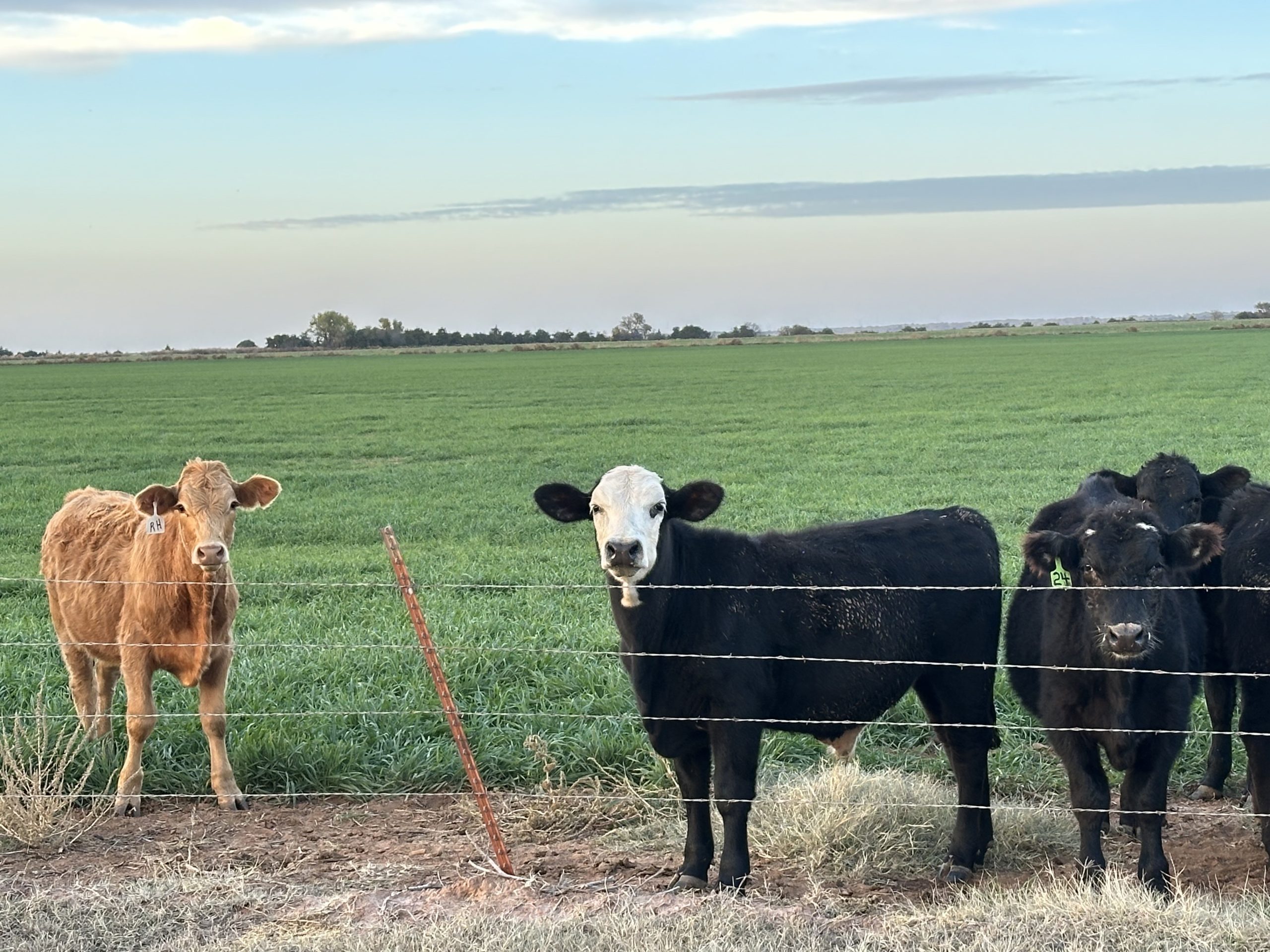
It’s that time of year when calves are being turned out onto a green carpet of wheat pasture for winter, but what can producers do to improve their forage at planting? This year there is a mixed bag of stand quality across Oklahoma that ranges from excellent to poor, mostly due to planting date.
In an Oklahoma State University webinar, Brian Pugh Extension OSU forage specialist, said good stands were in early planted fields, utilizing the late August moisture the state received. He said those fields did not receive as much damage from the fall army worms that have plagued much of the High Plains.
Moisture, sun, and heat units
Pugh said there are several keys to planting wheat pasture for grazing that can make a difference in forage production. However, the highest priority is always moisture.
“Of course, that’s what drives everything, but that’s also what gets us behind as well,” he said. “There’s a lot of data out there that shows if we have healthy plants and we have nutrients in the soil; it only takes about 4 inches of moisture to make a ton of production with cool season forage. Planting date is probably one of the biggest things that affects fall forage production, after the amount of moisture that we get at that location.”
Pugh said earlier is always better for wheat forage systems, preferably planted in early September, if possible.
“This is so we can capture sunlight, moisture, and heat to put that yield on,” he said. “After Sept. 1, to have plants germinated and out of the ground, we lose about 50 pounds of dry matter production per acre per day. That’s huge. That tells us, if we’re waiting to the end of September versus the first of September, we potentially give up 1,500 pounds of dry matter production per acre.”
Pugh compared the leaves on wheat plants to solar panels, collecting sunlight and converting it to energy to drive forage production. The earlier it is planted, the more time it will have to utilize that sunlight before winter creeps in, and there is less available solar radiation.
“We also need heat,” Pugh added. “We can’t grow those plants if it’s super cold. A really good thing to keep in mind is that we get as much sunlight intensity in the first week of September as we get in the entire month of November. That tells you these earlier plantings have a real advantage as far as their photosynthetic capability. It’s much easier for them to put yield on earlier in the fall.”
Pugh said heat units are another element to consider with wheat pasture.
“We use growing degree days to predict how much growth we’re going to get off of those small grain plants. On average, we should expect for each growing degree day or heat unit, to get about 3.3 pounds of dry matter per acre.”
Temperature lows can also affect plant growth. Pugh said for wheat, if the temperature gets below 42 degrees Fahrenheit, that plant stops growing for the day until it warms up again, which is another reason to plant early.
Planting depth matters
Wheat forage planting depth can be controversial with several schools of thought on how deep to plant depending on the environment and weather conditions. Pugh said planting too deep can hinder the seed and cause long-term problems with emergence.
“I know we have old timers that say, ‘Hey, if the soil is warm, you’ve got to plant deep to get to the moisture.’ That’s a very common saying, but that’s the exact opposite of what we want to do, and that is because of coleoptiles,” he explained. “The coleoptile is really the first stem that emerges from the seed. It’s a protective structure for those leaves and it allows that plant to send those leaves up through the soil without abrading against soil particles.”
Pugh said high soil temperatures reduce the coleoptile length in most of our wheat varieties. He said planting wheat seed too deep with certain varieties will lead to a shortened coleoptile length, and the plant will never emerge from the soil. Pugh said the susceptibility of wheat seed depends on the variety, which is why variety selection is crucial.
“We see this every year on early planted wheat that was planted deep,” Pugh said. “These plants actually end up trying to unfurl their leaves under the soil surface, and we get this accordion-shaped appearance. That plant just gets bound up in those soil particles, and it won’t emerge. One of the worst things we can do is try to plant deep to moisture, especially if we’re planting early in the year with warmer soil temperatures.”
Pugh said producers are better off dusting wheat in at a shallower depth and trying to capture what moisture is received through rainfall after planting.
What about seeding rate and row spacing?
Pugh then discussed increasing seed in wheat planting rate and how that could affect production from a forage standpoint. He said research has shown an increased seeding rate from 1 bushel per acre to 2 bushels per acre, leading to an almost 500-pound increase in fall forage production. Bumping the seeding rate to 3-bushel per acre leads to an additional 400 pounds of yield.
“The reason we’re seeing this is because we’re putting more solar panels out there to capture that sunlight as it comes down towards the soil surface,” Pugh explained. “There’s a whole lot of soil absorbing sun radiation, but we’re not actively using those photons for photosynthesis. By doubling the plant population, we can start to close the canopy faster. And the faster we close the canopy, the more of that sunlight we capture, and therefore the more yield we make.”
Row spacing is another topic that garners many opinions. Pugh said many will advise producers to plant in a narrower row spacing, but the issue is often the planter itself. Many of them are set and difficult to adjust. Instead, Pugh suggested changing the overall planting strategy to see improved results.
“As an example, if we run a 1-bushel planting rate north and south, and a 1-bushel planting rate east and west,” he proposed. “Yes, it doubles our passes across the field and that will incur more cost for us. But we will have a seven-and-a-half-inch square between rows. These plants basically have to creep about 3.75 inches across these open areas before we get complete canopy closure. So, is that better than a single straight row. Yes it would be a faster canopy closure than just a single straight row across a field.”
Another recommendation Pugh made was to make the second pass at an angle, which would mean only one spot where there is 7.5 inches between plants.
“What we would see is actually less than 10% of the plants have to grow over three and a half inches before it touches its neighbor plant. Most of these plants in this area here would not have to grow near as far before we get canopy closure, and again, that is how we’re capturing that sunlight.”
Fertility: Nitrogen, pH, DAP
Fertility is another key to the puzzle that producers can adjust to improve their forage production. Nitrogen application in particular can be the difference in poor forage production and abundant grazing.
“Assuming about 3 cents per pound of wheat forage and about 30 cents per pound of nitrogen, our breakeven is normally going to be somewhere around 40 to 60 pounds of nitrogen at planting,” Pugh said. “That’s what we would recommend for optimum forage production in the fall.”
Pugh said although some producers choose not to apply nitrogen up front, he feels they lose forage production that could have been added with some nitrogen at planting or shortly after. With pH levels, Pugh said there is a wide range of wheat variety tolerance, similar to sensitivity to heat, but the main point is to stay at 5 or above on the pH scale.
“If we get below about a 5, it’s probably time to start thinking about adding lime, especially if we’re more interested in forage than we are in grain,” Pugh explained. “If phosphorus is below 65 on the P-Index, or if the pH is below a 5, diammonium phosphate in the furrow with the seed will boost fall yield.”
Pugh said as the diammonium phosphate prill breaks down in the soil, pH is elevated in that band for a short amount of time, and it acts like a liming material in the soil.
“The plant doesn’t feel the full effect of that soil acidity for a short amount of time,” he said. “So, it’s a really good avenue to boost those fall yields. We don’t recommend going over 60 pounds of DAP in furrow per acre at planting. You can hit a point where we start to see some burn on those young seedlings as they come out of the ground.”
Lacey Vilhauer can be reached at 620-227-1871 or [email protected].



