Emerging markets for sorghum discussed at seminar
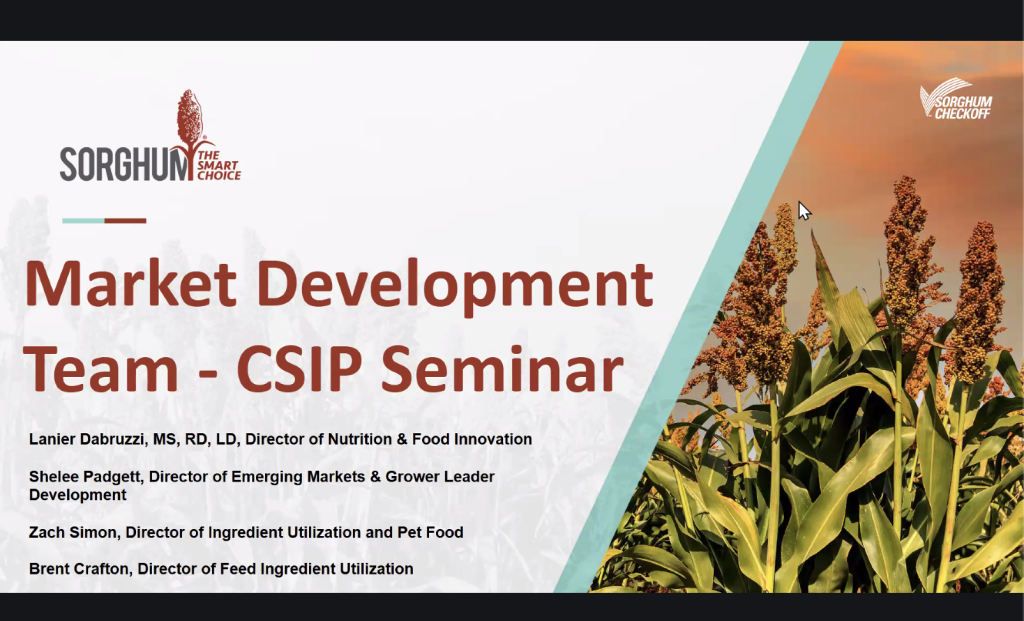
Members of the United Sorghum Checkoff Program marketing team shared their thoughts on subjects ranging from food innovation to feed ingredient usage in the United States as well as emerging markets and market development for the crop during an online seminar Jan. 13. The event was hosted by the Center for Sorghum Improvement.
Panelists included Lanier Dabruzzi, director of nutrition and food innovation; Shelee Padgett, director of emerging markets and grower leader development; Zach Simon, director of ingredient utilization and pet food; and Brent Crafton, director of feed ingredient utilization.
Dabruzzi said 2025 had its moments.
“The good news in the consumer food space is there is a tremendous demand,” she said. “Sorghum checks a lot of the boxes that consumers are looking for in products right now.”
Most of that is because of the antioxidant properties of sorghum, and it is a plant-based source of protein with fiber included. Plus, the ancient grain is non-GMO and gluten free.
“Protein is a big buzzword. If you saw the release of the dietary guidelines, the recommendations have been doubled,” she said. “You cannot go into a restaurant or go to the grocery store without the protein being screamed at you from a label.”
Dabruzzi said one reason food companies are looking to sorghum is because they want those important traits on the front of their label. Plus, it has “tremendous culinary versatility.”
“It’s used all over the world in food; here in the U.S., not so much,” she said. “Ironically, it’s grown here. We’re the top producers, so (we’re) really working to make that more of a human food here in the United States, and then (be) free from those top nine allergens—that’s very important.”
Sorghum is more versatile than other grains, Dabruzzi said, and that helps it meet consumer demands for many different forms. Some products include baby puffs that melt in their mouths. Because consumers don’t know much about sorghum more education is needed. Her team was able to help by developing a blurb on the packaging describing sorghum and its benefits.
“We do that with a lot of products, because what a lot of these companies are saying is, ‘we really love sorghum, we want to use it, but our consumers are going to say, I have no idea what this is. How do I communicate that?’” she said. “That’s one of the great benefits of working with the checkoff, is being able to help them with that communication as well.”
Dabruzzi said they’re excited to dig into sorghum’s health and nutrition benefits when it comes to humans.
The checkoff is launching the Wide World of Sorghum this year. With the Winter Olympics kicking off in February 2026 and FIFA in the U.S. at mid-year, there is an international spotlight opportunity.
Under the Consumer tab of www.sorghumcheckoff.com/explore-sorghum-recipes/, people can access an interactive map, she said. It highlights recipes and cuisines across the global landscape.
Connections
Padgett helps connect the dots between her colleagues and the research they’re working on both in-house and with their partners.
The big picture is exporting grain, she said.
“If you look at our markets, our export markets are extremely, extremely important for our farmers,” Padgett said. “So anywhere from 60 to 70, sometimes even higher, percentage of our crop is exported around the world.”
USCP offers different trials and demonstrations for new markets. The quality samples program, a U.S. Department of Agriculture program that USCP partners with the U.S. Grains and BioProducts Council, she said, has a goal to get U.S. sorghum into the hands of consumers.
They’ve recently worked with Colombia in that program and the pet food industry, which is using more and more sorghum in Colombia and the U.S.
Five containers, or about 120 metric tons, of sorghum was shipped to Colombia and the good news is when the price is right Padgett said officials are more inclined to purchase U.S. sorghum.
“It was a really relevant trial, and we’re hoping to see some benefits when the price works for us a little bit better,” she said. “Another trial that we also did was in Tanzania, and this was with broilers and layers.”
There they included 50%, 25% and 100% sorghum in layer rations and 15% and 25% sorghum in broiler rations to see how sorghum performed.
“Once again, it performed really well,” she said.
In Vietnam, Padgett said one sector of growth and interest involves aquaculture and similar opportunities are possible in other parts of Southeast Asia.
Catfish rations in the study have 20%, 15%, 10% and 5% sorghum and has performed well in trials, she said.
Sorghum export markets are extremely important to farmers, and Padgett said the vast majority of U.S. sorghum is exported to China, Mexico, Spain, and Saudia Arabia. The USCP, U.S. Grains and BioProductsCouncil and private industry are working hard together to build market access, she said.
India continues to be a market the U.S. is hoping to open, she said. Right now the focus is laying a foundation.
A handful of different representatives from India—a milk nutritionist and poultry industry officials—have visited the U.S. and attended seminars Padgett and her team have put on. Padgett and her team are also fostering relationships with China, Vietnam, the Philippines, and Thailand.
“Thailand has a 27% tariff at this point in time,” she said. “That’s something that as a marketing team, along with our partners, we’re continuing to work on behalf of our farmers, to make sure that when prices are right throughout the world and that we have the foundation laid so our grain can flow into those those markets.”
Feed ingredients
Sorghum is becoming more and more important as a functional feed ingredient, and Crafton said USCP is showing how it can improve feed efficiency with its benefits and in animal utilization programs.
“Some key considerations that we like to point out is it’s always formulating,” he said. “When you’re utilizing sorghum, take representative samples on each load. That’s typically what takes place at a feed mill. Formulate based on digestible amino acids.”
One aspect of sorghum that has always been a hot topic was tannins. More than once Crafton said he’s heard the comment from people that they can’t feed it because of the tannins. That is just not the case anymore.
Conventional breeding programs have changed the narrative for feed uses, Crafton said. “That is one of our market advantages is it increases energy value in a diet. It let us have a better feed conversion ratio and it helps us to perform a little bit better.”
Processing sorghum is important too because whether it is in a poultry or swine diet, processing the kernel makes it more digestible and protein becomes more available. USCP helps to find the best methods for this aspect in animal nutrition and share validated information to the industry at large.
Crafton is working on different feeding trials and commercial demonstrations are being conducted on the domestic and international front. One study involves aquaculture with feed trials over the past few years to validate sorghum protein concentrate. This is being accomplished with Florida pompano fish and rainbow trout.
“We’re doing data compiling right now in review, as well as our rainbow trout that will be launching here in the spring, up at the Bozeman Fish Technology Center, and that’ll have a 2026 completion,” he said.
Crafton said researchers are continuing to optimize the process to create parameters to follow.
“We wanted the system that could be in place that would be decoupled from the ethanol system,” he said. “It could be vaulted onto an ethanol system, but we wanted to be able to create a sorghum protein concentrate that was not tied to the ethanol industry. And so far so good. We’ll have some more results to share maybe next year at this time.”
On the commercial side, they’re launching some more trials this winter for Pacific White Shrimp.
For poultry feed trials, USCP has been invested over the past few years to see how sorghum continues to perform and dispel outdated myths and rumors about sorghum.
“A lot of that had to do with tannins, as we mentioned (before). But we’ve got a number of projects that continue to build out our portfolio for U.S. sorghum as a valuable feed ingredient,” he said.
The poultry project they’re working on just wrapped up, and they’re doing final edits at Kansas State University. This was looking at different particle sizes and inclusion of sorghum and how it affects growth and gizzard function in broiler chickens.
A project that is going to be launched in February is another commercial demonstration with growing turkeys.
“We built this project together with some of our partners at the University of Missouri, as well as some of these industry partners that are identified that expressed the high level of interest to participate, based on some feedback we’ve been getting from the commercial industry that was actually looking for over the past two years,” he said.
Crafton has a few other projects in the works with other universities. Regionally researchers are attending targeted events to help promote sorghum in feed and pet food including the world’s largest poultry event.
“I’ll be there as well as my colleague Zach Simon, who is handling the pet food component of that,” he said. “We’ll be doing Aquaculture America 2026 this year, it’s held in Las Vegas, as well as Vive Select India, 2026. in New Delhi.”
Pet food
Simon’s primary focus is pet food and the use of sorghum in it continues to grow. He said sorghum has broken into the top 30 ingredients utilized in U.S. pet food and the top 10 in some places.
“Pet food is a large, very large market in the U.S. Now pet food and treats have exceeded $60 billion in the U.S. market,” Simon said, adding that growing the market is very demanding.
Pet parents want to make sure there’s high quality ingredients and they are often looking for a very specific detail when buying pet food because those pets are now members of the family. Just like sorghum has advantages in human food, it has advantages in pet food.
“Sorghum is very, very similar to many of the other grains that are used as an energy source in a lot of the pet food rations,” he said. “It’s extremely digestible, even when extruded. It scored very well with fecal scores, which is very important to the pet parent, and the pet health. has a low glycemic index.”
Simon said people like to spoil their pets and there is a bit of an epidemic in the U.S. with obese pets. Sorghum is helpful in those diets because of the low glycemic index.
“The polyphenols, so those antioxidants, there’s been a lot of research as well that has shown an increase in the antioxidants in canine’s blood when fed a whole sorghum diet, and a lot of that is coming from those polyphenols in the brand,” he said.
There aren’t any concerns with the palatability of sorghum in diets that include it as an ingredient, either.
Researchers have trials in Colombia to help broaden the international market opportunities. They’ve brought in some trade teams recently from Latin America to meet with pet food experts at Kansas State University and see the extrusion lab.
“They get to see some of these hands-on things and get a lot of their specific technical questions answered while there and really great opportunities to let these trade teams explore and inspect all aspects of U.S. sorghum in their industry,” Simon said.
There are several ongoing pet food projects at K-State, he said. One involves making a co-product from sorghum, with a facility on campus doing the extractions. The “leftover” material can be used for cattle feed too.
“We took that and said, we are looking at additional potential value streams for them, while also serving as a good, functional ingredient in pet food that meets a lot of those needs that the consumers want,” Simon said.
Another project is being evaluated at the University of Arkansas where researchers are looking at how to use a wax that is contained in sorghum oil.
“This wax has some very unique properties that are very similar to carnauba wax,” he said. “Carnauba wax is used in tons of different applications, anything from car wax, fruit and vegetable coatings, the Department of Defense uses it in the manufacturing of munitions.”
By looking at how value can be added to sorghum, Simon and his colleagues are excited about this and other projects that can benefit Kansas, Oklahoma, Missouri, and Arkansas farmers.
Kylene Scott can be reached at 620-227-1804 or [email protected].