
Drones take on Eastern redcedar: A high-tech solution for rangelands
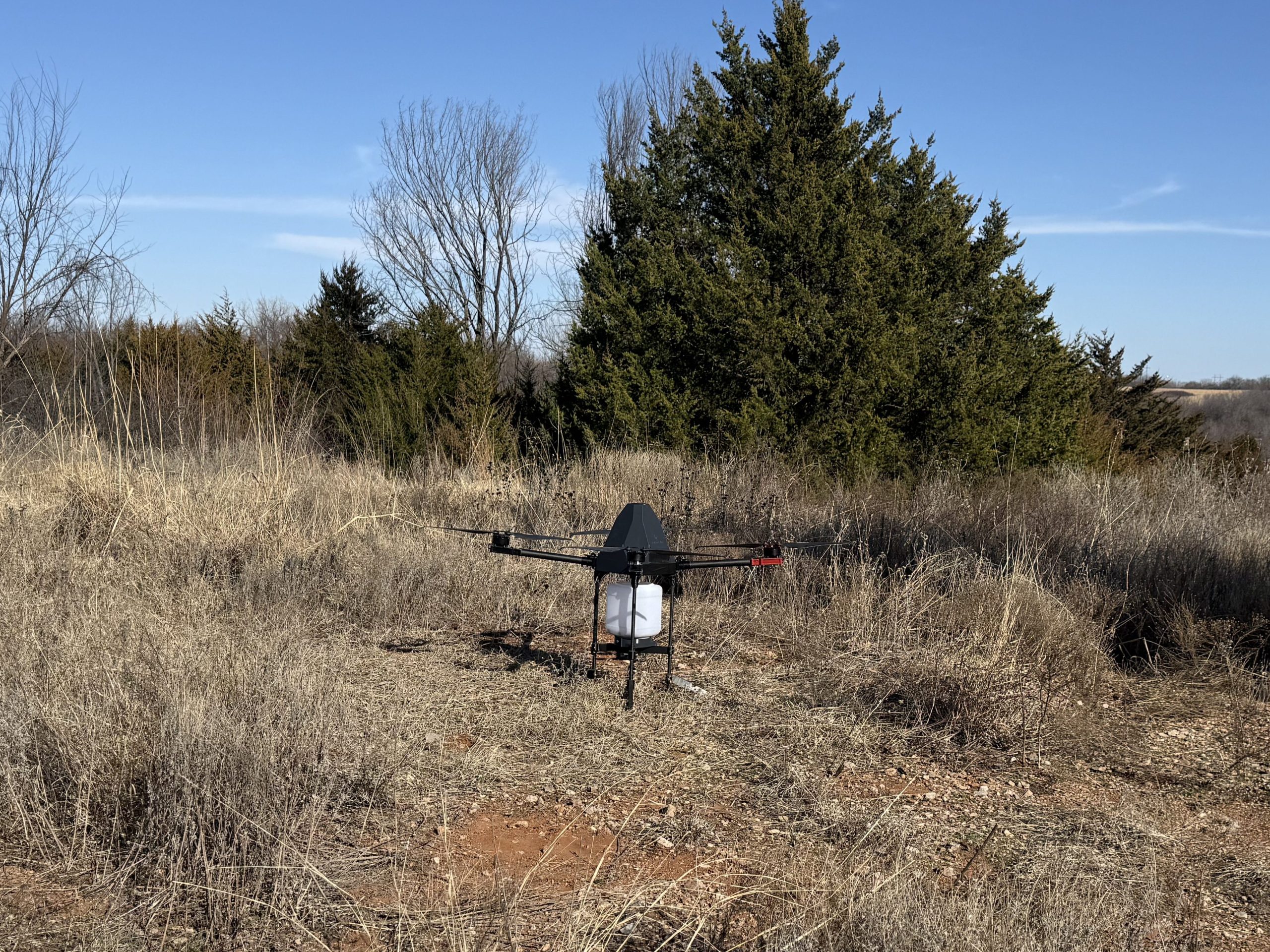
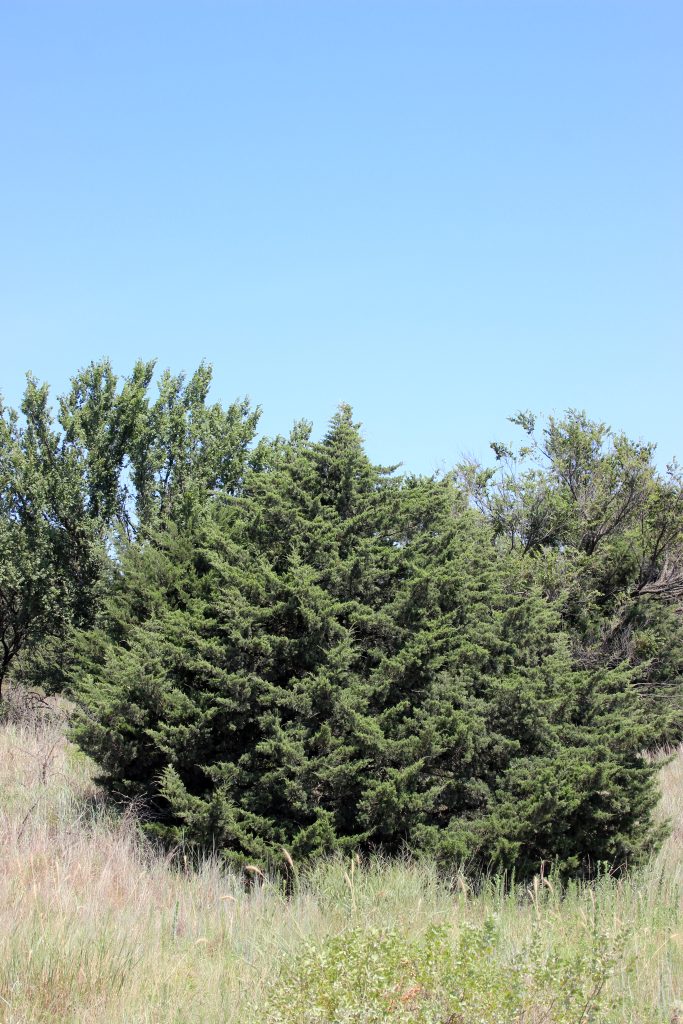
For the past 20 years, Eastern redcedar trees have seen a rapid encroachment on rangeland in the High Plains. Although there are several successful means of removal, these trees are spreading faster than landowners can eliminate them. According to the Natural Resources Conservation Service, Eastern redcedar tees are multiplying at a rate of 762 acres per day or more than 300,000 acres annually.
They reduce livestock grazing, suck up ground water and create dangerous wildfire risks in the process. So far in 2026, more than 1 million acres have already burned in the High Plains due to devastating wildfires that were accelerated by volatile oils and resins in these trees.
According to NRCS, in 2013 there were 12.6 million acres of Eastern redcedar infested land in Oklahoma. Today, that number is believed to be closer to 15 million acres. Oklahoma State University reports that a 12-inch, mature Eastern redcedar tree can consume up to 42 gallons of water a day. Additionally, the U.S. Department of Agriculture indicates 22.4 million tons of forage are lost annually in the Great Plains due to cedar tree encroachment. That is enough to feed 4.7 million cows. We have to stop the bleeding, and soon.
Drones: An alternative method
Although there have been two main options—mechanical removal and controlled burning—to remove cedar trees for decades, it seems technology is finally catching up with this invasive species and their takeover could experience a slow, but meaningful reversal.
Levi Wilson of Blanchard, Oklahoma, is president at Grass Ag, an agricultural drone company that developed a system of using drones to kill cedar trees from the sky. He said the idea arose a year and a half ago. After visiting his property in western Oklahoma, Wilson was considering methods to remove the many Eastern redcedar trees that dotted the landscape and made his land less profitable.
“All the current removal methods are good, but I was looking for a better alternative,” he explained.
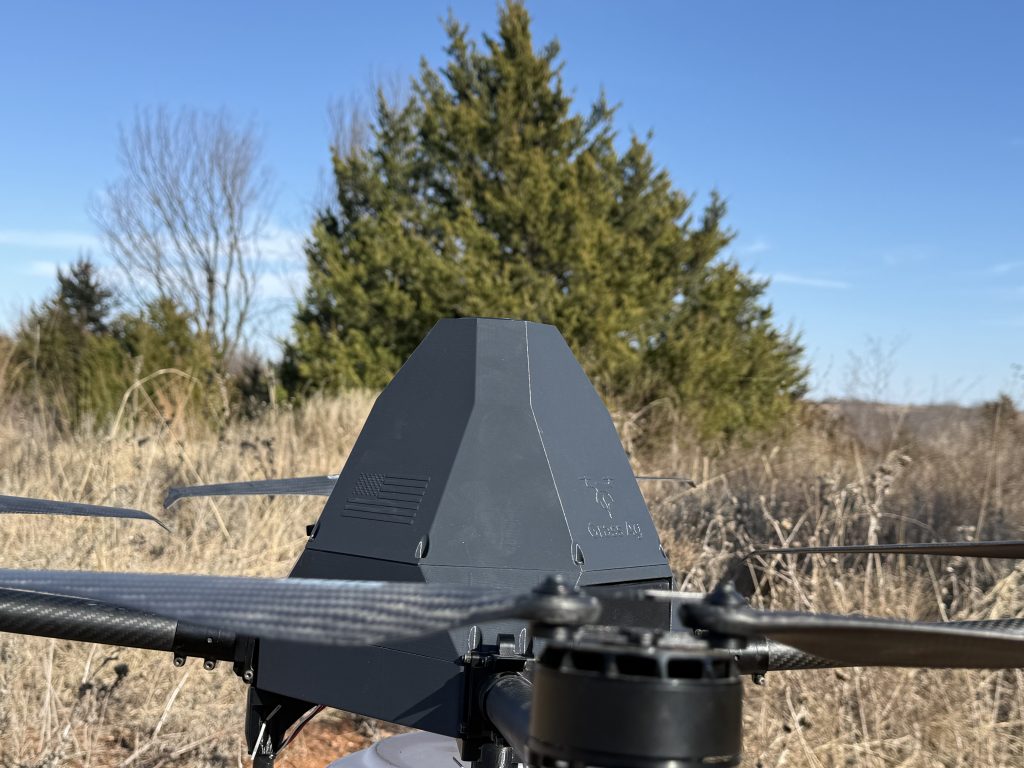
Wilson is a mechanical engineer and has experience working with drones. He wondered if they could be the answer to the cedar tree problem that keeps getting worse in the High Plains. He thought using drone technology to chemically treat cedar trees from above could save time, money and make the process easier for landowners. So, he decided to pursue the idea as a business opportunity.
Wilson tried different commercial agricultural drones for his new business, but none of them suited his needs. Eventually, he decided to build his own drone from scratch with all American-made parts.
Wilson said the company even developed its own patent-pending software to operate the drones and identify the Eastern redcedar tree species from the sky. The precision technology can determine tree size and the exact amount of poison needed to kill it, saving money on chemical.
“Our software system is fantastic at locating and identifying our target species,” Wilson said. “And we’re not guessing at sizes. We know exactly how big that tree is, and in turn, we know the right dose of chemicals to give that tree.”
Additionally, Grass Ag offers auditable results and precision targeting of trees.
“Not only can we go in and get all of the trees, but we can also select specific trees to kill,” he explained. “If there’s an area you want to keep for wildlife or a shelter belt for cattle, we can program the drone to not treat that area.”
Mode of operation
So, what does the poison consist of and what can landowners expect with post application?
“Our drones are set up to treat with a variety of rain-activated dry pellets or granules,” Wilson said. “Our preferred herbicide is Brush Bullet due to the proven effectiveness and ease of use with our platform. Everything is set up to be fully automatic, so basically, the operator will go out to the site, load the program, and from there, the drone will take over.”
He said once rainfall triggers the chemical, trees will start to turn brown in the first few months. He said it could take up to a year for them to fully die off, depending on the soil and the rainfall for the area. Once the trees die, they will no longer take up ground water, spread seeds or produce foliage that shades pasture ground.
There are several options once trees die, although landowners can choose to leave them alone. Wilson said the dead trees can be removed manually, or a controlled burn can be performed in the one to two years after chemical application.
“I’d probably burn most of those trees up at that point, since they’re all dried out,” he added.
He said using a drone is also better for the environment because the targeted chemical application means it uses 90% less chemical than broadcast applications. Additionally, wildlife habitats are not disturbed like they would be by a controlled burn.
“With one crew, you could easily cover hundreds of acres in a day depending on the tree density,” he said. “And it’s so easy for us to scale; we could easily get to the point of thousands of acres a day.”
Balancing fire, steel and tech
Although he has developed an improved method for killing cedar trees, Wilson said both mechanical and controlled-burn methods still have a place in cedar tree management, especially used in conjunction with drones. Still, the old methods have drawbacks that cannot be ignored.
“Fire is a great method, but it just can’t cover enough acres, and it’s quite a process to get fire breaks put up,” he said. “Plus, there are only certain days of the year you can burn, so that limits the sheer volume of land that can be burned in a year.”
Wilson said any time a fire is set, there are risks of it getting out of control as well. Additionally, controlled burns are not as effective on large, live cedar trees, thus the kill rate can be lower with this method.
“Your cedar kill rate with fire might only be 20 to 40% for the property,” he said.
Mechanical removal has its pros and cons as well. Wilson said it can be a great way to clear an area of cedar trees, but it’s cost prohibitive in most cases. It is also difficult to scale.
“That takes a lot of money just in equipment and time to go out and clear the ground,” he said. “But fire and mechanical are still going to be very valid during all this, because there’s aspects of every everybody’s property where certain things may or may not work better.”
Wilson said the drone fills in most of the shortfalls of the old removal methods. He said using a drone gives a 90 to 95% kill rate for trees, and drone applications are much less expensive compared to mechanical means.
A skid steer has a hefty price tag compared to a drone, and the drone can treat a tree in a matter of minutes and move onto the next target while it might take hours for a skid steer to tear out a single tree, he said.
“We can cover a lot of ground with these drones, and obviously they’re considerably cheaper than any mechanical option,” Wilson said. “If you combine that with our drone systems, I think we can easily start making a dent in this. Our drone system is a quick, highly scalable method that is designed to carry a lot of the load to get the problem under control.”
Reducing cedars and adding job opportunities
Wilson said Grass Ag has focused on perfecting research and development up until this point, but he is looking forward to officially launching the drone business and treating acres for customers by the end of this summer.
He hopes to expand to new states with Eastern redcedar infestations once the company is up and rolling in Oklahoma. Wilson is seeking skilled applicators to expand the business and slow down the spread of cedars.
“Given the size of the problem, it’s such a massive undertaking and we’re looking to get drone contractors and commercial applicators on board,” he said. “There’s a lot of opportunity here for current and new businesses to be applicators for this product.”
Wilson has plans to optimize his software system for producers to purchase it themselves and use their own drones to maintain cedars on their properties.
“It’s a very straightforward process to train and turn them loose to go do this on their own with the way our software system is set up,” he said.
Wilson sees drones as an essential land management tool for stewarding rangeland in the future. He also hopes the Grass Ag business can be a way to keep the lights on for rural areas and provide jobs to those in need.
“There are not many opportunities for the next generation to stay on the farm,” Wilson said. “One thing we are very passionate about as a company is providing opportunities for our future farmers and ranchers in the rural communities. We are actively working to develop a training/mentor program for high school graduates and beyond giving the robust understanding of land and business management as well as all of the licensing and certifications required to start their own successful agri-drone business.”
To learn more about Grass Ag, become an applicator or get on the waiting list for cedar tree removal, visit www.grass-ag.com.
Lacey Vilhauer can be reached at 620-227-1871 or [email protected].



