
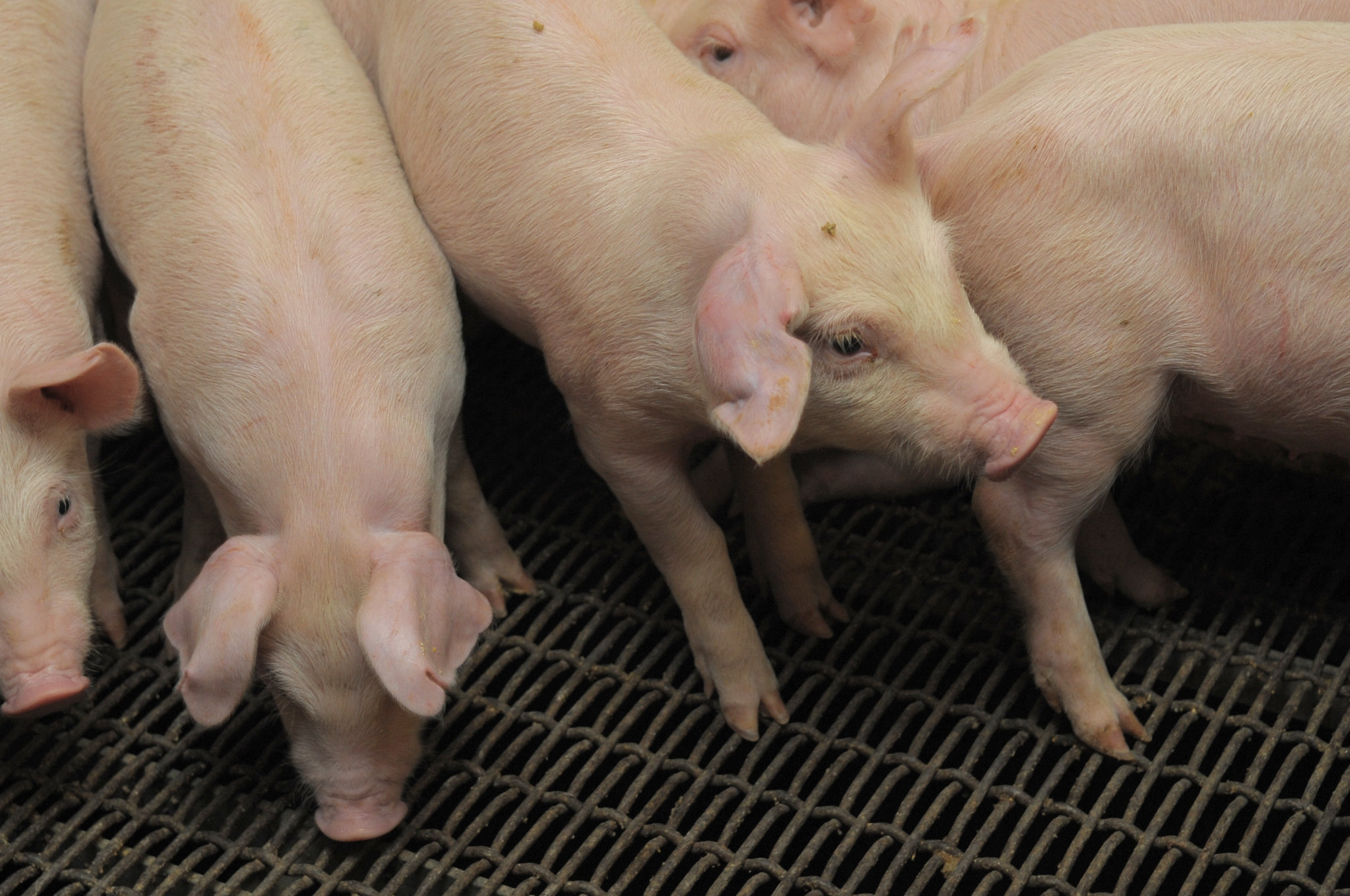
Newest work will be presented during annual K-State Swine Day on Nov. 20
Kansas State University researchers are shedding new light on swine nutrition, with findings that could help producers fine-tune diets for growing pigs — and improve both feed efficiency and economic returns.
Much of the recent work, to be presented at the university’s annual Swine Day on Nov. 20, centers around soybean meal — a major protein source in swine diets — and how it is best incorporated alongside synthetic amino acids.
K-State’s Swine Day features updates on the university’s research on nutrition, management, feed processing, feed safety and more. Information and online registration are available online at www.asi.k-state.edu/events/swine-day.
“Soybean meal is one of the primary protein sources for swine diets,” said Katelyn Gaffield, assistant research professor in the Department of Animal Sciences and Industry. “We are researching the consistency and quality of soybean meal so that we can integrate it appropriately into the diet.”
Gaffield and the university’s applied swine nutrition team have explored multiple quality parameters, including trypsin inhibitors, which can negatively affect swine performance. Controlling such factors, she said, could improve growth rates and feed efficiency.
Meanwhile, doctoral student Ron Navales is investigating the ratio of lysine to crude protein — a critical relationship in swine diets as producers increasingly use crystalline amino acids to meet nutritional needs.
“In the past, we formulated diets based on crude protein levels,” Navales said. “But now, with better technology and the availability of crystalline amino acids like lysine and methionine, we can more precisely meet amino acid requirements. However, aggressive use of crystalline amino acids can result in reduced crude protein in the diet, and in return, could potentially impact performance.”
Navales’ research, supported by the United Soybean Board, involved feeding more than 2,500 pigs across four experiments, adjusting lysine-to-protein ratios from 85% to 115% of the current estimated requirements.
Among the most promising results is that while pigs maintained steady weight gain, they consumed more feed when dietary protein was lowered — that is, pigs are compensating to meet their nitrogen needs, which Navales said could have been supplied by an intact nitrogen source such as soybean meal.
“This shows there’s a limit to how much we can replace intact proteins with synthetics,” Gaffield said. “Going too low in protein might hurt feed efficiency, even if amino acid levels are technically met.”
Gaffield and Navales emphasize that their research is directly applicable to swine producers. Results from these trials will help guide dietary formulation — particularly the balance between soybean meal and synthetic amino acids — to avoid inefficiencies that could impact profitability.
“It’s practical research,” Gaffield said. “We’re identifying ratios that can be directly implemented by producers and nutritionists.”
The research will also be validated on a commercial scale, Gaffield added, a next step that ensures the findings hold up outside of controlled university environments.
In addition, Gaffield’s team is conducting a nationwide survey — backed by the United Soybean Board — to evaluate the consistency and quality of soybean meal from 27-30 processing plants across the U.S.
“This will help define U.S. soybean meal quality and examine lab-to-lab variation,” she said.
Ultimately, Gaffield and Navales aim to help swine producers make more informed, cost-effective nutrition decisions.
“Feed efficiency affects your bottom line,” Navales said. “If pigs grow the same but eat more to compensate for lower protein, that impacts economics.”
Their sessions at K-State Swine Day will detail both the research on soybean meal quality and the optimal lysine-to-protein ratios, offering producers new insights to take home — and implement immediately.
For questions about K-State’s 2025 Swine Day, contact Katie Smith at 785-532-1267 or [email protected].
PHOTO: Swine. (K-State Research and Extension)


