Having a ranch succession plan can help operations continue
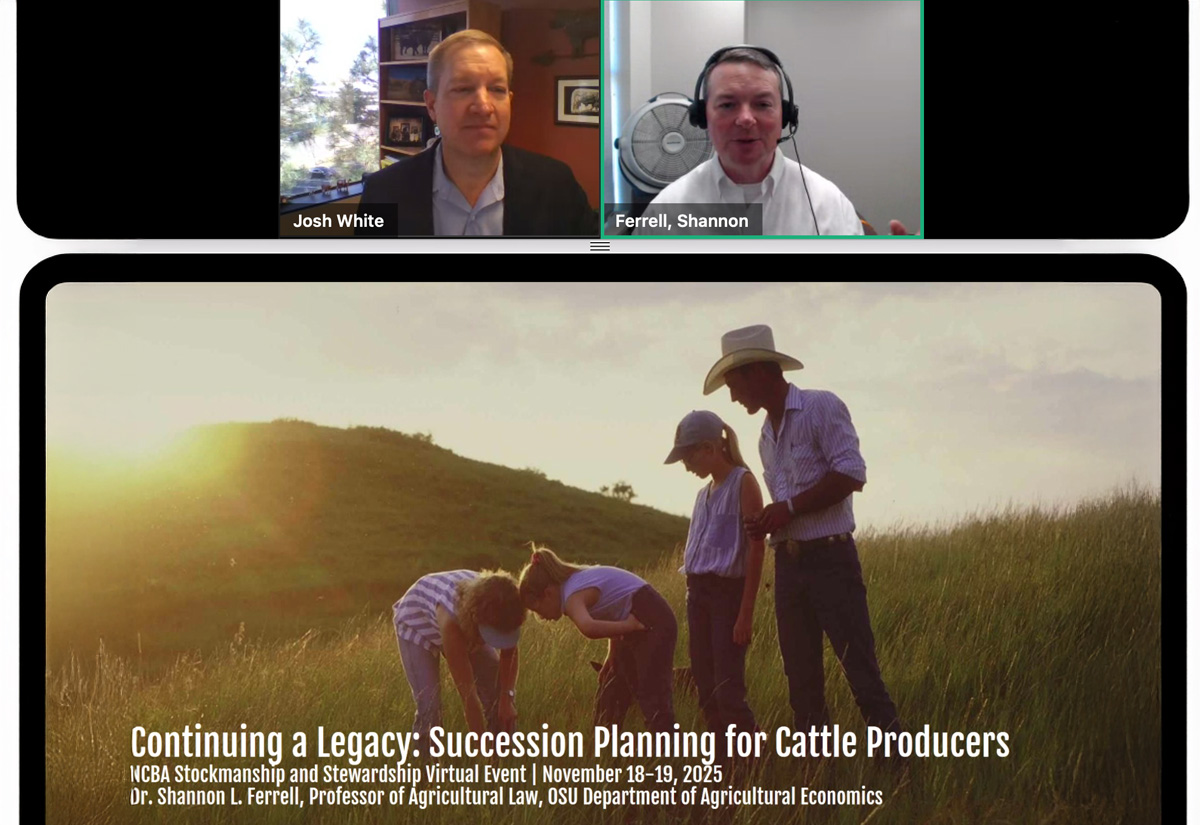
Shannon Ferrell, professor of agricultural law in the department of agricultural economics at Oklahoma State University, told Stockmanship and Stewardship virtual attendees in November, his family was no stranger to succession issues, and it helps drive him to make sure producers have the right tools to help their operations succeed.
In his session, Continuing a Legacy: Succession Planning for Cattle Producers, he said one could talk for days or weeks about the subject. Before diving into the succession plan, Ferrell said one must recognize how big a role mental health plays in the day-to-day operations of many agricultural operations.
Ferrell brings it up because he believes, one, “it’s up to us in agriculture to look out for each other.”
“And two, there really is a strong connection between our mental health and emotional issues and so much of the farm transition issue when we’re talking about family business, the hard part of family business isn’t the business part, it’s the family part,” Ferrell said.
How farmers and ranchers take care of themselves emotionally—both themselves and their families—sets the foundation that’s either sturdy or crumbling for any transition or succession work that needs to happen.
“I know that we don’t like to talk about self-care and agriculture because it’s got the word self in it,” he said. “So, let’s just call it maintenance. You are the most important asset that your ranch has. Take care of you. Because if you don’t take care of you, you’re not able to take care of anybody else or anything else on your ranch.”
Farm kid vs city kid
One situation Ferrell runs into all the time in agriculture is what he calls farm kid versus city kid. One wants to come back to the farm and ranch and operate it professionally for the rest of their life, while the other loves mom and dad, loves being a farm kid, loves the farm, but doesn’t have any interest in operating the farm as an ongoing concern.
Ferrell modeled an example using 20 years of farm and ranch income from the Kansas Farm Management Association. The ranch in question is a mix of assets, with an average net farm income over 20 years at $170,000. He had three strategies; one was treating all the kids the same, dividing the farm and all assets equally with each heir getting half interest in the assets. Strategy two gives all non-land assets to farm kid, then the operator has to come up with the value in financial savings for the other kid.
“Whether that’s a life insurance policy or stock investments or whatever, but mom and dad are going to save up so that they have an equivalent value to the operating assets to give to the city kid,” Ferrell said. “We’re going to put the land into a trust or an LLC.”
That sets a process where the rent money goes to both farm kid and city kid.
Strategy three is where farm kid buys mom and dad’s equity in the operating assets while their parents are still alive.
In tens of thousands of simulations, Ferrell said strategy No. 1 has never worked.
“Strategy No. 1 of splitting it down the middle, never, ever, ever, ever worked,” he said. “And to understand why you need to ask yourself this critical question, will it cost?”
When you force farm kid to buy out city kid, city kid has economic incentives to sell his or her share to the farm kid—not because he or she doesn’t like the farm or mom and dad or being a farm kid.
“All of their economic incentives are telling them, ‘Hey, if you don’t intend to be an active operator of this farm, you need to sell that asset, and a logical person to sell it to is farm kid,’” he said. “But if farm kid has to go out and buy half of this asset value all at once, they’re facing really, really large debt payments.”
Multiple generations put this kind of operation together, and now all of a sudden farm kid has to buy half of it at one point in time.
“There is no way that you can sustainably make those payments on a farm of this size of average net farm income per year of roughly $170,000, just doesn’t work,” he said. “But if you look at the strategy No. 2 and No. 3 options, that’s a lot more affordable for this operation.”
Ferrell encourages producers to think creatively and how to convey an active, ongoing business interest. That changes the approach and perspective.
When doing a “split it down the middle plan,” the net worth of the operation drops and equity is converted each time it’s split.
“They were basically converting the equity that they built in the operation back into debt,” he said. “We’re talking about a difference in net worth of almost $5 million, so there really is a lot of value in keeping the operating assets in the farm and not buying the farm back from yourself all the time.”
So, what needs to be done?
“The farm transition process can be big and daunting and scary if you look at it all at once,” Ferrell said.
To simplify, he broke it down into five steps. Those steps include inventory, communication, plan, a will, and don’t stop.
“Figure out what we’ve got right now. Communicate with not only the economic stakeholders in your operation, but with the emotional stakeholders in your operation as well,” he said. “We’re going to have a plan for how this intact business enterprise is going to move from its current ownership and management to its future ownership and management, and ideally, we’re going to begin that process while everyone is still alive, so they can add their experience to that process.”
Ferrell said to have all the estate planning tools in place and make sure they fit the operation.
“Don’t stop this is not a one-and-done process,” he said. “We’re going to keep going back, re-evaluating and revising this plan to make sure that it’s adapted to our needs.”
Process
Operators working on a succession plan need to put together a “magnificent seven” or a dozen professionals that will help guide a f a family through an ongoing process.
“Find yourself an accountant who understands agriculture and business planning and go through the tax and financial implications of the plan that you’re thinking about,” he said. “Find a good attorney who understands the legal mechanics of business succession planning and estate planning, and who also knows something about agriculture to help you put in place the right structures and transactions to actually make this work and to give it legal accountability.”
An investment adviser can help families understand what non-farm financial investments they might need when it comes to retirement savings and insurance products.
“Talk to a farm management consultant who understands how we need to move this business forward, and how we create important roles for those people coming back to the farm to fill in a way that will provide them the best chance of success and provide the best chance of success for the farm and ranch,” Ferrell said.
A human resource adviser might be helpful if people are coming back to the farm or ranch and how to fit their skill set into roles where they can prosper. A mediator might be needed if difficult conversations are anticipated.
“Some of those ag mediation programs are specifically authorized to help people with farm transition conversations, have a family communications consultant to help you avoid the fights, or if you do need to have the fight, then learn how to fight fair and respectfully,” Ferrell said.
Being prepared for a succession plan can make it easier for the “stuff you know is coming and the stuff you might not know it’s coming,” according to Ferrell.
“If you’ve got the willingness, the courage to take those steps right now, farm transitions are way bigger than estate planning,” he said. “Take care of your farm business, take care of your farm family, and take care of yourself and your operation. You can really enjoy tremendous success, not only now, but well into the future as well.”
Kylene Scott can be reached at 620-227-1804 or [email protected].
Tool box essential in planning process
By Kylene Scott
Having the right tools in the tool box is “absolutely essential” for estate planning, according to Shannon Ferrell, professor of agricultural law in the department of agricultural economics at Oklahoma State University.
He has an essential tool box list.
—Children. If there’s any children under the age of 18, know who gets charged with their care and provide some resources to go along with them. Have that conversation with your spouse and those who could be nominated.
—Investments/savings. If there are any sort of investment, savings accounts like a 401(k) or individual retirement accounts, certificates of deposit, general investment accounts or insurance policies, identify the beneficiary designations.
“That’s a very effective, very inexpensive estate planning tool that you definitely need to take advantage of. Anytime something big happens in life, change of jobs, marriage, divorce, birth, death, change in the ownership of that asset,” he said. “Make sure you go back and check those beneficiary designations and make sure they are the people that you want them to be.”
—Durable power of attorney. Ferrell said in this case durable means that even if we’re incapacitated, this power of attorney is still effective. Having this type of conversation is not easy, but a necessary one.
“We often think that advanced directive as a directive for end-of-life care,” he said. “In other words, if I have a terminal condition, if I’m in a condition where I don’t have any cognitive function, and there’s really no prospect that cognitive function is going to come back or find this in an otherwise terminal state. Do I want to have end of life care? And if so, what level of end-of-life care do I want?”
—Long-term care plan. Ferrell said males, 65 years or older have odds of needing long term care or a nursing home is about 60% with an average stay time of two years. Females of the same age are roughly 70%with an average stay of three years. He suggests operating under the assumption that long-term care will be needed at some point and plan for that now.
“Have a plan for how that’s going to be paid if you don’t have an insurance product for that, or if you don’t have other liquid assets, then start prioritizing which ranch assets am I willing to liquidate first in order to pay for those costs of care,” he said. “It can eat through a ranch’s balance sheet really fast.”
—Have a will. The more assets one has, Ferrell said, it might be smart to think about a trust as an estate planning vehicle, but keep in mind, the more restrictions or the more complicated the set of instructions you want to have, with respect to the management of your assets after you’re gone, that weighs in favor of us having a trust too.
“I don’t care how much stuff you have. I don’t care what your family picture looks like. Everybody, absolutely everybody needs to have a will,” Ferrell said. “I would encourage everybody have a will, a set of instructions for how we’re going to handle your property after you’re gone.”
—Life insurance. Ferrell said not everyone needs it, but two audiences might benefit from having it—younger producers just getting started who might be highly leveraged or dependent on off-farm income. The other is a little older, more seasoned operator who might have an off-farm heir that would want to receive some sort of inheritance.
“Let’s take care of the economic piece, that insurable piece, by getting some term life insurance coverage to protect us against that low probability but very high consequence event of losing that person,” he said. “A life insurance product might help you with that equation.”
—Long-term care insurance. Ferrell said this type of insurance is an affordable option, especially since long-term care can get “really expensive, really fast.”
Kylene Scott can be reached at 620-227-1804 or [email protected].