Moore looks forward to 2026 corn crop, commission work
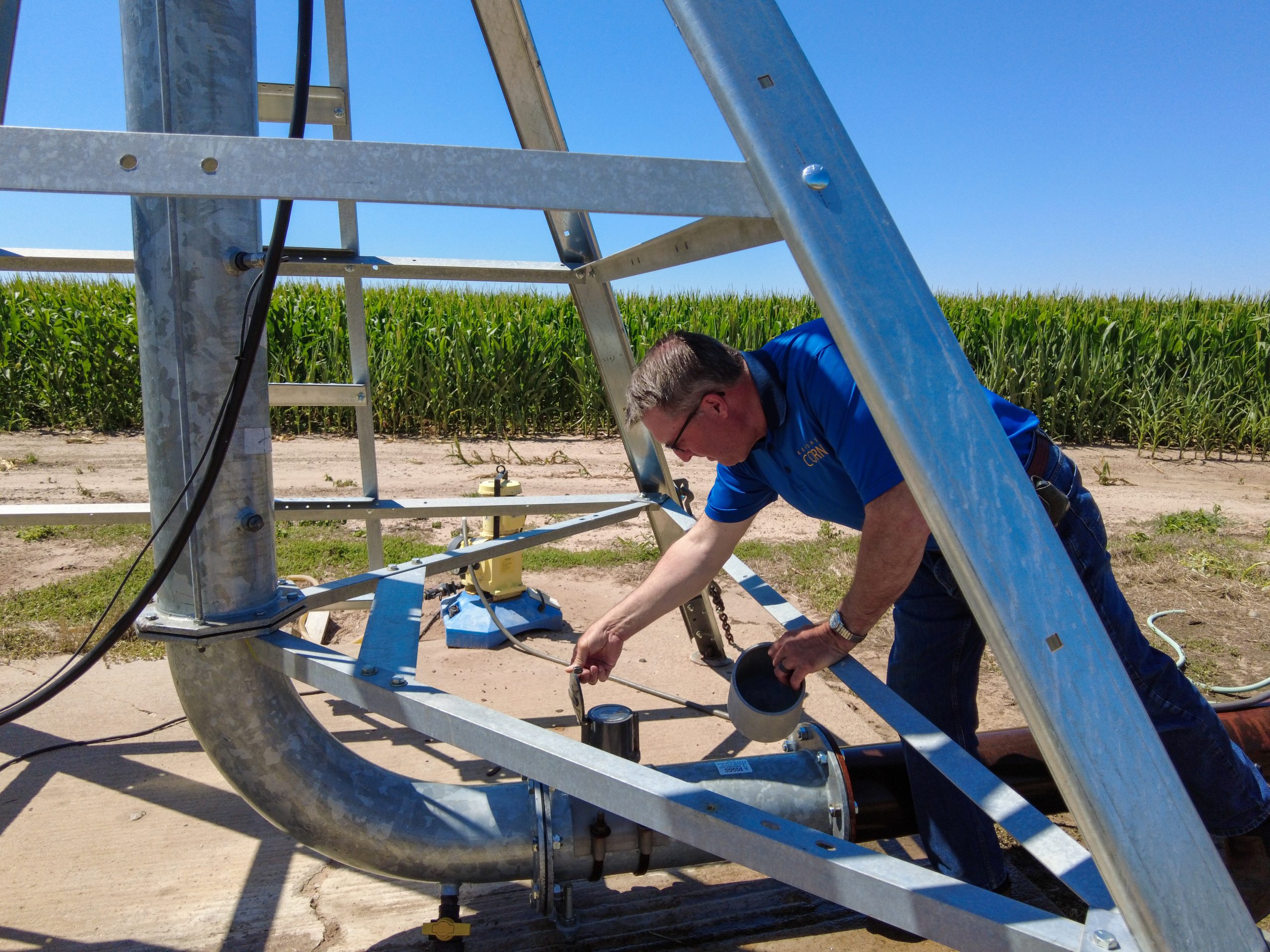
Farmer Kent Moore, who grows mostly corn in the northwestern part of Pratt County, is looking forward to 2026. Especially if he happens to get rain at the right times like he did last year.
“On our farm, we had a good crop. It wasn’t a record crop,” the Iuka farmer said of his 2025 crop. “Rain is always kind of thought of as being an absolute home run, or sometimes you get a little bit too much at the wrong time.”
He had about a month-long stretch from mid-May to mid-June where it was just too wet.
Moore, who is also the Kansas Corn Commission chairman, said despite his lower yields, Kansas had a “monster crop.”
“Over 900 million bushels. We had a lot of acres,” he said. “Most of the state had really beneficial rains throughout the summer.”
That made for a great growing season, and it was reflected in the number of bushels farmers in Kansas were able to crank out.
Moore said most of his acres are irrigated, and he focuses on growing corn, but has some soybean and wheat acres to help with his crop rotations. His 2026 corn acres will be a little smaller because of his normal rotations.
“Some of that is obviously market driven,” he said. “You just start looking at your input costs, and the dollars it’s going to take to take to operate in 2026 and you start to start to make some decisions about what’s the right crop mix to try to utilize the capital that you are employing in that given crop year in a manner in which you hope to price your product.”
Moore is hoping for a good year but knows it might not be ideal.
He came back to the farm in 1989 and reflected on the time he’s been there and said the thing that’s changed the most for him is technology. His granddad farmed in western Kansas, and Moore said he’d always ask what the next new thing was in regard to technology.
“Then you think about the technological changes that he saw in his farming career, and we kind of always think that we’re the ones seeing the most drastic change, but change is just a constant,” he said. “You know, he saw a tremendous change in the capacity of farmers to do work, and that’s different than from 1989 to today.”
Change is likely going to keep driving forward, and Moore hopes to embrace it. Technology like artificial intelligence intrigues him.
“(It’s) just going to continue to accelerate our capacity for decision making, and input analysis,” Moore said. “It just boggles your mind that you can pose a question to some AI type of engine, and 10 seconds later, you spit out a pretty darn good answer.”
He’s been involved with Kansas Corn for a long time and has served as the commission chair a couple different times.
“I think that the corn commission plays a real vital role in helping our industry at the state level and the national level and try to accomplish things that benefit all corn growers,” he said. “That goal is to try to do things, whether it’s research or production practice or whatever, but it’s the effort is to try to take that checkoff penny and make wise use of it and turn that into where corn farmers are getting a real good return on investment of that penny.”
With the help of corn organizations, growers can see the big picture. Moore said KCC continues to advocate for year-round E15.
“It’s really frustrating that we haven’t been able to get that across the finish line. We’re darn close,” he said. “I think that is an important step. The higher ethanol blends that we can put in the system, whether it’sE15 or blender pumps, that lets consumers have a greater choice of what ethanol blend to put in their tank.”
Having that option for consumers affects the prices, and when a station has higher blends, people tend to gravitate toward those because they’re typically cheaper.
“Anything that we can do to increase the ethanol blend rate is something that we are always focused on,” Moore said. “The Kansas Corn Commission has invested a lot of dollars in helping fuel retailers with the expense of putting in pumps that have the capacity to dispense higher blends of ethanol.”
He believes that’s a really good use of the checkoff dollar to help expand the market for higher blends of ethanol.
“It’s just a no brainer, in my opinion, to do that,” he said. “It’s been frustrating to not see that happen at a state, and national level, but I kind of think we’ll get there,” he said. “It just always seems like that carrot’s out there in front of us, and it always gets yanked away a little bit right at the very end.”
One bright spot for Kansas, Moore said, is the effort they have put into the education program in the K-12 school system in the state.
“We’re providing lessons and the tools that those teachers need to teach those lessons,” he said. “The idea being is that we need to send the message to students that gives them a better understanding of what agriculture is, what corn farming is, the impact that it has on the local economy and the state economy as a whole.”
If the effort is put in to make sure students know that there is a future in agriculture, Moore hopes more students might consider farming as a career path.
“It doesn’t necessarily mean that you’re going to be a quote farmer, but obviously we’ll always need people to be involved in the industry,” he said. “Whether it’s local technicians at dealerships or just a number ofthings that provide opportunities for young people to hopefully stay in the state, be involved in agriculture and make a good living. Bottom line, that’s what we’re looking for.”
Kylene Scott can be reached at 620-227-1804 or [email protected].