
Trade deals offer potential wins for farmers and ranchers
President Donald Trump is touting his recent trip to China to meet with President Xi Jinping, saying it includes wins for farmers and ranchers.
According to a White House news release, President Trump and President Xi agreed the United States and China should build a constructive relationship of strategic stability based on fairness and reciprocity. President Trump will welcome President Xi for a visit to Washington this fall. The two countries will also support each other as the respective hosts of the G20 and APEC summits later this year.
The wins for agriculture, according to Trump, include:
- China will purchase at least $17 billion per year of U.S. agricultural products in 2026 (prorated), 2027 and 2028, in addition to the soybean purchase commitments it made in October 2025.
- China restored market access for U.S. beef by renewing expired listings of more than 400 U.S. beef facilities and adding new listings. China will work with U.S. regulators to lift all suspensions of U.S. beef facilities.
- China resumed imports of poultry from U.S. states determined by the USDA to be free of highly pathogenic avian influenza.
None of the details have been confirmed by Chinese trade officials.
The pact also calls for establishing U.S.-China boards of trade and investment. As the cornerstone of this agreement, President Trump and President Xi chartered two new institutions to optimize the bilateral economic relationship: the U.S.-China Board of Trade and the U.S.-China Board of Investment.
The board of trade will allow the U.S. government and the government of China to manage bilateral trade across non-sensitive goods. The board of investment will provide a government-to-government forum to discuss investment-related issues.
The American Soybean Association appreciates President Trump’s ongoing discussions with President Xi. Strong and reliable trade relationships are critical to the continued success of America’s soybean growers, and China remains one of the most important export markets for U.S. soybeans.
“ASA appreciates the ongoing dialogue between the United States and China and hopes to see additional soybean purchases this marketing year, as well as continued progress toward fulfilling future purchase commitments,” said Scott Metzger, ASA president and Ohio farmer. “As U.S. soybean farmers plant our 2026 crop, we are looking forward to a successful harvest to fulfill China’s purchase commitments. Greater certainty and consistency in the marketplace help provide farmers with the confidence they need as they make decisions for the year ahead.”
At the previous trade summit between the two nations, China committed to purchase 25 million metric tons of soybeans annually through 2028—an increase from the current marketing year commitment of 12 MMT.
U.S. Meat Export Federation President and CEO Dan Halstrom, speaking to attendees at a recent spring conference in Oklahoma City, Oklahoma, provided an overview of the latest export results for U.S. pork, beef and lamb and offered insights on key developments, including the announcement that China had renewed registrations for U.S. beef establishments. The impasse had kept most U.S. beef ineligible for export to China for about the past year, but some shipments have now resumed.
Halstrom cautioned, however, China must remove significant technical barriers before the market can be considered fully reopened.
“While that wasn’t solved last week, it’s going to be focused on in the very near future,” Halstrom said. “And I can tell you this—we have customers in China who are ready to go now.”
Halstrom also applauded a recent breakthrough with Saudi Arabia, in which Saudi officials agreed to remove barriers that had effectively locked most U.S. beef out of the market for the past dozen years.
“That’s a big, big deal that could lead to exports as high as a couple hundred million dollars per year, once the business gets going,” he said. “For both China and Saudi Arabia, I want to thank the Office of the U.S. Trade Representative and the U.S. Department of Agriculture for their tireless efforts to reopen these markets. These are tremendous wins for our industry.”
Corn sales to Africa?
The National Corn Growers Association, along with 12 national agricultural associations, is encouraging the Trump administration to remove barriers to biotech products, including corn, so American exporters can access markets in Africa.
The move comes as the U.S. Trade Representative sought public comments on modernizing and extending the African Growth and Opportunity Act. AGOA is authorized through Dec. 31, and Congress will have to act before then to prevent the program from lapsing.
NCGA filed comments regarding barriers to corn and ethanol trade with nations in Africa and sent a letter to Deputy U.S. Trade Representative Jeffrey Goettman outlining ways the act could better facilitate the trade of biotech products.
“This effort to modernize AGOA provides an important moment in time to establish criteria that foster market access opportunities for American farmers and can set the stage for future trading relationships that are mutually beneficial,” the letter said. “A continuation of the status quo will not only limit development in Africa, but it will relegate American farmers to residual market share when, in actuality, the quality and standards upheld by American farmers and exporters are second to none.”
The letter is part of a broader effort by NCGA to open markets for corn growers and eliminate barriers with existing markets. Issues surrounding biotech corn are important to U.S. growers because 94% of the nation’s planted corn is derived from biotechnology.
Dave Bergmeier can be reached at 620-227-1822 or [email protected].
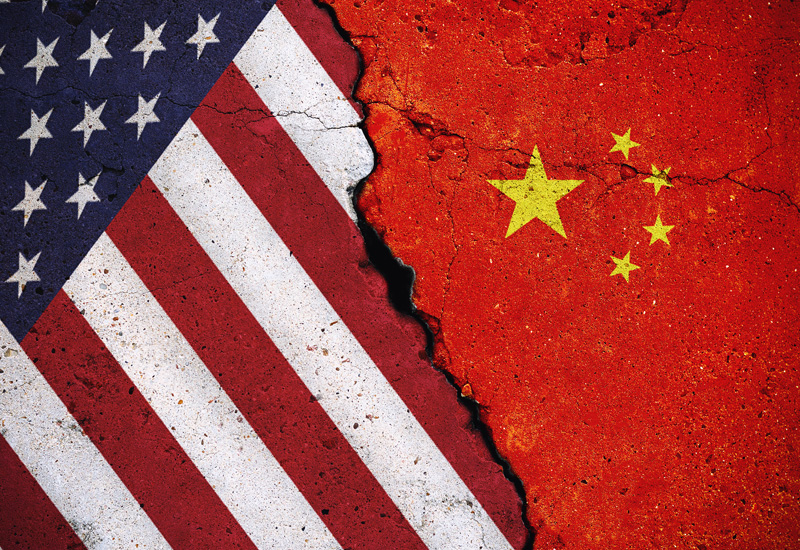
PHOTO: Concrete slab with large cracks, flags of the USA and China. (Photo: Adobe Stock │ #328134219 – Iurii Gagarin)



