Expert explains common misconceptions about sugar, sulfites, tannins and sparkling wine
You may have grabbed a bottle of wine labeled sugar-free, low sulfite or tannin-free and felt somewhat virtuous about it.
However, Andreea Botezatu, Ph.D., Texas A&M AgriLife Extension Service enologist and associate professor, Department of Horticultural Sciences, said some common beliefs about wine don’t hold up to science.
Botezatu teaches wine science and winemaking, researches wine quality, and hosts “The Wine Lab,” a non-commercial educational podcast that has reached listeners in 72 countries worldwide.
Here, Botezatu explains the science behind five common wine myths.

Myth 1: ‘Sugar-free wine’ is a special kind of wine
Dry wine is always naturally sugar-free. All grape juice naturally contains sugars. However, during fermentation, yeast consumes sugars and converts most of them into alcohol. When fermentation finishes, the result is a dry wine with no sugar remaining.
“I find this kind of marketing misleading, because all wines that are dry, meaning they have no sugar left, are sugar-free wines,” Botezatu said. “It doesn’t need anything special to be a sugar-free wine.”
By contrast, winemakers intentionally make sweet wines with sugar. They either stop fermentation early, leaving sugar behind, or let fermentation finish and add sugar afterward. Either way, sweet wine will always contain sugar, while dry wines never do.
Botezatu compares advertising “sugar-free” wine to another familiar label trick: “It’s like gluten-free water. It shouldn’t have gluten in it.”
Myth 2: Prosecco and Champagne are basically the same thing
Both are sparkling wines and go through a second fermentation. However, they are made differently and have distinct flavors.
Champagne can only be called “Champagne” if it is made in France’s Champagne region with approved grapes and the Champagne method. It undergoes a secondary fermentation in the bottle. Then, the wine goes through extended aging on the lees, the spent yeast cells left after fermentation.
As yeast cells break down, they release compounds called mannoproteins. These compounds give Champagne its characteristic creaminess and breadiness. People often describe this taste as brioche or baked bread notes.
Prosecco is Italian, made from Glera grapes in the Prosecco region. Its secondary fermentation happens in large, pressurized tanks rather than in individual bottles, and the aging period on the lees is much shorter. As a result, Prosecco is typically fruitier and lighter, with a less intense carbonation than Champagne.
One surprising fact is that two of the three grape varieties used in Champagne, pinot noir and pinot meunier, are red grapes. Champagne stays white because winemakers quickly separate the grape skins from the juice before the skins can transfer much color.
Myth 3: Tannins are something to fear
Tannins are the compounds that give red wines a dry, puckering sensation — what wine drinkers often call structure.
Once in your mouth, the tannins in wine bind to proteins in saliva, reducing the natural lubrication in your mouth. That is the dry, slightly rough feeling people associate with a bold red.
The word “tannin” comes from leather tanning, a process dating back thousands of years. The process used tannin-rich tree bark to bind to proteins in animal hides to preserve the leather.
“They give wine astringency, and we mostly find them in red wines, not so much in whites, because they tend to be located in the skin of the grapes,” Botezatu said.
Red wine is fermented with the skins still in contact with the juice, which pulls tannins and color from the skins. White wine and rosé are made by separating the juice from the skins earlier, which is why they have much less of that dry sensation.
As for tannin allergies, Botezatu said true allergic reactions are rare.
If wine bothers you but tea and chocolate don’t, Botezatu said the alcohol or another component is likely the cause, because tea and chocolate are rich in tannins.
“There’s a very, very small percentage of the population who is actually allergic to tannins,” she said. “If you’ve had tea, like black tea or green tea, or if you’ve had chocolate or cacao, and you’ve had no issues with those, then you’re probably not allergic to tannins.”
Myth 4: Sulfites in wine are bad for you
Sulfites are highly effective preservatives that are commonly misunderstood. People blame them for everything from headaches to hangovers, but Botezatu said they’re usually harmless.
The legal limit for sulfites in wine is 350 milligrams per liter — the standard bottle of wine is 0.75 liters. But most finished wines contain much less — often around 50 milligrams per liter. For comparison, Botezatu said dried fruits, such as apricots, raisins and cranberries, contain 10 to 100 times more sulfites than a glass of wine.
Without sulfites, wine is more likely to spoil because of unwanted microorganisms, which can produce compounds called biogenic amines. These compounds are related to histamines and can cause headaches and flushing.
“I don’t know who came up with the idea to vilify sulfites, and I don’t really understand it,” Botezatu said. “If used properly, within the legal limits and for the right reasons, sulfites do a really good job of keeping your wine good and healthy. Not using them is more problematic than using them, in my view.”
Myth 5: Wine selection is complicated and intimidating
This is the myth Botezatu most wants to dispel.
“Absolutely do not be intimidated by wine. It was never meant to be an intimidating drink,” she said. “We’ve been consuming wine for 8,000 years, if not more, and we’ve been doing it with our families and friends, sometimes at work or at parties. It’s meant to be approachable and friendly.”
Of course, that also means enjoying it responsibly and always in moderation.
Her advice for beginners is simple. Ignore the price or food-pairing rules and just start tasting to see what you like.
“Price is not always the best reflection of quality in a wine,” she said.
A $6 or $7 bottle from a discount grocer is perfectly fine to start with. White wines are often better to start with than reds since they carry little to no tannin.
Beyond that, Botezatu said the only real rule is to make sure neither the food nor the wine overpowers the other. Everything else comes down to personal preference.
Above all, she said, wine is meant to be shared.
“I would definitely not recommend drinking wine alone,” she said. “Wine is a social drink.”
No special glassware required, no occasion necessary. Just good company and an open bottle.
Learn more from ‘The Wine Lab’
Andreea Botezatu’s educational podcast, “The Wine Lab,” features 10- to 20-minute episodes that make wine science approachable for everyone.
Episodes explore everything from sparkling wine styles to the chemistry behind a wine’s color, weaving in cultural and historical references alongside the technical details to make wine science approachable for everyone.
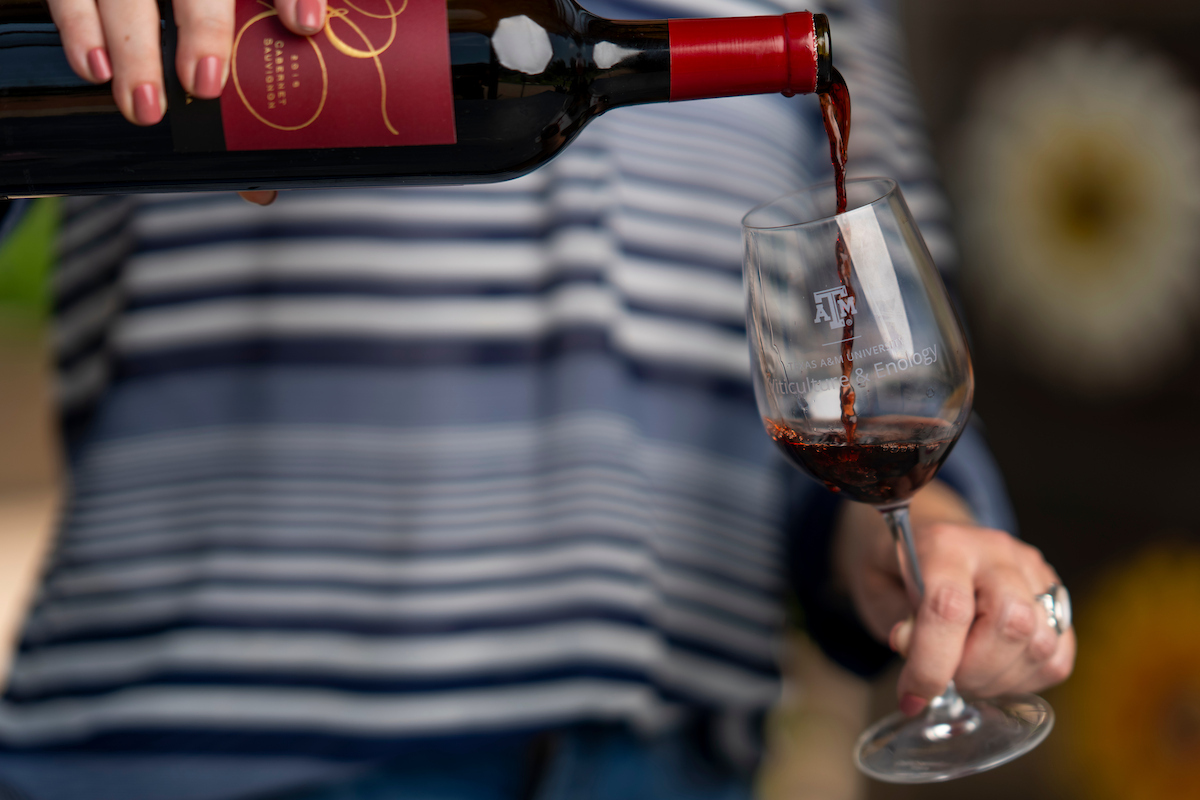
TOP PHOTO: Andreea Botezatu pours wine into a Texas A&M branded glass. (Michael Miller/Texas A&M AgriLife)